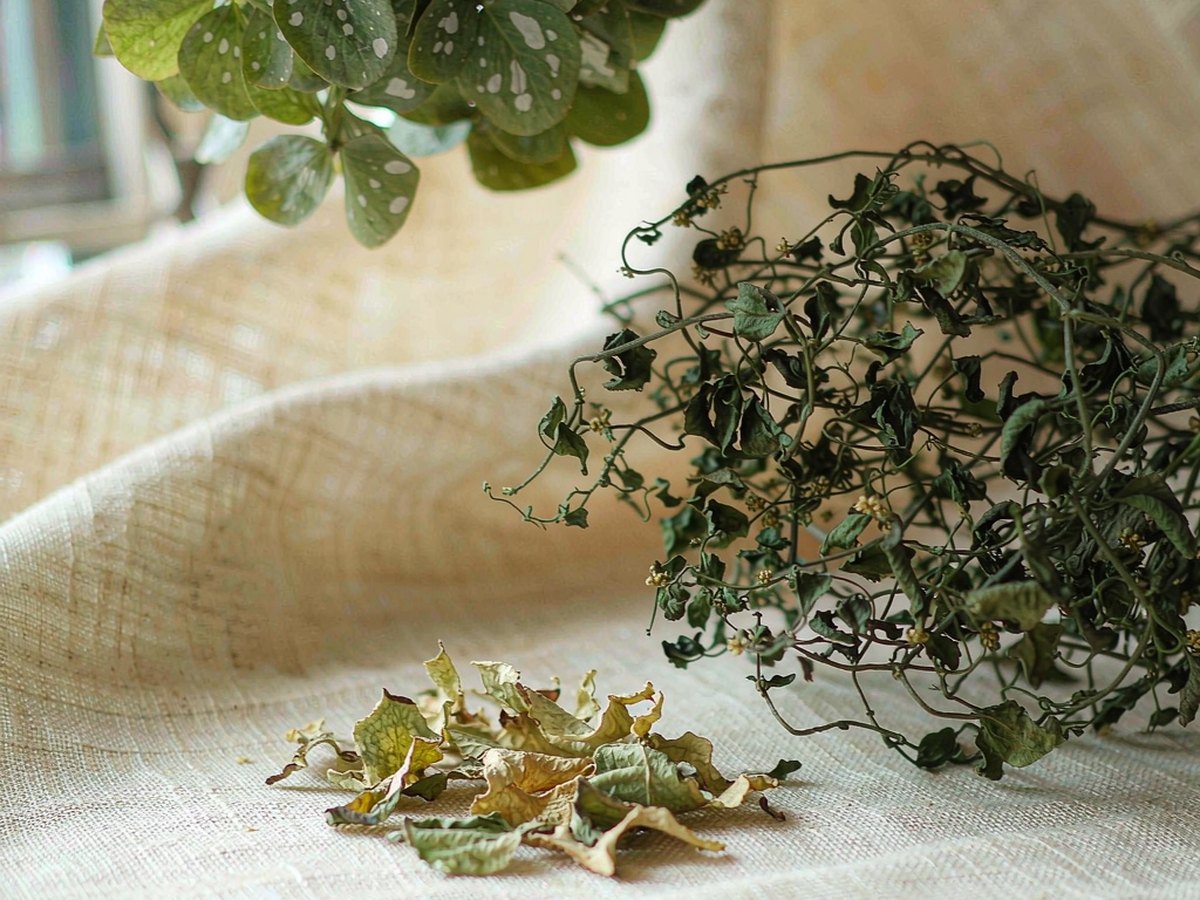
Ji xue teng is a woody climbing vine whose cut surface leaks a striking blood-red sap, and the Chinese name means blood-ginseng-vine. In the classical system it is unusual in a specific and genuinely useful way: it both moves blood and nourishes it. Most blood-moving herbs dry and deplete. This one is supposed to do both.
- Botanical
- Millettia dielsiana (and closely related Millettia species) — a woody legume climber of the family Fabaceae, which is the source of the red heartwood.
- Part used
- The dried vine or stem, cut into slices. The red heartwood is the classic material; the pale outer wood is less active.
- Origin
- Guangxi, Guangdong, Hunan, Jiangxi and Fujian. Wild vines are harvested, and the supply has been a conservation concern.
- Flavour
- Bland with a faint bitterness and a very slight sweetness, and no aroma to speak of.
- Use
- 6–12 g per 200 ml, simmered 20–30 minutes. Always blended.
- Keeps
- 18–24 months sealed and dry.
Moving and nourishing at once
The classical description of ji xue teng is worth understanding because it explains its place in the formulary. It is classed as bitter, warm, and belonging to the liver, and its action is to move blood, to dispel stasis, and to nourish the blood — all three at once.
That combination is unusual. The classical blood movers — safflower, san leng, myrrh, frankincense — are powerful and they are drying, which means they can deplete a person who is already deficient. The blood nourishers — dang gui, prepared rehmannia, longan — are nourishing and they are heavy, which means they can congest someone with stasis.
Ji xue teng sits between the two groups, and it is used for the specific picture where a person has both: stasis and deficiency together. That is the picture classical medicine describes as a deficiency of blood with stasis, and it is the reason ji xue teng appears in formulas for menstrual problems where the patient is pale as well as painful.
The vine and the red wood
Millettia dielsiana is a large woody climber, and when you cut a stem the sap at the cut surface turns a remarkable dark red. This is where the name comes from, and it is also how you tell a good lot: the slices should show red streaks and blotches running through the pale wood.
The vines are cut in the autumn, and the standard preparation takes the vine, slices it, and often cooks it with rice wine, which is called jiu ji xue teng — the wine-processed form, used specifically for the blood-moving and pain-relieving action rather than for the nourishing one.
There is also a stir-fried form and a raw form, and the distinction matters in a formula. Raw ji xue teng is more for nourishing the blood; the wine-processed form is more for moving it and for pain.
Conservation and identification
Wild Millettia has been harvested hard for the traditional medicine trade, and several species in the genus are listed as vulnerable or endangered. Most commercial supply now comes from cultivated plantations, and the cultivated material is a legitimate herb with a similar profile.
The identification problem is real. There are several Millettia species whose vines are cut for similar purposes, and they are not identical. A supplier that states the botanical name is worth paying a little more for here.
One practical note: good ji xue teng slices are hard, woody and heavy, with a visible red centre and pale outer rings. A lot that is uniformly pale with no red at all is either the wrong part of the plant or has been bleached.
What it is used for
- Moving blood and dispelling stasis A classical blood-moving action, and it appears in formulas for the stasis patterns, particularly menstrual ones.
- Nourishing the blood Unusually for a mover, it also nourishes, which is why it is used where there is stasis with deficiency.
- Pain in deficiency patterns Used for pain that comes with a depleted picture, which is the specific combination it is valued for.
- Wind-damp joint pain Classically used in the wind-damp category of painful, obstructed joints, in combination with the other wind-damp herbs.
- Menstrual patterns A common ingredient in classical formulas for menstrual irregularity and pain, always in combination.
- Preparation differences The raw, stir-fried and wine-processed forms are used differently, and the wine-processed form is the one that moves blood and relieves pain.
In the kitchen
- The classical blood-nourishing formula Ji xue teng with dang gui and prepared rehmannia, simmered thirty minutes.
- Wine-processed with ginger The warming, pain-relieving version, simmered with a thumb of ginger.
- With the wind-damp herbs With sinomenium and du huo for a cold, painful, obstructed joint picture.
- With citrus peel and ginger A kitchen blend that makes the woody slices drinkable.
- Never alone It is bland and almost flavourless, and every classical formula pairs it.
Ji xue teng moves blood and is traditionally avoided in pregnancy, which is the standard caution for the whole blood-moving group. It is also traditionally avoided in people with a bleeding disorder.
B
e
c
a
u
s
e
i
t
m
o
v
e
s
b
l
o
o
d
a
n
d
i
n
t
e
r
a
c
t
s
w
i
t
h
t
h
e
a
n
t
i
c
o
a
g
u
l
a
n
t
a
n
d
a
n
t
i
p
l
a
t
e
l
e
t
d
r
u
g
s
,
a
n
y
o
n
e
o
n
b
l
o
o
d
–
t
h
i
n
n
i
n
g
m
e
d
i
c
a
t
i
o
n
s
h
o
u
l
d
s
p
e
a
k
t
o
a
c
l
i
n
i
c
i
a
n
b
e
f
o
r
e
u
s
i
n
g
i
t
.
I
t
i
s
a
l
s
o
t
r
a
d
i
t
i
o
n
a
l
l
y
u
s
e
d
w
i
t
h
c
a
u
t
i
o
n
i
n
p
e
o
p
l
e
w
i
t
h
a
w
e
a
k
c
o
n
s
t
i
t
u
t
i
o
n
.
Disclaimer
The clinical picture this herb addresses — stasis together with deficiency — is a traditional pattern that requires a diagnosis. Do not use ji xue teng to treat menstrual problems, pain or any other condition, and do not use it during pregnancy.