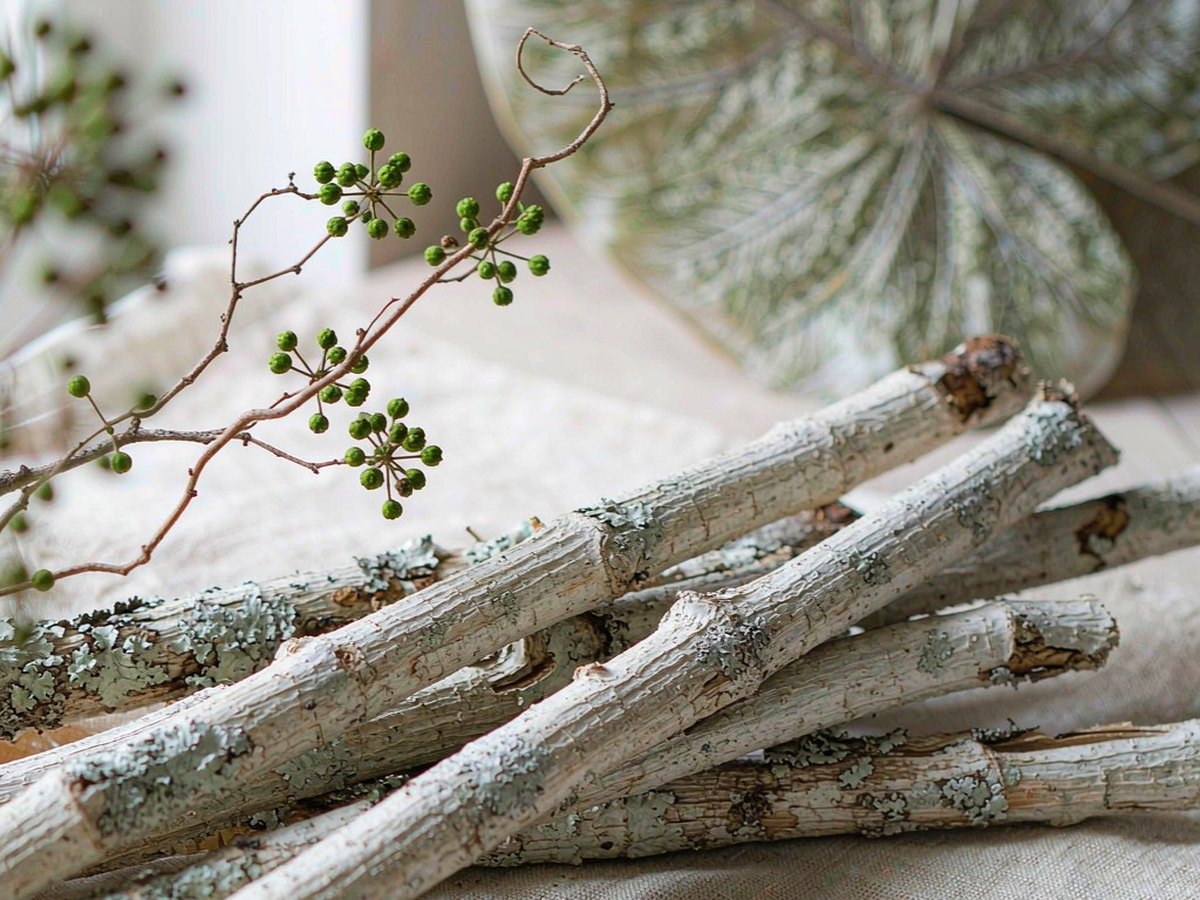
Qing Feng Teng is a thick, woody climbing vine, and it is one of the more interesting entries in the Chinese pharmacopoeia because the traditional description and the modern pharmacology agree unusually closely. The classical texts say it treats pain, disperses wind and dampness, and — notably — that it makes you drowsy. The pharmacology says the same thing in different words.
- Botanical
- Sinomenium acutum — the Chinese silk vine, a woody climber of the Menispermaceae family. It twines counter-clockwise and the stem is the part used.
- Part used
- The dried stem, cut into slices. Older, thicker stems are preferred because the active alkaloid is concentrated in the outer bark.
- Origin
- Sichuan, Hubei, Hunan, Jiangsu, Anhui and Shaanxi. Also Japan, where it grows widely and is a common garden climber.
- Flavour
- Bitter and slightly pungent, with a faint woody smell and no sweetness.
- Use
- 3–9 g per 200 ml, simmered 20–30 minutes. It is a decoction herb.
- Keeps
- 18–24 months sealed and dry.
An herb that makes you drowsy
Sinomenine, the principal alkaloid, is a central nervous system depressant. It has been shown in laboratory and animal studies to produce sedation, and in Chinese medicine the herb’s own classical description notes that it causes drowsiness.
That combination of a well-documented sedative effect and a classical framework is unusual, and it makes sinomenium one of the few herbs on this shelf where you can honestly say that the traditional description is a pharmacological observation rather than a poetic description.
The research has also focused on sinomenine’s anti-inflammatory effects, particularly in arthritis models, and on its effects on immune function. It has been studied for rheumatoid arthritis and for allergies. The clinical evidence in people remains thin, and it is not an approved treatment for either.
What it is classically used for
In Chinese medicine, qing feng teng is used to dispel wind and dampness from the channels — which in practice means the whole class of what traditional medicine calls bi syndrome, the painful, obstructed conditions of the joints and muscles, including what western medicine would recognise as rheumatic and arthritic pain.
It is also used for itching and for skin conditions, and for the sinus and nasal complaints that come with the wind-cold or wind-damp picture. And it is used for the kind of pain where the classical description mentions numbness and heaviness.
In the classical system it is a wind-damp dispelling herb that also unblocks the channels, and it is often paired with herbs that nourish the blood and the qi so that the dispersing action has something to disperse.
The vine itself, and how to buy it
Sinomenium acutum is a vigorous climber that can grow fifteen metres a year, and it has escaped cultivation in places, where it is treated as an invasive species — most notably in the United States, where it smothers native woodland in the southeast.
That same vigour explains the herbal trade. The stems are cut in winter when the alkaloid content is highest, the outer bark is scraped or left in depending on the grade, and the stems are sliced and dried.
Good sinomenium is pale grey-brown to tan outside, with a fibrous interior and a clear ring. Slices that are very pale and uniform may be from a young stem with less bark, which means less sinomenine. A lot with a strong, bitter, slightly numbing aroma and a firm, fibrous texture is what you want.
What it is used for
- Joint and rheumatic pain The principal classical use: for the painful, obstructed joint and muscle conditions that traditional medicine attributes to wind and dampness, including what is recognised as arthritic pain.
- Sedative effect Sinomenine depresses the central nervous system, and both the modern pharmacology and the classical description of drowsiness agree on this. It is one of the few herbs where the two match.
- Itching and skin conditions Traditionally used for itching and for skin complaints in the wind-damp category.
- Sinus and nasal complaints Used for the sinus and nasal problems that go with the wind-cold or wind-damp picture.
- Anti-inflammatory activity Well documented in animal and cell models, including in arthritis models. The clinical evidence in people is not established.
- Channel-unblocking Classically used to unblock the channels, and usually paired with qi- and blood-nourishing herbs.
In the kitchen
- The classical arthritic formula Sinomenium with angelica and red peony, simmered — the standard pairing for wind-damp joint pain.
- With ginger A quarter teaspoon of powdered sinomenium with ginger and a pinch of rock sugar, for a warming, sedative evening cup.
- Cold-infused A slow cold infusion over several hours gives a gentler, less bitter cup and extracts the alkaloids more gently.
- Evening timing Given that it is sedative, it is traditionally taken in the evening.
- Blending Two slices with jujube and ginger covers the bitterness and makes the decoction drinkable.
Sinomenium makes many people drowsy. Do not drive or operate machinery after taking it, do not combine it with alcohol, and do not combine it with sedative or sleeping medication without medical advice.
I
t
i
s
t
r
a
d
i
t
i
o
n
a
l
l
y
a
v
o
i
d
e
d
i
n
p
r
e
g
n
a
n
c
y
a
n
d
i
n
p
e
o
p
l
e
w
i
t
h
a
d
e
f
i
c
i
e
n
c
y
–
t
y
p
e
p
i
c
t
u
r
e
,
b
e
c
a
u
s
e
t
h
e
d
i
s
p
e
r
s
i
n
g
a
c
t
i
o
n
c
a
n
b
e
i
n
a
p
p
r
o
p
r
i
a
t
e
f
o
r
a
d
e
p
l
e
t
e
d
s
y
s
t
e
m
.
A
n
y
o
n
e
w
i
t
h
a
c
l
o
t
t
i
n
g
d
i
s
o
r
d
e
r
o
r
o
n
b
l
o
o
d
–
t
h
i
n
n
i
n
g
m
e
d
i
c
a
t
i
o
n
s
h
o
u
l
d
a
s
k
a
c
l
i
n
i
c
i
a
n
,
s
i
n
c
e
s
i
n
o
m
e
n
i
n
e
h
a
s
e
f
f
e
c
t
s
o
n
p
l
a
t
e
l
e
t
f
u
n
c
t
i
o
n
.
Disclaimer
Sinomenium is one of the few herbs on this shelf where the classical description and the modern pharmacology line up, and that makes it genuinely interesting rather than a catch-all. It is still a sedative with real pharmacological activity, it should not be taken alongside alcohol or sedatives, and it is not a substitute for medical assessment of joint pain.