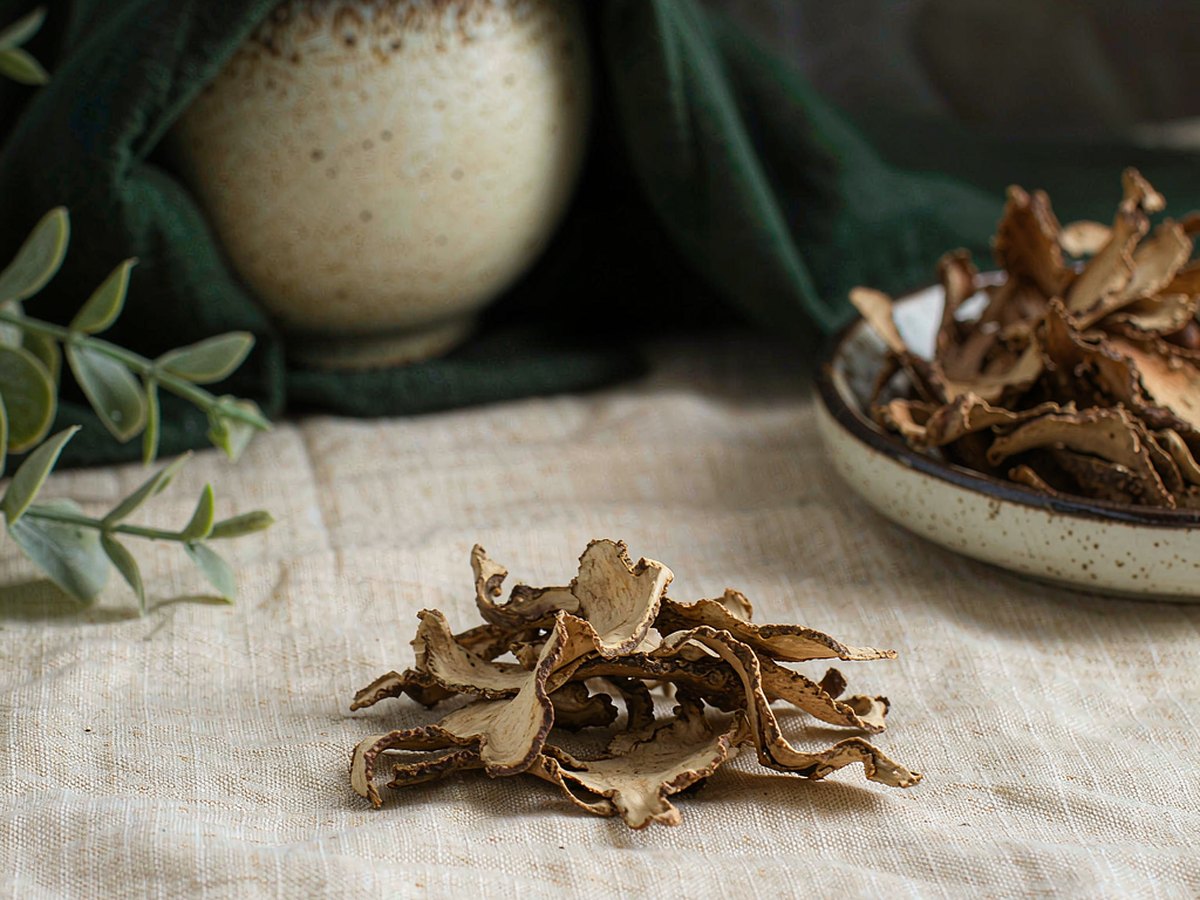
Qian Hu is the root of a tall aromatic umbellifer that grows in the mountains of western China, and in Chinese medicine it is the standard herb for the picture of a chest and diaphragm that feel tight and blocked. It has an unexpected European relative: the very same species, a little more famous in the west under a different name.
- Botanical
- Peucedanum praeruptorum — the root of a tall umbellifer in the carrot family. The same species appears in western herbalism as the root of the herb chuan xiong’s cousin, and as the source of the coumarins studied in Peucedanum.
- Part used
- The dried root, sliced. It is a substantial, pale, dense root.
- Origin
- Sichuan, Hubei, Shaanxi, Gansu and Jiangsu. Wild-gathered in the mountains of western China; also cultivated.
- Flavour
- Bitter and pungent, with a distinctly aromatic, almost anise-like quality that is unusual for a root.
- Use
- 3–9 g per 200 ml, simmered 20–30 minutes. Usually blended with ginger and citrus to make it drinkable.
- Keeps
- 18–24 months sealed and dry.
The blocked picture
Qian Hu is used in Chinese medicine for one specific classical picture: something is stuck in the chest. The formal description is of an upward and outward counterflow of qi, with a fullness or tightness in the chest, a sensation of something lodged in the throat, and a cough that comes in waves and comes up with difficulty.
It is classified as slightly cool, and it is used to move what is obstructing and to direct the qi upward and outward — in modern terms, to relieve a feeling of restriction in the chest and upper abdomen. That feeling of restriction is a remarkably common complaint in Chinese medicine consultations, and Qian Hu is one of the herbs used for it.
It appears in classical formulas alongside licorice, citrus peel and ginger, and the combination is what makes it drinkable. The aromatic character of the root is genuinely pleasant, which is unusual for a root that is this active.
A western relative
The species Peucedanum praeruptorum is not the same plant as the western herb chuan xiong, which is Ligusticum chuanxiong, but the two are close relatives in the same family and they share a lot of their pharmacology. Chuan xiong has become one of the most-studied Chinese herbs, particularly for its effects on platelet aggregation and on microcirculation, and it is a component of several traditional patent medicines.
Peucedanum species are also the source of furanocoumarins, and that is worth knowing because furanocoumarins are photo-activated: they can cause severe phototoxicity, which is the reason some Mediterranean members of this family — wild parsnip, celery, rue — are grown under restriction and why the giant hogweed is a problem to handle bare-handed.
Chinese qian hu is not a phototoxic hazard in the way those plants are, because the furanocoumarin content of the dried, processed root is much lower. But it is a useful piece of general knowledge about the family, and it is one more reason to buy from a supplier that states the species rather than one that lists only a common name.
What a good lot looks like
Good qian hu is a pale yellow to yellow-brown, dense, firm root, cut into thick slices. The slices are the useful part — a good lot shows a clear, slightly translucent flesh with a darker outer ring where the bark was left on.
It should smell strongly and pleasantly aromatic when you break it — that aroma is the furanocoumarin and the volatile oil, and it is what distinguishes it from a generic root slice. A lot with no aroma has either been over-processed or is not what it claims to be.
The colour should be a clean yellow, not a grey-brown. Grey-brown usually means the root has been stored long enough for the aromatic oils to go.
What it is used for
- Chest tightness and blockage The principal classical use: for the picture of something stuck in the chest, with tightness, a lump in the throat and a cough that comes in waves.
- Counterflow of qi Used to direct qi upward and outward, and to relieve what traditional medicine calls rebellious qi.
- Aromatic quality Unusually aromatic for a root, which is why it can be drunk without a supporting blend as often as most.
- Coumarin content The species contains furanocoumarins, related to the compounds in celery, parsley and rue. This is a family characteristic rather than a medicinal claim.
- Modern research Peucedanum and its relatives are studied for effects on platelet aggregation and microcirculation, largely in laboratory models.
- Digestive The aromatic quality also gives it a mild digestive and carminative action.
In the kitchen
- Qian hu with ginger and citrus The classical blend — three slices, a thumb of ginger and a small piece of dried tangerine peel, simmered.
- Licorice pairing With licorice root for the cough and chest picture, which is the classical formula.
- In a soup A few slices in a light poultry broth, for a subtle aromatic lift.
- Powdered The root can be ground, and it is the form used in the classical powder formulas.
- Timing It is normally taken in the morning and in smaller, repeated doses rather than as one large decoction.
Qian Hu is a moving herb and it should not be used in pregnancy. It is traditionally avoided in people with a weak constitution or a tendency towards dizziness.
B
e
c
a
u
s
e
t
h
e
P
e
u
c
e
d
a
n
u
m
s
p
e
c
i
e
s
c
a
r
r
y
f
u
r
a
n
o
c
o
u
m
a
r
i
n
s
,
a
n
y
o
n
e
o
n
a
n
t
i
c
o
a
g
u
l
a
n
t
o
r
a
n
t
i
p
l
a
t
e
l
e
t
m
e
d
i
c
a
t
i
o
n
s
h
o
u
l
d
a
s
k
a
c
l
i
n
i
c
i
a
n
b
e
f
o
r
e
u
s
i
n
g
q
i
a
n
h
u
r
e
g
u
l
a
r
l
y
.
H
a
n
d
l
e
t
h
e
r
a
w
r
o
o
t
w
i
t
h
g
l
o
v
e
s
i
f
y
o
u
a
r
e
s
e
n
s
i
t
i
v
e
t
o
t
h
e
f
a
m
i
l
y
,
a
n
d
b
e
c
a
r
e
f
u
l
w
i
t
h
s
u
n
e
x
p
o
s
u
r
e
w
h
i
l
e
t
a
k
i
n
g
f
u
r
a
n
o
c
o
u
m
a
r
i
n
–
c
o
n
t
a
i
n
i
n
g
p
r
e
p
a
r
a
t
i
o
n
s
.
Disclaimer
The classical indication for qian hu involves a specific set of symptoms that require a diagnosis rather than a guess. Do not use it to treat chest pain, a persistent cough or a lump in the throat — those need assessment. And no herb should be used in place of prescribed care.