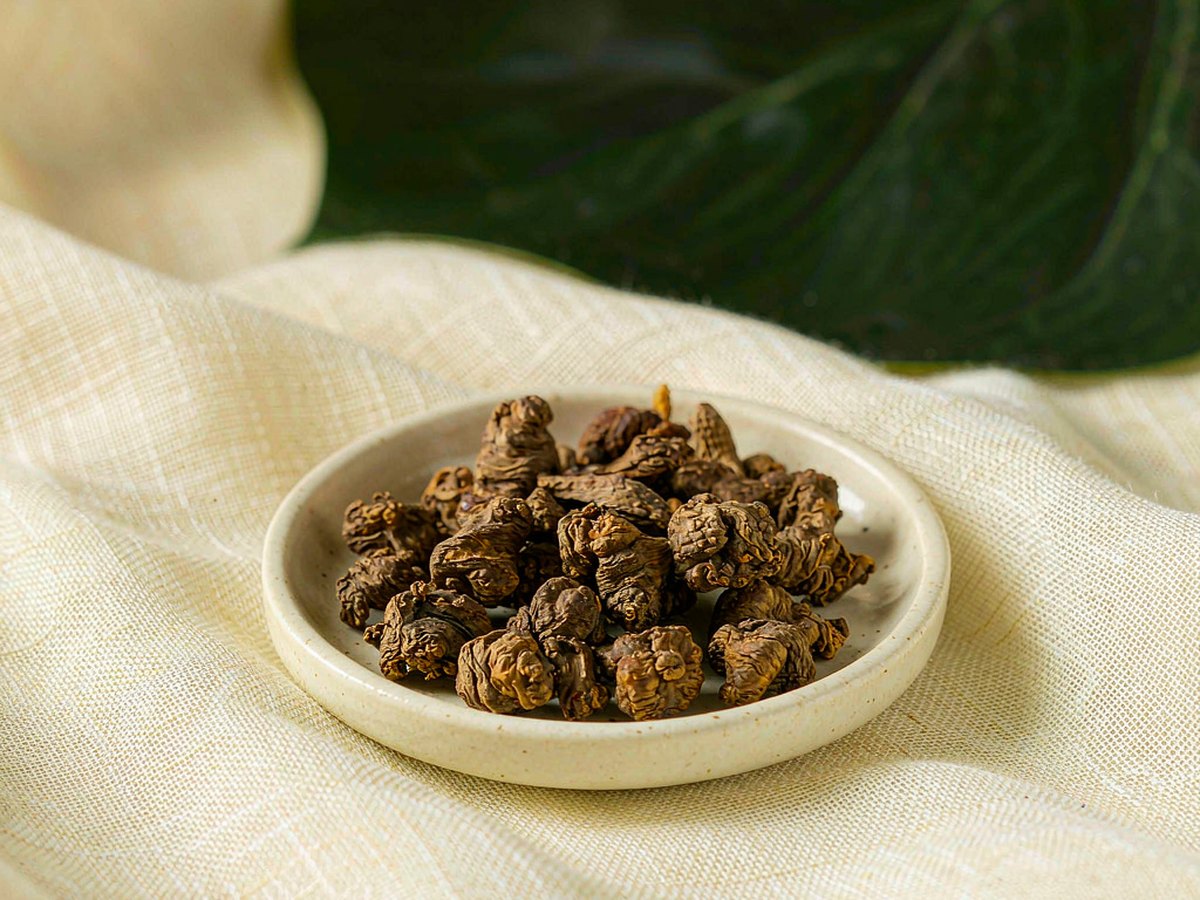
Mai Dong is the most-used herb for dryness in the entire Chinese pharmacopoeia. It is also sold under two botanical names that refer to two different plants, and most shops do not tell you which one they have. The difference is small, but it is the difference between a herb that nourishes and one that clears.
- Botanical
- Ophiopogon japonicus (Mai Men Dong, the dwarf lilyturf root, and the standard Chinese pharmacopoeia species) and Liriope spicata (the large lilyturf, sold in the trade as Hubei Mai Dong and used as a substitute in many markets).
- Part used
- The fleshy tuberous root, dried. It is spindle-shaped, tapering at both ends, and pale.
- Origin
- Sichuan, Zhejiang, Jiangsu, Hubei and Guizhou. The Sichuan and Zhejiang crops are the reference.
- Flavour
- Bland and very slightly sweet, with a faint viscous texture in the mouth. Neither has any aroma.
- Use
- 6–12 g per 200 ml, simmered 20–30 minutes. It is a substantial decoction herb, not a light infusion.
- Keeps
- 18–24 months sealed and dry. The tubers are dense and store extremely well.
The substitution question
The Chinese pharmacopoeia entry for Mai Men Dong is Ophiopogon japonicus, a small grasslike plant with fibrous roots and small white tubers. In the trade across much of China, the tuber of Liriope spicata — a bigger, more robust plant with a larger tuber — is sold in its place, and it is accepted in most local markets even though it is not the official entry.
The two are pharmacologically similar enough that most formulas do not distinguish them, and the substitution is long-established rather than fraudulent. But there is a real difference in the traditional descriptions. Ophiopogon is used more for nourishing the yin and generating fluids, and Liriope is used more for clearing heat and drying dampness.
In practice, the practical difference is small and the flavour is nearly the same. The honest guidance is: buy from a supplier that states the species, and do not be alarmed if you receive Liriope — but if you are buying to match a specific classical formula, ask which one you are getting.
What it is for
Mai Dong belongs to a small group of Chinese herbs that are described as nourishing the yin and generating fluids, and it is probably the most-used of them. The classical picture it addresses is dryness: a dry mouth and throat, a dry cough with little phlegm, thirst, and in the more severe forms, a dry stool and a dry, hot, red tongue.
It is the herb that goes into the classic formula with Dendrobium, Shi Quan, where it is paired with another yin-nourishing and fluid-generating herb. It is also in the very widely used formula Sheng Mai San, together with ginseng and Ophiopogon, which is the standard remedy for what traditional medicine calls qi and yin deficiency with excessive sweating.
In practical terms, mai dong is what you reach for when the complaint is dryness rather than heat, and when the body is depleted rather than merely inflamed. It is the opposite of the chrysanthemum, which cools without nourishing.
The look of a good lot
Good mai dong is spindle-shaped, tapering to a point at both ends, about the size and shape of a small fat carrot, and pale yellow-white to creamy white. It is slightly translucent when fresh-looking and it snaps rather than bends.
It should be plump and smooth, not shrivelled, and it should smell faintly sweet and fresh. A lot that is hard, dark or wrinkled has been stored too long or badly.
The sliced form is common and convenient, and it is worth knowing that slices lose the freshness faster than whole tubers do. If you can, buy whole.
What it is used for
- Nourishing yin and generating fluids The principal classical use: for dryness — a dry mouth and throat, thirst, and a dry cough with little phlegm.
- Dry cough Used for a dry, irritating cough with no phlegm, and for a dry throat.
- Qi and yin deficiency In the classical formula Sheng Mai San, with ginseng and Ophiopogon, for depletion with excessive sweating.
- Mucosal dryness Used for dry eyes, dry skin and dry stools, which are all described in the classical literature as yin deficiency signs.
- Heat with dryness It is used where there is heat, but only where the heat comes with dryness and depletion rather than with a full, robust heat.
- Food value Ophiopogon root is used as a mild food ingredient in Cantonese sweet soups and herbal soups, often with lily bulb and dates.
In the kitchen
- Cantonese herbal soup Mai dong with lily bulb, jujube and a piece of lean pork or chicken, double-boiled for two hours. The canonical use.
- Sheng Mai San The classical formula — mai dong, Ophiopogon and ginseng — for sweating and depletion.
- With dendrobium The yin-nourishing pair, simmered together for a cooling, moistening drink.
- Sweet soup With dried longan and rock sugar, as a cooling summer dessert soup.
- Never alone It has no flavour and no aroma, so it needs the sweeter or more aromatic herbs to be drinkable.
Mai dong is nourishing and moistening, which means it is exactly the wrong herb for a person with dampness or loose stools — it will make those worse. Traditional sources also advise against it in pregnancy and in people with a cold, sluggish digestion.
I
f
y
o
u
a
r
e
o
n
m
e
d
i
c
a
t
i
o
n
f
o
r
d
i
a
b
e
t
e
s
,
m
a
i
d
o
n
g
‘
s
e
f
f
e
c
t
o
n
f
l
u
i
d
b
a
l
a
n
c
e
a
n
d
b
l
o
o
d
s
u
g
a
r
i
s
w
o
r
t
h
m
e
n
t
i
o
n
i
n
g
t
o
y
o
u
r
p
h
a
r
m
a
c
i
s
t
.
A
n
y
o
n
e
w
i
t
h
a
c
h
r
o
n
i
c
c
o
u
g
h
s
h
o
u
l
d
b
e
d
i
a
g
n
o
s
e
d
r
a
t
h
e
r
t
h
a
n
t
r
e
a
t
e
d
w
i
t
h
a
m
o
i
s
t
u
r
i
s
i
n
g
h
e
r
b
.
Disclaimer
The yin and dryness framework described here is a traditional pattern and not a medical diagnosis. Mai dong is a genuine medicine with a long history, and its traditional indications belong in a supervised context. Do not use it to treat a persistent cough or any other condition in place of medical assessment.