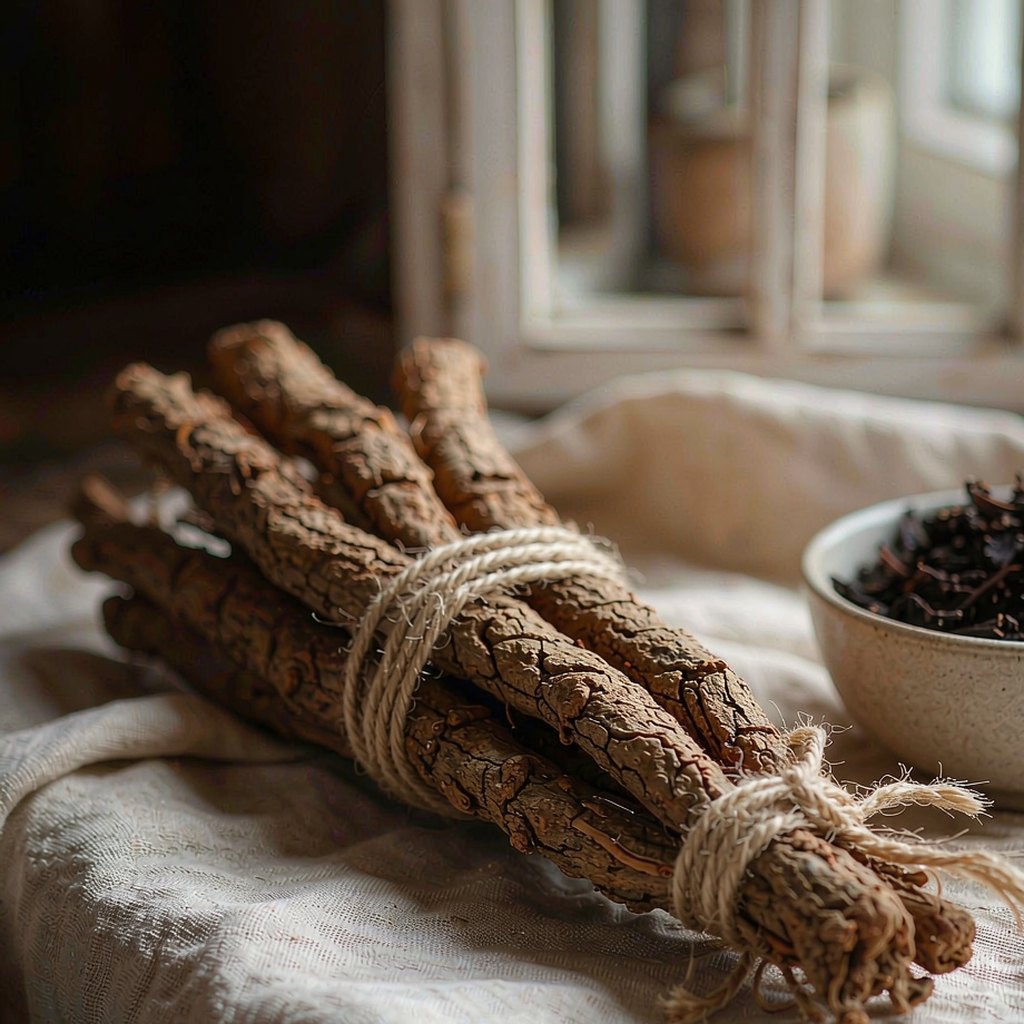
Every cut is a wound. A whole root keeps its aroma behind its own skin; slice it and you have opened a hundred new surfaces to the air. The trade-off is real, and it is only worth making for specific jobs.
Whole
The best keeping quality by a wide margin, the slowest extraction, and the least convenient. A whole root or a whole dried flower holds its volatile oil inside intact cells; the clock only starts when you break it. For anything you will keep for more than a year — or anything you want to taste the way it tasted in the field — whole is correct.
The cost is time and inconsistency: two whole roots of the same weight can differ in how much they give up, and a whole root needs 60 to 90 minutes of gentle heat before it has said everything.
Sliced
The working compromise, and what most of our catalogue is. Slicing multiplies the surface area, which cuts simmering time roughly in half and makes the portion easy to judge — four slices is a portion, a piece of root is a guess. What you lose is aroma, steadily: a sliced root left in an open bag for six months will smell of very little, while a whole one in the same conditions is still usable.
Slice thickness is not cosmetic. Thin slices (1–2 mm) give up everything in ten minutes and are right for teas and quick decoctions. Thick slices (3–5 mm) hold together through a two-hour braise and release slowly. A bag of mixed thickness will cook unevenly and you will over-extract the thin ones getting flavour out of the thick ones.
Powdered
Maximum surface area, maximum extraction speed, minimum shelf life. Ground herb loses its volatile fraction in weeks, not months — the aromatic compounds literally evaporate out of the powder. A six-month-old jar of ground ginger is a brown substance that tastes vaguely warm; the same weight of dried slices, re-ground that morning, is a different ingredient.
Powder is the right form for three things only: baking and dry rubs, where the powder must disappear into the matrix; blends where you want a uniform colour; and cases where the herb is being swallowed rather than brewed, which is a medicinal use and outside what we sell for.
The practical rule
- Buy whole for anything you will keep longer than a year, and for flowers you intend to brew in a glass.
- Buy sliced for anything going into a pot, which is most of the catalogue, most of the time.
- Buy powdered only when the recipe cannot take texture, and buy small — 100 g, not 500 g.
- Grind at home if you need powder from something you already own sliced. A spice grinder and twenty seconds is better than any pre-ground jar.
What slicing does to shelf life, in numbers
Rule of thumb from our own stock rotation: whole roots hold their aroma for 24 months in a sealed jar; the same root sliced holds 12 to 15; ground, four to six. Flowers are shorter across the board — 18 whole, 10 to 12 as petals, and barely 4 as powder. None of these are food-safety limits. They are the point at which the herb stops doing anything in the pot.
One exception worth knowing. Some herbs are traditionally used only sliced, because the whole form is too dense to extract in a home kitchen — dang gui tails, astragalus, and most woody roots. For those, buy sliced and use it within the year.