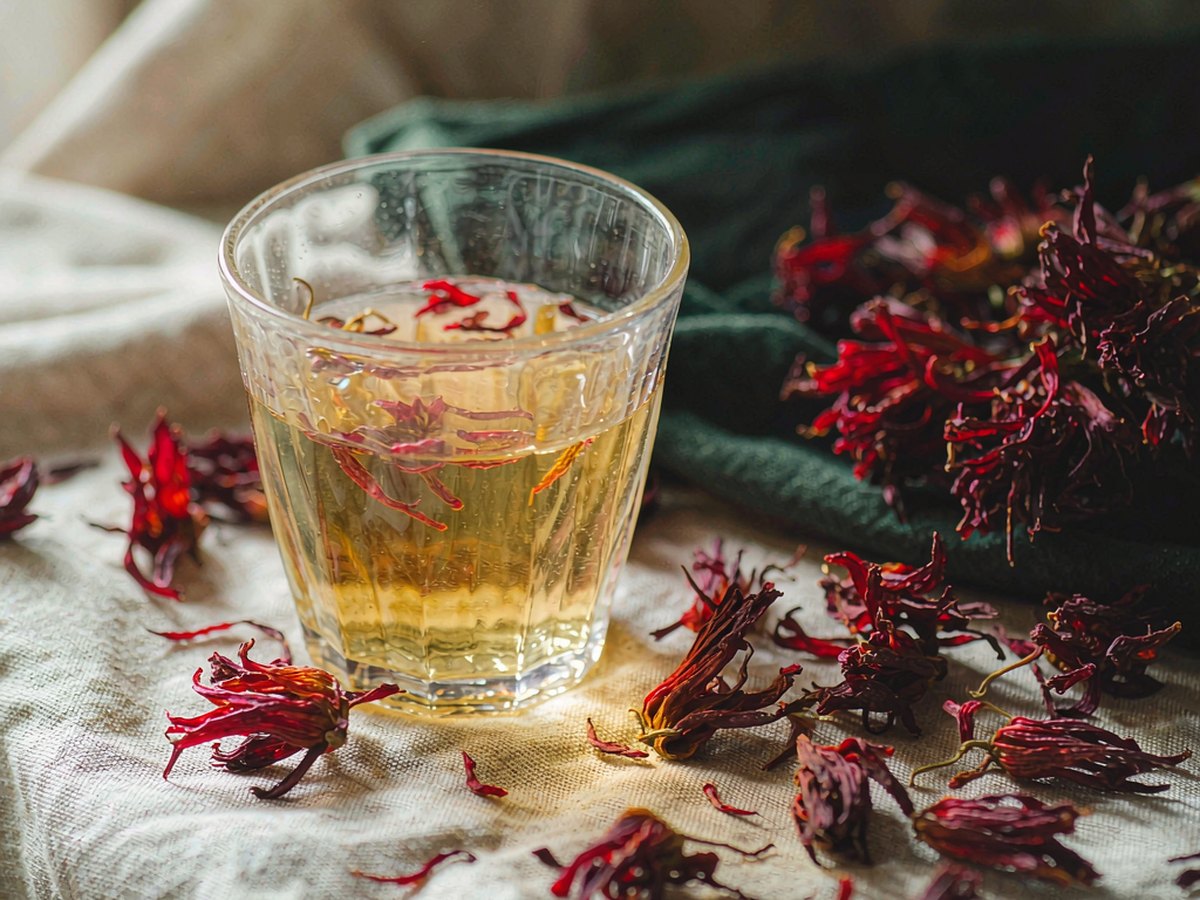
Safflower is a thistle-family flower that has been grown for its dye for four thousand years, and it makes a cup the colour of strong tea with a very faint, grassy flavour. It is also one of the most heavily used herbs in the Chinese pharmacy, mostly for a purpose that has nothing to do with how it tastes.
- Botanical
- Carthamus tinctorius — the safflower, a thistle of the family Asteraceae, unrelated to true saffron.
- Part used
- The dried corolla florets — the petals only, pulled from the flower head and dried. The yellow tubular florets underneath are removed and are bitter.
- Origin
- Zhejiang, Henan, Sichuan and Hebei in China; also Egypt, India, Spain and Mexico, where it is grown for oil as well as for dye.
- Flavour
- Very faintly grassy and herbal, with a light bitterness at the back and no real perfume. The colour is the point.
- Use
- 5–8 florets per 200 ml, 90 °C, 3 minutes. A handful gives a deep red-gold; a few give a pale straw colour.
- Keeps
- 12–18 months sealed and dark. It is fragile and crumbles, and the colour fades in light.
Not saffron
True saffron is the dried stigmas of Crocus sativus, and it takes roughly 150,000 flowers to produce a kilogram. Safflower gives you a comparable colour for a tiny fraction of the price and is used as the dye of choice in the Middle East, India and China for exactly that reason.
The colours are not identical. Saffron gives a more golden, honeyed tone; safflower gives a redder, more vermilion one. In a dish, safflower is a colour and a mild body rather than a flavour, and it is used in rice, in dough, in butter and in cheese.
It is also far more robust: safflower holds its colour through heat, while saffron bleeds out badly. For a red-dyed rice, safflower is the better tool.
A flower in the Chinese pharmacy
Hong Hua is classified as a blood-moving herb — one that is used to move blood that traditional medicine describes as stagnant. It appears in classical formulas for menstrual pain and for blood stasis, and it is the ingredient in several well-known Chinese patent medicines.
The two most famous clinical applications are for menstrual pain and for the treatment of a mild, non-severe postpartum haemorrhage. Both are traditional indications from the classical literature; neither is something to self-treat.
Its modern research history is genuinely interesting — safflower extracts have been studied for effects on blood clotting and on microcirculation, and safflower oil is a well-studied polyunsaturated fat. None of that makes a cup of safflower tea a treatment for a clotting disorder, and the interaction risk runs the other way: it can make anticoagulants more potent.
Dried vs fresh, and what to look for
The dried florets should be a vivid orange-red to crimson, intact and slightly curved, with a soft matte surface. A dull brownish-red lot has been either old or over-exposed to light.
Fresh safflower petals are used directly as a dye in some kitchens — steeped in warm water to draw out the pigment, then the water is used to colour the dish. Dried florets do the same job and keep for a year.
There is one adulteration worth knowing about: safflower is sometimes bulked out with dyed safflower petals that have had their colour reinforced, or with other red plant material. Colour that does not fade when you pour water over it, or a lot that smells of nothing, is the thing to look for.
What it is used for
- Blood circulation The principal traditional use in Chinese medicine: moving stagnant blood, used for menstrual pain and for blood-stasis patterns. This is a classical indication, not an established clinical treatment.
- Colour in cooking Its main kitchen function — a strong, heat-stable red dye for rice, dough, butter, cheese and pickles.
- Mild warming A gently warming herb with a slight dryness, used in blends that need warmth without a heavy aromatic.
- Postpartum use Classically used in formulas for postpartum bleeding. This must be supervised by a qualified practitioner and is not a self-treatment.
- Oil and fatty acids Safflower seed oil is one of the richest common vegetable sources of linoleic acid, and is a well-studied subject in cardiovascular nutrition research.
- Antioxidant activity The petals contain carotenoids and polyphenols with laboratory antioxidant activity.
In the kitchen
- Red-dyed rice A handful of florets in the cooking water for the last ten minutes of a red rice dish. This is the classic East Asian use.
- Coloured dough The pigment in a pale dough or a steamed bun, for festival food.
- Butter and cheese Safflower-infused butter for a yellow-orange spread, and in some Alpine cheese traditions.
- Pickles and preserves A handful in a brine for a deep red colour.
- Infusion Six florets in 200 ml of hot water for a bright red-gold cup, more often used to colour a second infusion than drunk for its taste.
This is the most important caution in this article: safflower is used to move blood and it affects clotting, so it interacts with anticoagulants, with antiplatelet drugs, and with any preparation before surgery. Anyone on blood thinners, or pregnant, should not use it without asking a clinician.
S
a
f
f
l
o
w
e
r
i
s
t
r
a
d
i
t
i
o
n
a
l
l
y
a
v
o
i
d
e
d
d
u
r
i
n
g
p
r
e
g
n
a
n
c
y
,
a
n
d
t
h
e
s
a
m
e
c
a
u
t
i
o
n
a
p
p
l
i
e
s
t
o
a
n
y
o
n
e
w
i
t
h
a
b
l
e
e
d
i
n
g
d
i
s
o
r
d
e
r
.
I
t
a
l
s
o
i
n
t
e
r
a
c
t
s
w
i
t
h
s
e
v
e
r
a
l
o
r
d
i
n
a
r
y
d
r
u
g
s
,
i
n
c
l
u
d
i
n
g
s
o
m
e
a
n
t
i
b
i
o
t
i
c
s
a
n
d
s
o
m
e
d
i
a
b
e
t
e
s
m
e
d
i
c
a
t
i
o
n
s
.
Disclaimer
Safflower’s traditional indications are real within Chinese medicine, and they are not the same as proven clinical treatments. This article is written for a kitchen and a tea tray. Do not use safflower to treat heavy periods, to stop bleeding, or to influence any medication, and do not use it in place of prescribed care.