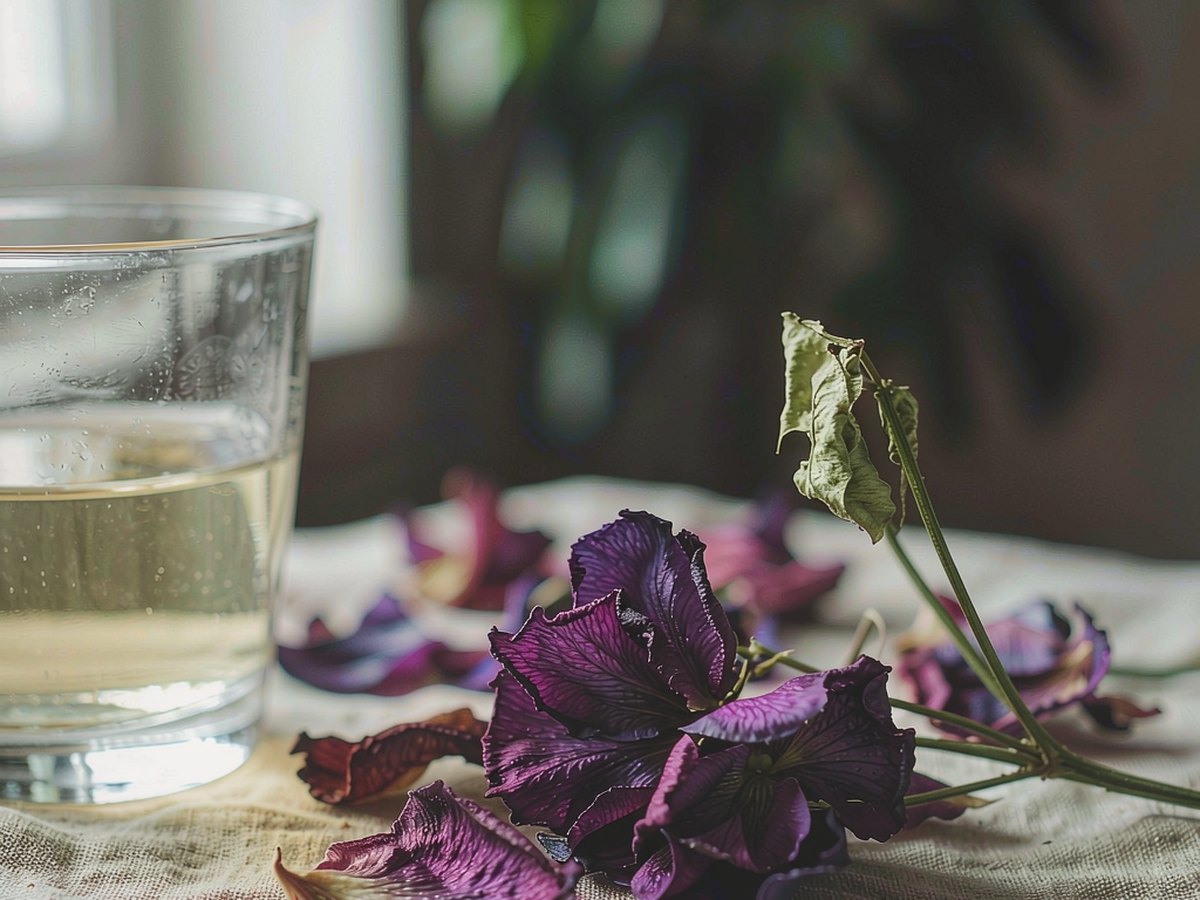
Violet is a sweet, gentle flower with a short, grassy aftertaste, and it is one of the few dried blossoms that works equally well in a cup and on a plate. The complication is that the flower sold for tea and the herb sold in the Chinese pharmacy are both called zi hua di ding, but they are different plants with entirely different characters.
- Botanical
- Viola species. The ornamental violets sold as edible flowers are usually Viola cornuta, V. x wittrockiana or V. tricolor. The Chinese pharmacy herb Zi Hua Di Ding is Viola yedoensis, a small wild violet gathered with the roots.
- Part used
- The dried flower — petals, often separated from the calyx and stalk. The pharmacy herb is the whole plant, roots included.
- Origin
- The ornamental violet trade is European, Dutch and French mostly, with Chinese production of V. yedoensis concentrated in Anhui, Jiangsu, Zhejiang and around the Yangtze delta.
- Flavour
- Sweet and lightly perfumed, with a grassy, slightly mineral finish. Very mild.
- Use
- 2–4 petals per cup, 85 °C, 2 minutes. A little goes a long way; a pot of petals will taste of grass rather than of violet.
- Keeps
- 12 months sealed and dark. The colour fades to a dull mauve within a year even in good storage.
Flower and herb
The Chinese medicine Zi Hua Di Ding is Viola yedoensis, and it is harvested with the whole plant — roots, leaves and flowers — because in that tradition the root is the medicinal part. It is a classical heat-clearing and detoxifying herb, used for inflamed sores and sore throats, and it is a totally different material from a cup of dried petals.
The dried flowers sold for tea and for cooking are ornamental violets, picked after opening, and they are a culinary and aromatic material. Confusing the two leads people to drink a packet of dried leaves and stems and wonder why it tastes like grass.
If a bag of violet has visible stems and small rooty fragments in it, it is likely the whole-plant herb rather than the clean petals. That is not a bad thing — it is a different thing, with a different use.
Violet in the western kitchen
Violet is one of the very few dried flowers that is a genuine culinary ingredient in Europe rather than only a tea. Candied violets are the classic use, and violet sugar — the basis of violet chocolate, and of the French bonbon that is more or less a solid violet perfume — is made by pounding the fresh flowers with sugar and adding a little warm water.
The older uses are worth remembering too: violet leaves were used as a mild laxative, and violet syrup was a common nineteenth-century remedy for coughs and for children’s chest complaints, mostly on the strength of the flowers being mucilaginous.
Dried petals rehydrate remarkably well. A teaspoon of dried violet blooms into a small, recognisable flower in warm water, which is part of the charm.
Picking and quality
Violet petals are thin and bruise easily, and most commercial dried violet is quite dark — a deep blue-purple that has gone almost to navy. That is normal and it is the result of drying, not of a bad lot.
Pale grey-green or brown petals mean the flowers were dried after they had started to turn, and they will taste of old hay. A good bag has a sweet, powdery, violet perfume when opened and petals that are intact rather than reduced to fragments.
The colour fades regardless, and there is no way to store a jar of dried violet that stays purple for a year. Expect it to be a soft mauve by the time you use it, and buy the smallest bag you can finish.
What it is used for
- Soothing and mild Traditionally used as a gentle infusion for a sore throat and for settling a cough, in both European and Chinese folk practice.
- Cooling A mild cooling quality, and it appears in the European tradition of cooling summer infusions alongside elderflower and rose.
- Skin and lymphatic folk use Violet leaf was a classic European herbal remedy for minor skin complaints and as a mild laxative. This is a folk use, not an established indication.
- Heat-clearing in Chinese practice For the whole-plant herb rather than the flower: a classical herb for inflamed and angry conditions.
- Flavour and perfume Its main modern use — an edible, candied, crystallised and syruped aromatic.
- Mild sweetness A gentle natural sweetness that works in blends that need a soft note rather than a strong one.
In the kitchen
- Candied violets Fresh petals dipped in a light egg white and dusted with fine sugar, dried on baking paper. The classic use.
- Violet sugar Petals pounded with a little sugar and a splash of warm water, steeped, strained. The base of violet chocolate.
- Syrup One tablespoon of petals per 100 ml of water, steeped warm, strained and set with sugar.
- Blending Two petals with jasmine or rose in a delicate floral tea.
- Baking Scattered over a shortbread or a posset before serving.
Violets are safe as a food, but buy only flowers grown for edible use. Violets from florists are treated with pesticide and with preservatives that are not intended for consumption, and the same applies to anything bought in a pot at a garden centre.
I
f
y
o
u
a
r
e
p
r
e
g
n
a
n
t
,
n
u
r
s
i
n
g
,
o
r
o
n
m
e
d
i
c
a
t
i
o
n
,
a
s
k
a
c
l
i
n
i
c
i
a
n
b
e
f
o
r
e
d
r
i
n
k
i
n
g
v
i
o
l
e
t
t
e
a
r
e
g
u
l
a
r
l
y
,
a
n
d
n
o
t
e
t
h
a
t
t
h
e
r
o
o
t
o
f
<
e
m
>
V
i
o
l
a
y
e
d
o
e
n
s
i
s
<
/
e
m
>
i
s
a
g
e
n
u
i
n
e
m
e
d
i
c
i
n
a
l
p
a
r
t
w
i
t
h
i
t
s
o
w
n
c
a
u
t
i
o
n
s
.
Disclaimer
This article describes an edible flower and its long culinary and folk-medicine history. Nothing here is a claim that violet treats any condition, and no herb should be used in place of prescribed treatment. Only use flowers that have been grown for edible use.