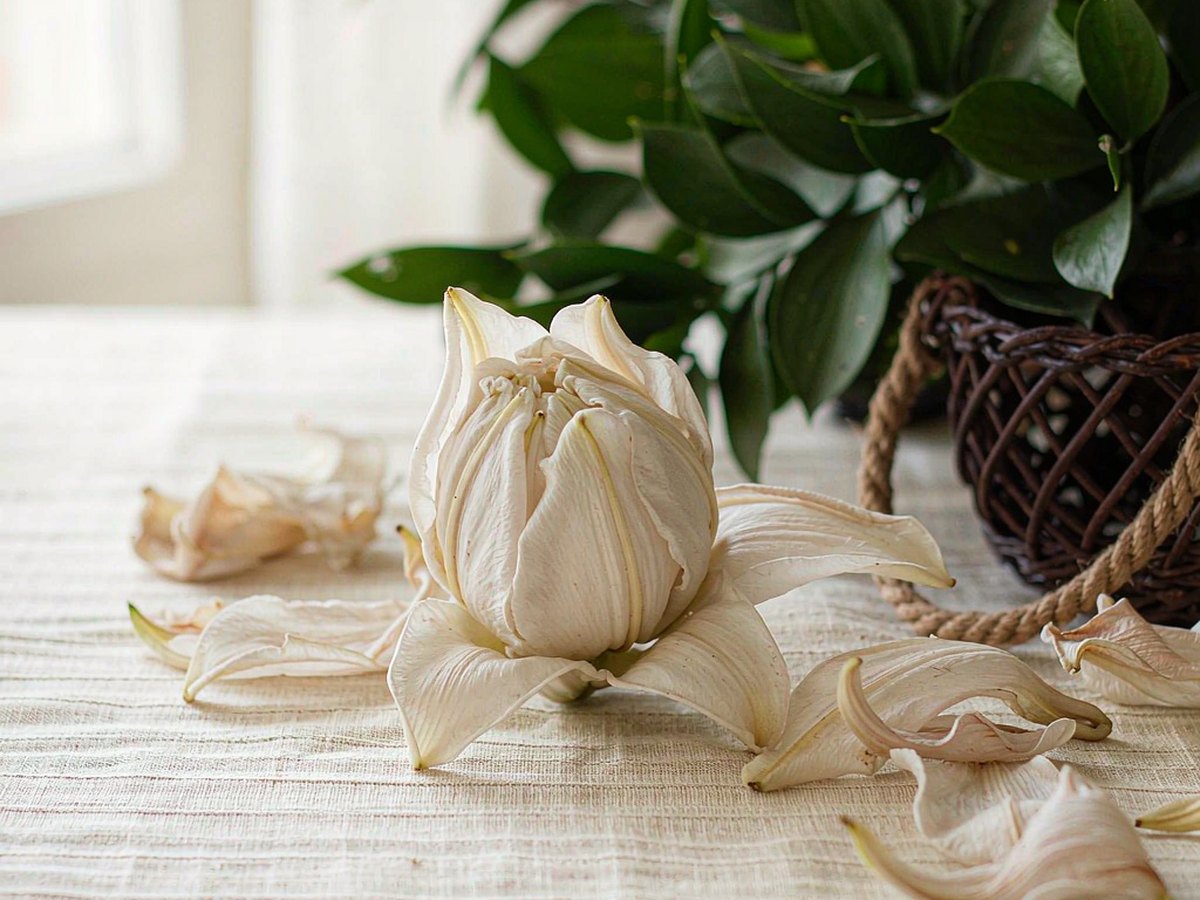
A dried lily flower is a soft, faintly sweet, almost starch-like infusion that looks like petals floating in water and tastes gentler than almost anything else in the herbal tea world. It is also worth being clear about something that confuses people constantly: the lily in the Chinese pharmacy is not this flower. Bai He is the bulb scale, not the bloom.
- Botanical
- Lilium species — most commonly Lilium brownii, L. lancifolium (tiger lily) or L. pumilum in Chinese production. The pharmacy drug Bai He is the dried bulb scale of the same genus, not the flower.
- Part used
- The dried flower — petals, and often the whole bloom with the pistil removed. In the pharmacy, the separate and much more medicinal item is the layered bulb scale.
- Origin
- Hunan, Hubei, Gansu, Sichuan and Jiangsu for the bulbs; the dried flowers come from the same growing regions, along with Fujian and Yunnan.
- Flavour
- Very mild, faintly sweet and slightly starchy, with almost no bitterness and no perfume.
- Use
- 2–4 flowers per cup, 85–90 °C, 2–3 minutes. The petals soften and unfurl as they steep.
- Keeps
- 12 months sealed. The petals are fragile and break easily, so a good bag has whole petals rather than dust.
The flower and the bulb are different drugs
In the Chinese pharmacopoeia, Bai He is the dried fleshy scale leaf of the bulb of Lilium brownii, L. lancifolium or L. pumilum. It is a firm, white, slightly translucent, petal-shaped scale that is boiled into sweet soups and used to moisten the lungs in traditional medicine.
The dried flower is not Bai He. It is a floral material, sold for tea and for culinary use, and it does not have the same properties, the same dosage, or the same traditional indications. It is a light, pleasant drink rather than a medicinal decoction.
The confusion is worth flagging because both are sold as “lily”, often in the same shop, and because the bulbs are used in sweet soups that are genuinely medicinal in intent while the flowers are simply fragrant.
What the dried flower actually is
Commercially, dried lily flowers are usually the separated petals, often with the pistil and stamens removed because they discolour and turn bitter. Good material is ivory to pale cream, pliable, with no brown spotting and no dark central strip.
A tiny proportion of the trade is dried from bulbs that were left to flower and then dried whole, stems and all — a rougher product with a woody, slightly grassy character and a duller colour. It is not a superior lot; it is a different one.
The petals rehydrate fast. Put them in the cup first, pour the water, and they open and turn translucent within a minute. That is the whole charm of the ingredient: a cup of floating, unfurling petals.
Where it fits in a sweet soup
The flower is used in Chinese cooking as a delicate aromatic in sweet soups — alongside dried longan, red date and lily bulb — and in some Cantonese dessert recipes where the petals are added at the very end of the simmer so they do not turn to mush.
It also works as a light fragrance in a savoury broth, where a single flower in a clear chicken or pork broth adds a barely-there floral note. It is one of the few flowers that genuinely improves a savoury pot.
What it is used for
- Gentle hydration A very mild, slightly sweet infusion that is easy to drink in the evening or when you want nothing sharp.
- Moistening in traditional use The bulb — not the flower — is the classical moistening lung and yin-nourishing ingredient. The flower shares the association but not the evidence.
- Astringent and cooling A mild cooling and astringent quality in traditional practice, used where heat and dryness are the diagnosis.
- Palate and light sweetness Used as an aromatic in sweet soups, giving a soft floral lift without much sugar.
- Savoury fragrance Rare among flowers, but a lily petal in a clear broth adds a note that nothing else does.
- Calming evening cup A mild, starchy cup with no caffeine and no sharpness, which is why it is often the last drink of the night.
In the kitchen
- Straight infusion Three petals in a glass, 85 °C poured over them, left three minutes. Watch them open.
- Sweet soup Added in the last five minutes of a longan and red date sweet soup.
- Clear savoury broth One flower per pot of clear chicken or pork broth, added with the ginger, removed before serving.
- Nourishing soup Used alongside lily bulb, dried longan and jujube for a gentle, sweet, restorative-tasting broth.
- Blending One or two petals in a light floral blend with jasmine or osmanthus.
The flower is mild and generally safe as a food. It is the bulbs and seeds of the lily that carry the real caution: lily bulbs are edible only when correctly identified and prepared, and lily seeds are toxic. Buy dried bulb material from a supplier that states the species.
I
f
y
o
u
a
r
e
p
r
e
g
n
a
n
t
o
r
n
u
r
s
i
n
g
,
o
r
i
f
y
o
u
a
r
e
b
u
y
i
n
g
t
h
e
b
u
l
b
f
o
r
a
s
w
e
e
t
s
o
u
p
,
c
h
e
c
k
w
i
t
h
a
c
l
i
n
i
c
i
a
n
o
r
a
q
u
a
l
i
f
i
e
d
C
h
i
n
e
s
e
m
e
d
i
c
i
n
e
p
r
a
c
t
i
t
i
o
n
e
r
,
a
s
t
h
e
b
u
l
b
i
s
a
g
e
n
u
i
n
e
m
e
d
i
c
i
n
a
l
i
t
e
m
w
i
t
h
a
c
l
a
s
s
i
c
a
l
d
o
s
a
g
e
.
Disclaimer
This article describes a dried edible flower and the differences between it and the related pharmacy drug. Traditional uses of lily bulb are recorded in Chinese medicine and are not established clinical indications. Do not use lily in any form as a substitute for prescribed treatment, and do not self-identify or prepare wild lily bulbs.