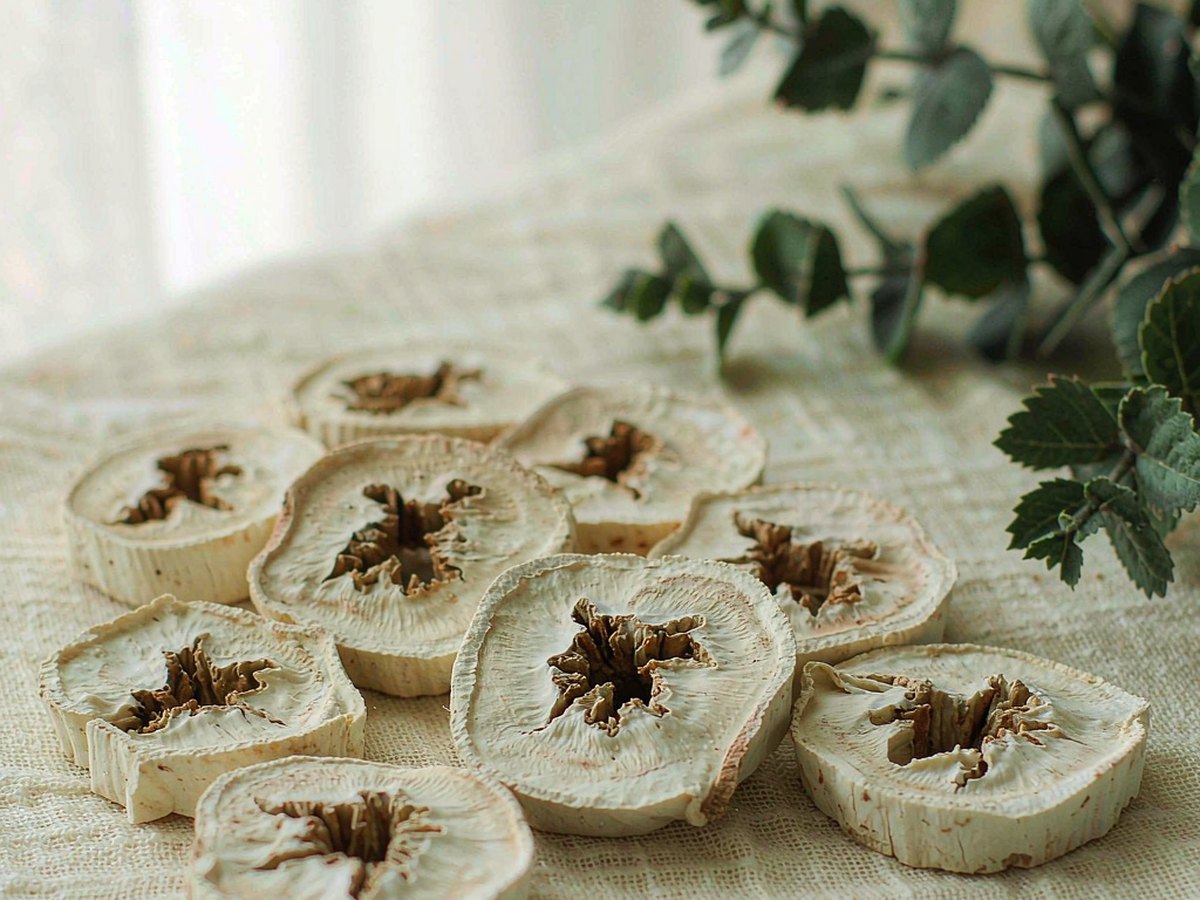
Jie Geng explained: what it is, how to pick it, and what actually matters when you use it.
Platycodon grandiflorus is a blue bellflower with a white root that tastes soapy and slightly sweet, and in Chinese medicine it is the standard herb for anything to do with the chest — a blocked chest, a cough, a lump in the throat, or a chest that will not expand properly. It is also one of the very few cough herbs with a real modern research record.
- Botanical
- Platycodon grandiflorus — the balloon flower, a perennial bellflower. The root is Jie Geng; the flower is Jie Geng Hua, a separate item.
- Part used
- The dried root, usually sliced. Sliced roots are paler and lose the sticky quality faster than whole root.
- Origin
- Anhui, Hebei, Henan, Hubei, Jiangsu and Sichuan. The Anhui and Jiangsu crops are the standard.
- Flavour
- Slightly sweet, bland, with a distinctive soapy or slimy texture when chewed — the root’s saponins give it that, and it is the plant’s signature.
- Use
- 3–9 g per 200 ml, simmered 20–30 minutes. A decoction herb.
- Keeps
- 18–24 months sealed and dry.
The two classical actions
Platycodon is used in Chinese medicine for two separate things, and understanding them separately explains why the herb appears in so many different formulas.
The first is raising and dispersing lung qi — the idea that the chest needs to open and the breath needs to move outward and upward. The classical picture is a cough with a lot of sputum, a chest that feels full, or simply a sense of something not expanding properly. It is the standard herb for that.
The second is what traditional medicine calls dispersing carbuncles and eliminating pus — the action applied to swollen, painful, pus-filled lumps anywhere in the body, and also to the throat. This is the “plum blossom” or “jie geng” of the famous formula that treats the throat.
The important qualification is that it is classified as slightly cold, and it moves things upward and outward. In a person with a weak, depleted constitution, that upward movement can be unwelcome — which is why it is usually paired with something nourishing in classical formulas.
The saponins, and why it is interesting
The soapy character is not a defect. Platycodon contains a group of triterpenoid saponins — platycodin D is the best studied — and saponins are surfactants, which is why the root makes a slight foam when simmered and why it feels slimy in the mouth.
Platycodin D and the other saponins have been studied extensively for anti-inflammatory, antitussive and, notably, anti-tumour activity. Some of the anti-tumour work is genuinely remarkable in cell and animal models, and platycodin D is one of the compounds that has been repeatedly flagged as a candidate for further drug development.
The gap between a cell-culture result and a treatment for cancer in people is enormous, and platycodin D is not an approved cancer drug in any country. It is also not available as a supplement in most places, largely for regulatory reasons rather than because it is dangerous. The honest position is that this is a herb with unusually serious research interest behind it and no established clinical dosing.
Which part, and how to buy it
The root, Jie Geng, is the standard item. The flower, Jie Geng Hua, is used separately and more rarely, and is a beautiful pink-lilac bellflower that is also edible.
Good platycodon root is white to pale yellow, firm, and has a strong soapy smell when you break it — that smell is a marker of saponin content and of freshness, and a lot with no scent has lost what makes it worth buying.
The slices should be white, not yellow or brown. Yellowing means age, and the root loses both its potency and its sweetness with it.
A practical note on the taste: the soapiness is real and some people find it off-putting. Simmering with jujube and ginger covers it, and the classical formulas almost always do.
What it is used for
- Opening the chest The principal classical use: for a cough with copious sputum, a full chest, and the sensation of not being able to expand the chest properly.
- Raising lung qi Used where the breath needs to move outward and upward, traditionally in formulas with a licorice root and an apricot kernel.
- Sore throat and swollen lymph nodes Classically used for the throat and for what traditional medicine describes as carbuncles — swollen, pus-filled lumps.
- Antitussive activity Platycodin’s saponins show clear cough-suppressant effects in animal models, which is consistent with its classical use.
- Anti-inflammatory activity Well-documented in laboratory models, and the basis of much of the modern interest in platycodin D.
- Anti-tumour research Platycodin D is one of the more actively studied plant compounds in cancer research, almost entirely in cell and animal models. It is not a cancer treatment.
In the kitchen
- Platycodon and apricot kernel The classical pair for a cough with phlegm, simmered with licorice.
- Sore throat decoction Platycodon with jujube and ginger, for the sore, swollen-throat picture.
- With pear A pear simmered with platycodon for a cough with thirst, the home-remedy version.
- Blending Two slices in a pot of ginger and jujube, which covers the soapiness completely.
- The flower The dried flower is a separate, gentler item and can be infused rather than decocted.
Platycodon is slightly cold and it moves things upward, which is not what you want in someone with a weak constitution, a chronic loose cough or a depleted stomach. It is traditionally avoided in pregnancy.
S
a
p
o
n
i
n
s
c
a
n
i
r
r
i
t
a
t
e
t
h
e
s
t
o
m
a
c
h
i
n
l
a
r
g
e
d
o
s
e
s
,
a
n
d
p
l
a
t
y
c
o
d
o
n
h
a
s
a
n
e
f
f
e
c
t
o
n
b
l
o
o
d
s
u
g
a
r
t
h
a
t
m
a
t
t
e
r
s
f
o
r
a
n
y
o
n
e
o
n
d
i
a
b
e
t
e
s
m
e
d
i
c
a
t
i
o
n
.
A
n
y
o
n
e
o
n
r
e
g
u
l
a
r
m
e
d
i
c
a
t
i
o
n
s
h
o
u
l
d
a
s
k
a
p
h
a
r
m
a
c
i
s
t
b
e
f
o
r
e
u
s
i
n
g
i
t
.
Disclaimer
The antitumour research on platycodin D is real and worth knowing about, and it is also easy to overread. Platycodon root is not a cancer treatment and no herbal product containing it should be presented as one. It is a classical medicine with real and well-documented pharmacology, and it deserves to be used within its traditional framework rather than beyond it.