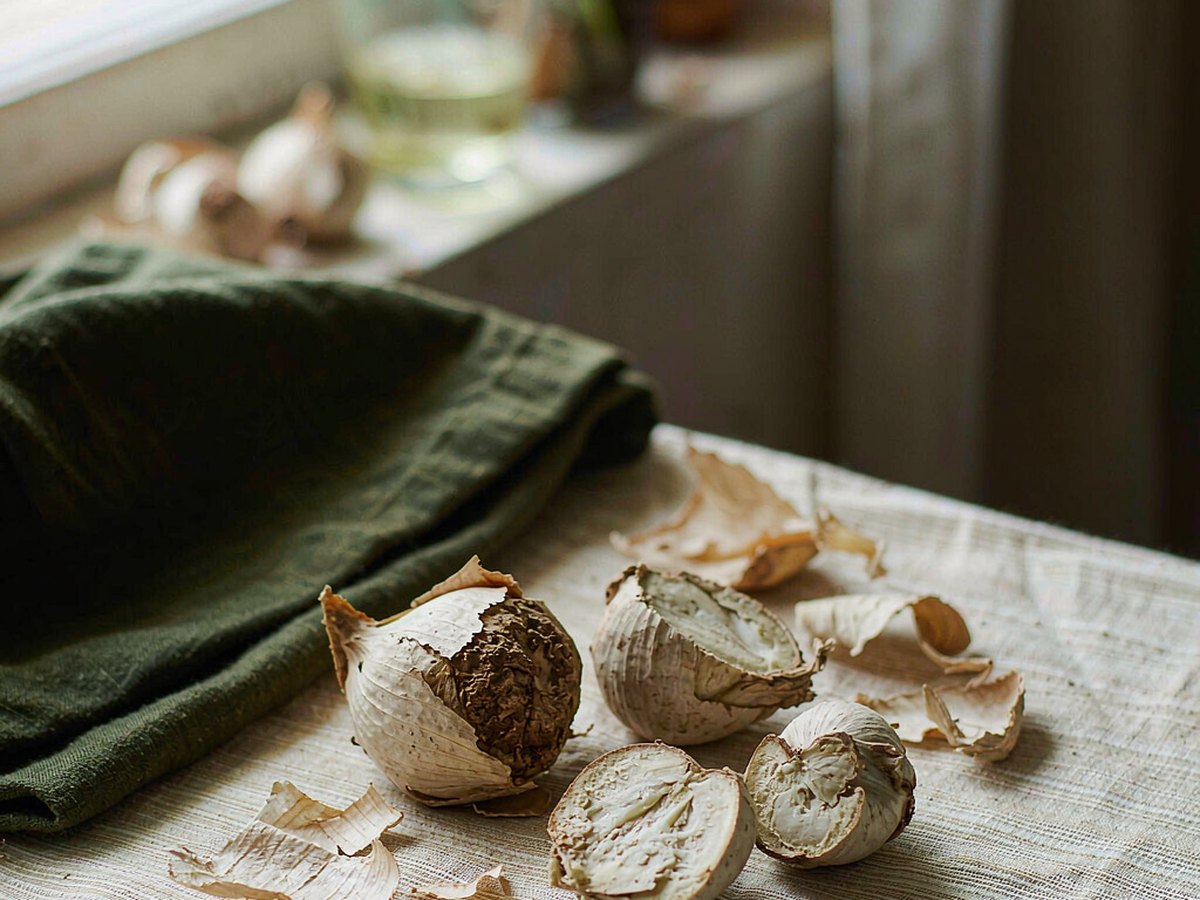
Fritillaria is the bulb of a spring-flowering bellflower, and in Chinese medicine there are two of them that look nearly identical and are used for opposite coughs. One is for a wet, rattling, productive cough; the other for a dry, irritating one. Getting them the wrong way round is the classic error, and it is easy to make because they are sold in the same bag shape.
- Botanical
- Fritillaria cirrhosa (Chuan Bei Mu, the Sichuan bulb) and Fritillaria thunbergii / F. ussuriensis (Bei Mu, the Zhejiang or Ussuri bulb). Two species, two bulbs, two jobs.
- Part used
- The dried bulb, whole or in slices. Chuan Bei Mu is the whole small bulb; Bei Mu is usually larger and is often sold sliced.
- Origin
- Sichuan, Gansu and Shaanxi for Chuan Bei Mu; Zhejiang, Jiangsu, Anhui and Liaoning for Bei Mu. Also gathered wild across the Himalaya and in Korea.
- Flavour
- Bitter, slightly cold and slightly sweet, with a faint chalky note. Both are quite unpleasant on their own.
- Use
- 3–6 g per 200 ml, decocted for 20–30 minutes. Always with something else; they are never pleasant alone.
- Keeps
- 18–24 months sealed and dry. Bulbs keep very well.
The rule, stated plainly
Chuan Bei Mu, the Sichuan bulb, is the one for a wet cough. It is used when there is a lot of phlegm, when the sputum is thin and watery, when the cough sounds loose and rattling, and when there is a sensation of something stuck in the chest that will not come up. Its traditional description is that it clears heat, transforms phlegm, disperses the nodules that form in the chest, and opens the way out.
Bei Mu, the Zhejiang bulb, is the one for a dry cough. It is used when the throat is dry and scratchy, when the cough is dry and irritating with little or no phlegm, and when the heat is in the lungs. Its traditional description is that it moistens the lungs, clears heat, calms the cough and loosens the phlegm that is there.
So the rule is: wet and loose, take Chuan. Dry and irritable, take Bei. Getting them wrong is not dangerous, but it will not do what you wanted.
Telling the two apart
Chuan Bei Mu is the smaller bulb, round to flattened, about half a centimetre to a centimetre across, with a smooth, glossy, cream to ivory surface and a distinct closing curve at the top where the stem detached. It often arrives whole, and it looks rather like a tiny peeled garlic clove.
Bei Mu is the larger bulb, usually half-moon or crescent-shaped, flatter, and often sold in slices. The slices are more revealing: they show concentric structure, a slightly translucent flesh, and a clear dividing line between the outer layer and the centre.
The colour difference is the other giveaway. Chuan Bei Mu is a warmer cream; Bei Mu is whiter and more translucent. If a bag does not say which species it is, it is worth asking, because the two are not interchangeable.
Why it is never drunk alone
Both fritillaria bulbs are bitter, cold and unpleasant on their own, and both are used in formulas rather than alone. The classical pairing for the wet cough is Chuan Bei Mu with fritillaria bulb, loquat leaf, and in modern patent medicines, with a rock sugar base in the form of the Chuan Bei Gan Lu Wan lozenges.
For the dry cough, Bei Mu is paired with the opposite set: with dendrobium, with fritillaria’s own relative Ophiopogon, with pear, and with the moistening herbs. In classical practice, the two bulbs are sometimes used together in the same formula when a cough is mixed.
There is also a significant question about the wild-harvested supply. Fritillaria bulbs have been over-collected in the wild for several decades, and much of the trade is now cultivated, particularly for Chuan Bei Mu in Sichuan and for Bei Mu in Zhejiang. Farmed bulbs are more consistent but the wild ones are considered more potent by some buyers — and the endangered wild populations are a genuine conservation problem worth knowing about.
What it is used for
- Wet, productive cough The principal use of Chuan Bei Mu: for a loose, rattling cough with copious thin phlegm and a blocked chest.
- Dry, irritating cough The principal use of Bei Mu: for a dry, scratchy throat and a dry cough with little phlegm and heat in the lungs.
- Phlegm transformation Both are classically used to transform phlegm, which is the shared core of their action.
- Dispersing chest nodules Chuan Bei Mu is used in classical formulas for what traditional medicine describes as nodules and masses in the chest — a pattern-based description rather than a diagnosis.
- Cooling Both are classed as cold, which is why they are the herbs of choice when the diagnosis includes heat.
- Nutraceutical interest Fritillaria is one of the major items in the traditional Chinese pharmaceutical industry, and it is a protected species in several regions.
In the kitchen
- Chuan Bei Gan Lu Wan The classical lozenge — Chuan Bei Mu with loquat leaf, fritillaria, and rock sugar — the standard Chinese cough lozenge.
- Pear and fritillaria soup The classical home remedy: a Chinese pear simmered with a slice of Chuan Bei Mu for a wet cough with thirst.
- Bei Mu in a moistening formula Bei Mu with dendrobium and Ophiopogon for a dry, scratchy cough.
- Never solo Both bulbs taste unpleasant alone; pair them with a pear, with rock sugar, or with a formula.
- Dose reality Three to six grams a day in a decoction. It is a measured herb, not a handful herb.
Fritillaria is cold and slightly toxic in large doses — the classical pharmacopoeia notes this directly. It should not be used in pregnancy, and it should not be used for a cough with copious watery sputum if you are Bei Mu rather than Chuan Bei Mu.
S
o
m
e
f
r
i
t
i
l
l
a
r
i
a
s
p
e
c
i
e
s
a
r
e
p
r
o
t
e
c
t
e
d
,
a
n
d
p
r
o
d
u
c
t
s
s
o
l
d
a
s
f
r
i
t
i
l
l
a
r
i
a
c
a
n
b
e
a
d
u
l
t
e
r
a
t
e
d
w
i
t
h
l
o
o
k
–
a
l
i
k
e
b
u
l
b
s
f
r
o
m
o
t
h
e
r
g
e
n
e
r
a
,
i
n
c
l
u
d
i
n
g
t
h
e
p
o
i
s
o
n
o
u
s
w
h
i
t
e
h
e
l
l
e
b
o
r
e
.
B
u
y
f
r
o
m
a
s
u
p
p
l
i
e
r
t
h
a
t
s
t
a
t
e
s
t
h
e
s
p
e
c
i
e
s
a
n
d
t
h
e
o
r
i
g
i
n
,
a
n
d
n
e
v
e
r
c
o
l
l
e
c
t
i
t
y
o
u
r
s
e
l
f
.
Disclaimer
Cough is a symptom with many causes, and a persistent cough needs a diagnosis rather than a herb. Fritillaria’s traditional indications are pattern-based and belong in a supervised practice. Do not use it to treat a cough in place of medical assessment, and do not use any product whose species you cannot verify.