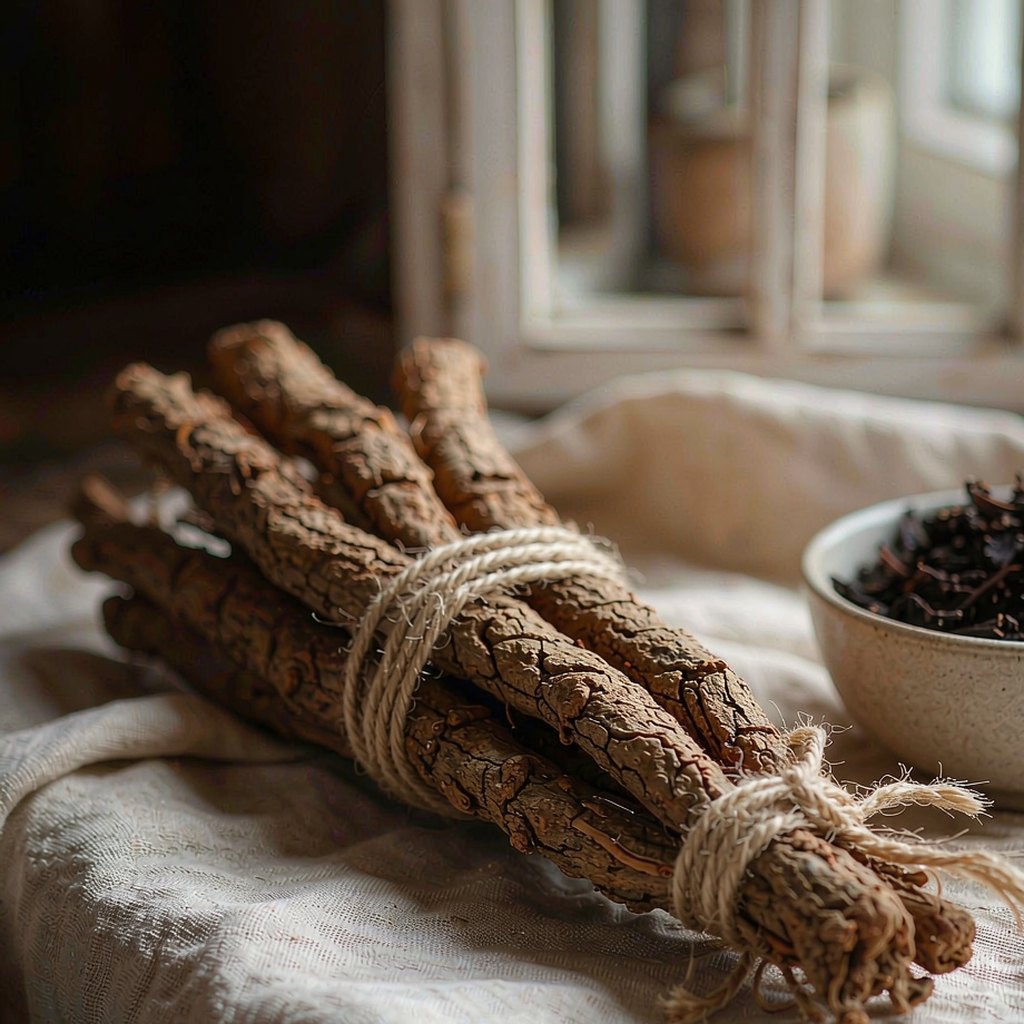
Dang gui smells like a cross between celery and old books, and it will take over any pot you put it in. Used well it is the backbone of a winter braise. Used badly it tastes like a pharmacy.
- Botanical
- Angelica sinensis — not the European Angelica archangelica.
- Part used
- Dried root, sliced crosswise into thin discs.
- Origin
- Minxian county, Gansu — the reference origin. Also Yunnan, Sichuan, Shaanxi.
- Flavour
- Sweet first, then celery and musk, with a bitter edge that grows if you overcook it.
- Use
- 3–5 g per litre of broth. It is loud; treat it like a spice, not a vegetable.
- Keeps
- 18 months whole. Ground, six months at most.
One root, three parts
A whole dang gui root is graded by section, and the sections are not interchangeable.
- The head — the crown where the stems met — carries the strongest aroma and the most oil. Best for stocks where you want the smell to lead.
- The body — the main root — is sweeter, denser, and slower to give up its flavour. This is the part for braises.
- The tail — the thin rootlets — is more bitter and extracts fast. It is what you get in cheap sliced bags.
For most cooking, buy whole-root slices: even discs cut across the full root, with a pale cream interior and a visible ring of brown oil glands. If a bag is mostly thin, dark, irregular slivers, it is tail and it will turn your soup bitter in twenty minutes.
Why Gansu
Minxian sits at around 2,000 m on loess soil, with cool nights and a short growing season. Roots grown there are denser and oilier than lowland crops, and the smoke-cured drying method used locally leaves a faint resinous note that is considered correct. Grade is by root diameter: the fat, uniform roots are worth several times the thin ones, and price in this category is almost entirely a function of grade.
How much, and when
Three to five grams per litre. A whole 20 g root will dominate four litres of stock and there is no way to take it back out. Add it early — it needs forty minutes of gentle heat to soften and release — and if the broth starts to taste medicinal, a piece of chen pi or a couple of red dates will pull it back.
In the kitchen
- Chicken soup. Half a root, four red dates, a thumb of ginger, three litres of water, ninety minutes. The canonical version.
- Lamb braise. Dang gui and lamb is a northern winter pairing; the root’s sweetness against the fat.
- Soy-braised beef shank. Two slices in with the star anise and cassia. Barely identifiable, structurally important.
- Egg tea. A strong decoction, an egg poached in it, brown sugar. Breakfast, not a dessert.
Buying
Outside should be pale yellow-brown, not white. Inside cream to off-white, with brown oil dots visible across the cut face. Break a slice: it should smell immediately, sweet and celery-like. Sulphur-treated roots are unnaturally white, uniform, and smell sharp rather than sweet — they also taste hollow. Soft or bendy slices have taken on moisture and lost their aroma.
Two things to check first. Dang gui is traditionally avoided during pregnancy, and it interacts with warfarin and other anticoagulants. If either applies, leave it out and use astragalus or a plain chicken stock instead. This is kitchen information, not medical advice.