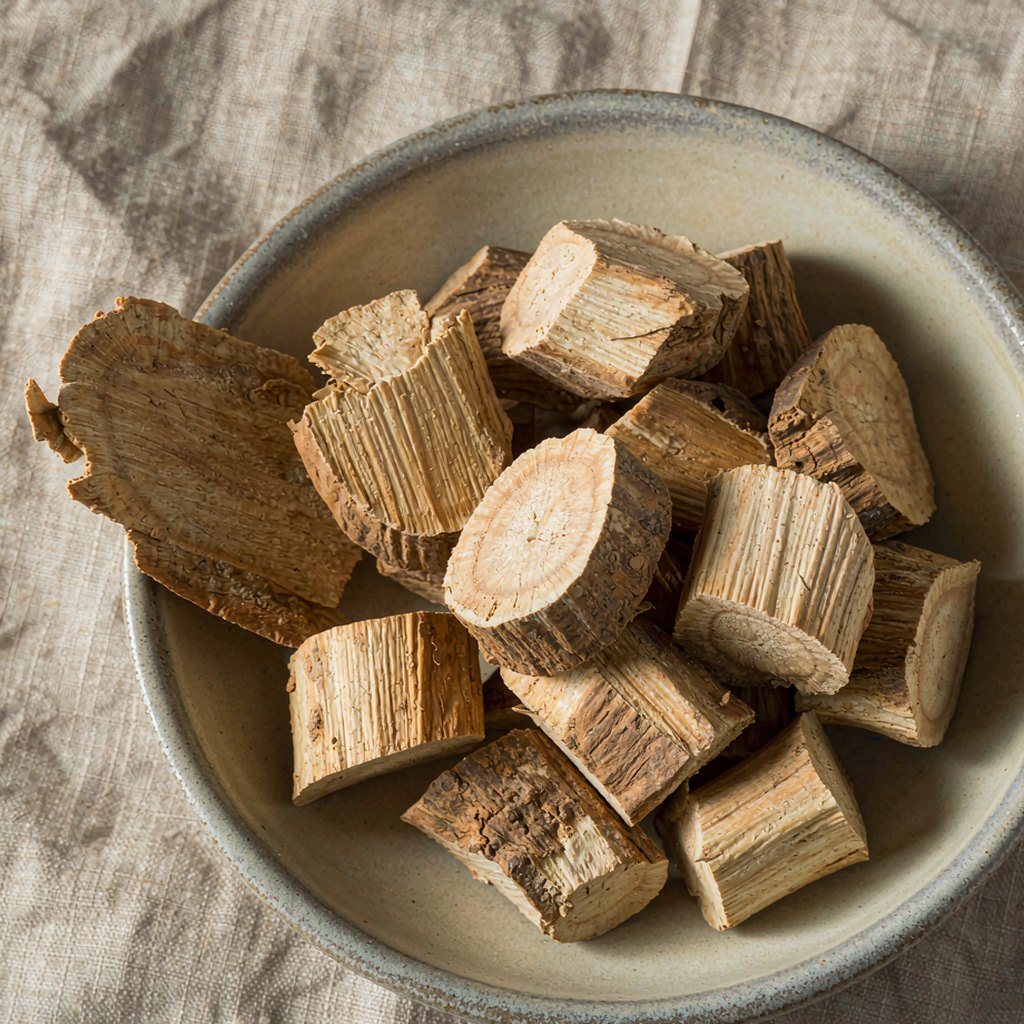
Pale, woody, faintly sweet, and about as aromatic as a boiled potato. Astragalus is the least assertive root in the cabinet, which is precisely why it goes into pots that already have something else to say.
- Botanical
- Astragalus membranaceus.
- Part used
- Dried root, sliced on the diagonal into long ovals.
- Origin
- Shanxi, Gansu, Inner Mongolia, Heilongjiang.
- Flavour
- Mildly sweet, beany, faint resinous note, no bitterness when properly cooked.
- Use
- 10–15 g per 2 litres of stock, in from the start.
- Keeps
- Two years sealed. This is one of the few herbs that barely fades.
What it is
A legume root, which is why it tastes faintly of beans and why it behaves more like a vegetable than a spice. The slices are pale cream with a distinct yellow core and a thin brown skin; good ones are firm, fibrous, and bend rather than snap. It has almost no volatile oil, so it does not perfume a dish the way dang gui does. What it contributes is body, a low sweetness, and a savoury roundness that makes a thin broth taste longer than it is.
The two grades you will see
Wild-simulated, 3–5 years — grown on hillsides, harvested late, sliced thin. Darker core, denser fibre, chewy after two hours of simmering, and the one worth paying for. Field-grown, 1–2 years — fatter, paler, softer, and cheaper. Not fraudulent, just weaker: you will use half again as much to get the same body. Both are typically sold as diagonal slices; whole roots are rare outside the producing regions.
Why it pairs with everything
Because it argues with nothing. Astragalus plus red date plus ginger is the base stock of a thousand Chinese home kitchens — no aroma clash, no bitterness, no colour shift. It also takes the edge off louder ingredients: put a few slices in with dang gui and the medicinal note softens; put them in with lamb and the fat reads cleaner.
In the kitchen
- Chicken stock. 15 g, a whole chicken, four red dates, two slices of ginger, 2.5 L, two hours. Strain; the root has given everything it has.
- Vegetable broth. With dried shiitake and a piece of kombu. This is the one vegetarian use where it earns its place.
- Rice. Two slices in the rice cooker with the water. Subtle, and it makes the rice taste of more than rice.
- Congee. With millet and red date, for the version of congee that is a meal rather than a side.
The one rule
Give it time. Astragalus is dense and its flavour moves slowly; fifteen minutes in a cup of hot water produces something that tastes of warm water. Ninety minutes in a covered pot produces the thing people are talking about. It also does not respond to being ground — the powder is gritty and the flavour is no more available.
On expectations. Astragalus is the herb most often oversold in English-language marketing, usually with immunity claims no food can support. Cook with it because it makes stock taste rounder. That is a real effect and a good enough reason.