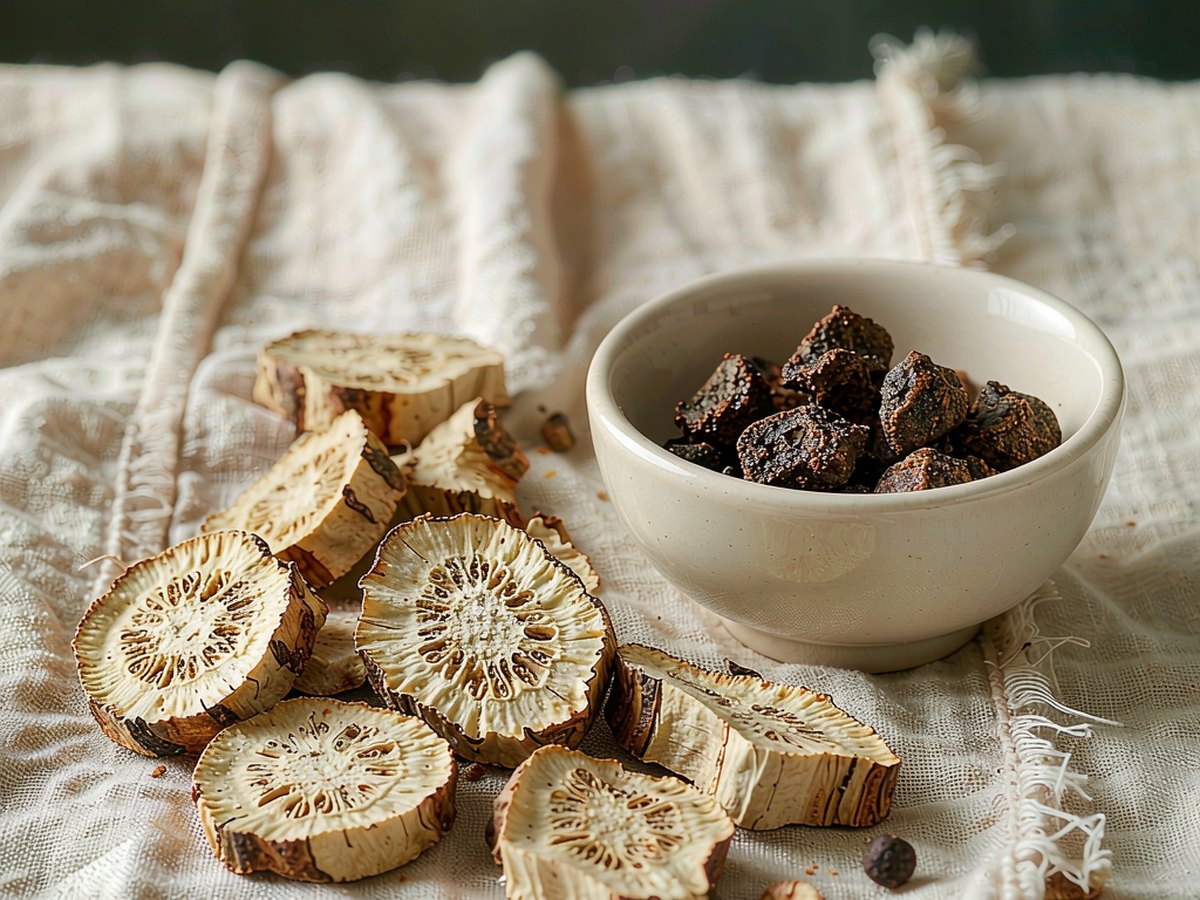
Chicory root is one of the very few plant materials that genuinely deserves two separate articles, because it is two separate things: a coffee substitute that fooled Napoleon’s contemporaries, and a Chinese medicine with an indication nothing else on the shelf covers. It is also, incidentally, the reason the pale blue flower of the same plant is one of the most recognisable weeds in Europe.
- Botanical
- Cichorium intybus — chicory, of the family Asteraceae. The same species produces the root, the blanched salad leaves, and the blue roadside flower.
- Part used
- The dried root, cut into pieces or cubed. The roasted, ground root is a different product entirely.
- Origin
- Cultivated for the root in Egypt, India, Java and Belgium, and gathered from the wild in Europe, where it was a famous coffee substitute in the Napoleonic era.
- Flavour
- Raw, faintly bitter and woody. Roasted, it becomes dark, nutty, slightly bitter and genuinely coffee-like, with a faint woody note behind.
- Use
- 3–6 g of raw root per 200 ml, simmered 20 minutes. Roasted root: 2 g per cup, brewed like coffee.
- Keeps
- 24 months for raw root, 12 months once roasted and ground, because the aroma is the thing that goes.
The coffee substitute, and how it works
Chicory root was a coffee substitute in Europe for a long time, and during the Napoleonic blockade of the early 1800s it became the standard replacement. It works because of what roasting does to it. The inulin in the root caramelises, producing the dark colour and the bittersweet roasted character, and the fructans break down into compounds with a genuinely coffee-like bitterness.
It does not have caffeine and it does not have coffee’s aroma, and anyone expecting a cup of coffee will be disappointed. What it does have is a dark, full, slightly bitter body with a woody, almost vanilla-ish note, and it is entirely pleasant on its own or cut with coffee.
The traditional European use beyond coffee is worth knowing: the roasted root was used to stir up a cold cup of coffee and to make a “chicory coffee” that was drunk long before the plant was used as a substitute at all.
The Chinese medicine, and the unusual indication
In the Chinese pharmacopoeia, chicory is Ju Zi or more usually Ju Gen, and its classical indication is genuinely unusual. It is used for what traditional medicine describes as a damp-heat pattern with an emphasis on the digestion — specifically, for a picture of feverishness and a sensation of heat in the chest and stomach, with a bitter taste in the mouth, and for a red, swollen, painful eye.
The eye indication is the one that stands out. Chicory appears in classical formulas for a red, painful, swollen eye, and in the old story of a physician who prescribed a decoction of chicory for a patient’s inflamed eye. It is a heat-clearing herb with a specific affinity for the upper body and the eyes.
It is also used for the digestion in a different way from the European use. Rather than as a bitter stimulant, it is used to clear damp-heat from the middle burner — which in practice means a heavy, sticky, sluggish digestion with heat signs. That is a different picture from the European use of chicory as a coffee substitute and a mild bitter tonic.
Identifying it, and the roasted version
Raw chicory root should be a hard, fibrous, brownish-grey material cut into pieces or cubes, with a faint woody smell. It is a common enough plant that it is rarely adulterated, which puts it ahead of most of the roots on this shelf in terms of buying with confidence.
Roasted chicory root, sold as granules or a brown powder, is a different product. It is already roasted, it is ready to brew, and it has a much darker, coffee-like smell. It is also the form most people actually want, and it is the form most often sold as a pure product — the common adulteration for chicory in the coffee trade is cheaper root, or roasted barley, or roasted acorns.
If you are buying roasted granules for coffee, look for a product that states it is 100% chicory root. If you are buying the raw root for a decoction, that is the dried, woody, cut root and nothing else.
What it is used for
- Coffee substitute Roasted chicory root makes a dark, bitter, caffeine-free drink with a coffee-like body. It is not coffee and does not pretend to be.
- Caffeine-free Contains no caffeine at all, which is the reason it is used as a decaf substitute and drunk in the evening.
- Bitter digestive In European herbalism, a mild bitter and tonic, used to stimulate digestion and as a gentle coffee replacement.
- Inulin and prebiotic The root’s fructans are prebiotics — the inulin content is high and survives into the cup, which has made chicory root a well-known prebiotic food.
- Clearing damp-heat in Chinese practice The classical indication: for a damp-heat picture with heat in the chest and stomach, a bitter taste in the mouth, and a red, painful eye.
- Eye complaints Classically used for a red, swollen, painful eye, in one of the more distinctive indications in the whole pharmacopoeia.
In the kitchen
- Roasted chicory coffee Two grams of roasted granules per cup, brewed like coffee. Add a splash of milk and it is very convincing.
- Half and half A spoon of roasted chicory granules in a cup of coffee. This is the traditional European way to use it, and it is genuinely good.
- Root decoction Five grams of raw root simmered in 300 ml for 20 minutes, strained. A bitter, woody cup.
- Chicory and apple A roasted root and apple-based blend, which is the common European drink and is much sweeter.
- In a cold brew Roasted granules in cold water overnight, for a smooth, mild, coffee-like drink with none of the bitterness.
Chicory root contains a good amount of inulin, and in people sensitive to fructans — which is a large group, and includes most people with IBS — it can cause gas, bloating and discomfort. That is a real effect and it is dose-dependent.
I
t
i
s
a
l
s
o
c
l
a
s
s
i
c
a
l
l
y
a
v
o
i
d
e
d
d
u
r
i
n
g
p
r
e
g
n
a
n
c
y
,
a
n
d
i
n
p
e
o
p
l
e
w
i
t
h
a
c
o
l
d
,
d
e
f
i
c
i
e
n
t
c
o
n
s
t
i
t
u
t
i
o
n
.
A
n
y
o
n
e
w
i
t
h
a
g
a
l
l
b
l
a
d
d
e
r
c
o
n
d
i
t
i
o
n
s
h
o
u
l
d
b
e
c
a
r
e
f
u
l
,
b
e
c
a
u
s
e
c
h
i
c
o
r
y
s
t
i
m
u
l
a
t
e
s
b
i
l
e
f
l
o
w
.
A
n
y
o
n
e
o
n
m
e
d
i
c
a
t
i
o
n
s
h
o
u
l
d
a
s
k
a
p
h
a
r
m
a
c
i
s
t
b
e
f
o
r
e
u
s
i
n
g
i
t
d
a
i
l
y
.
Disclaimer
Chicory is a good coffee substitute and a genuine traditional medicine, and both of those things are worth having. It is not a treatment for an eye condition, and it should not replace prescribed care for any eye complaint — a red, painful eye needs looking at.