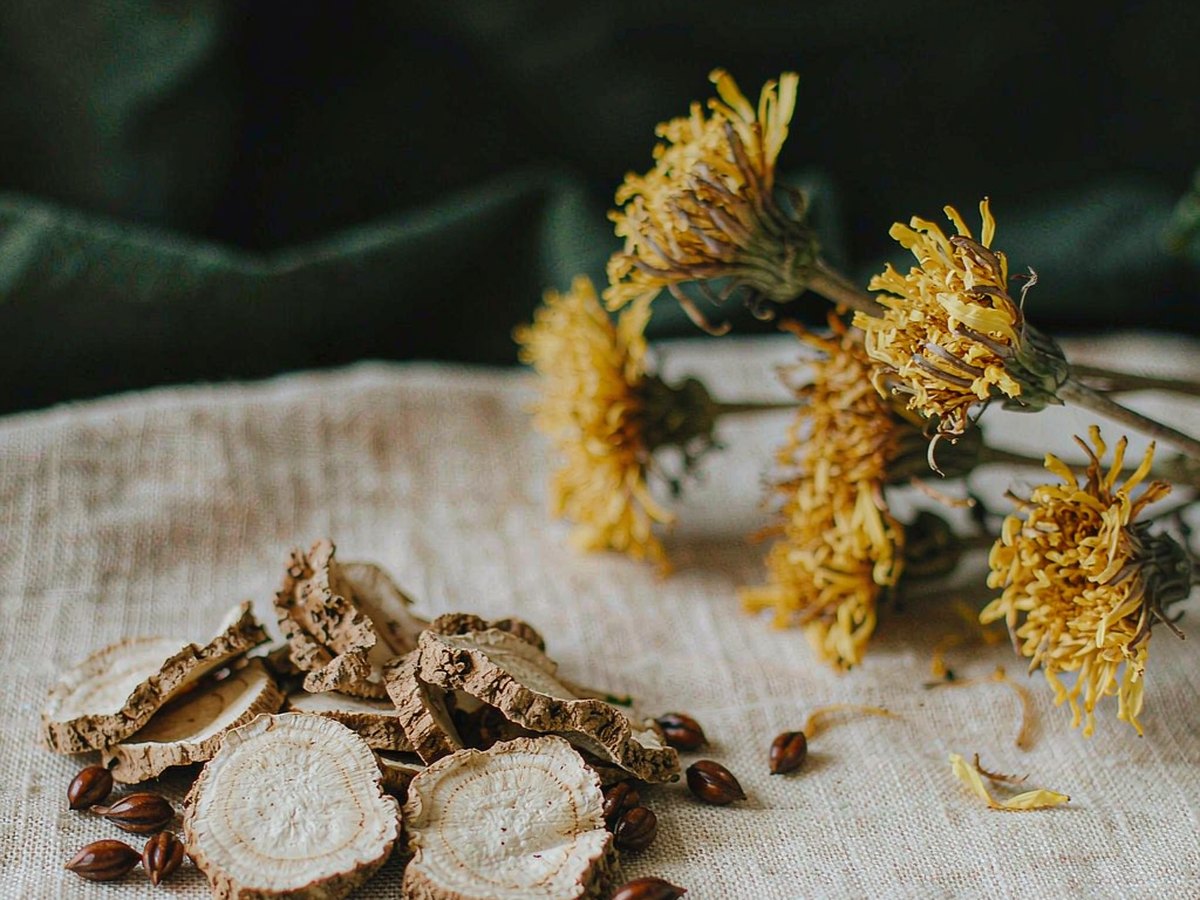
Dandelion is one of the very few plants that has been simultaneously a serious medicine in three separate traditions, a cooked green in Italy, and a lawn nuisance everywhere else. The Chinese pharmacy item Pu Gong Ying is the whole plant — root, leaf and flower — and it is one of the most frequently prescribed herbs in the country.
- Botanical
- Taraxacum mongolicum is the standard Chinese species; Taraxacum officinale, the European dandelion, is the one most often found in western herbalism. They are close enough to be used interchangeably, and deliberately cross-pollinated by hybridisers.
- Part used
- The whole plant with the root — the Chinese pharmacy item. Root-only slices and leaf-only dried herb are also sold, and each has a different traditional use.
- Origin
- Wild-gathered across northern China, and also cultivated in Anhui, Hebei and Henan. The European dandelion is a common weed and a cultivated crop in Italy and France.
- Flavour
- Bitter and slightly sweet, with a grassy green note. The root is more bitter than the leaf, and roasted root is a completely different animal.
- Use
- Root slices simmered 15–20 minutes. The leaf can be infused: 3 g per 200 ml, 85 °C, 3 minutes. Raw leaf is also excellent as a salad green.
- Keeps
- 12 months for dried root; the dried leaf keeps 6–12 months and loses its green colour quickly.
Root, leaf and flower are three herbs
In the Chinese pharmacopoeia the root and the whole plant are separate items, and the difference is worth knowing. The root, or root slices, is used for what traditional medicine calls heat and toxin — an inflammatory, febrile picture, with swollen glands, feverishness and red, tender swellings. It is the classic heat-clearing and detoxifying herb of the Chinese countryside, and it was the standard remedy for a breast inflammation before antibiotics existed.
The whole plant with the flower is used more for dampness and heat in the liver, and the flower specifically for the same heat-clearing use as the root but gentler and more cooling.
In western herbalism the leaf is the part used, and it is a well-known bitter tonic and diuretic. The French name pissenlit and the English folk name wet-a-bed are both about that.
The latex, and why people with allergies should skip it
When you break a dandelion stem, it exudes a white, milky sap. That sap is the plant’s defence chemistry, and it is the reason the whole plant is classed as a contact allergen in the daisy family. People with a ragweed or chrysanthemum sensitivity can react to it, and the reaction to a dandelion is usually a contact dermatitis rather than anything dramatic.
The latex is also bitter, which is a large part of why the plant is bitter at all, and why it is used as a bitter tonic — the bitterness is what stimulates digestion. In the kitchen the same bitterness is the point: the young leaves are bitter, and the French eat them with the bitterness as the flavour.
For a tea, the flowers are the most pleasant part of the plant to use, and the root is the most functional.
Roasted root as coffee
Dandelion root roasted and steeped is the best-known coffee substitute in Europe, and it is better than it has any right to be. The roasted root develops a dark, nutty, slightly bitter character that genuinely resembles coffee, and it contains no caffeine at all.
The traditional method is to dig the roots in autumn, wash them, slice them, and roast them until they are dark and brittle. A slow oven or a dry pan both work. The result keeps for a year and takes to milk in the way coffee does.
This is also the old Chinese preparation for the root in a milder form: the raw root is stir-fried until its bitter edge is cooked off, which turns it into a gentler, warmer, more digestive material.
What it is used for
- Heat and inflammation The principal classical Chinese use of the root: for febrile, inflammatory conditions with swelling and redness, and classically for breast inflammation. This is a supervised, traditional indication.
- Liver and gallbladder In western herbalism, dandelion root is a classic bitter and cholagogue, used for sluggish digestion and for the liver. It is one of the most-used herbs in that whole tradition.
- Diuretic The leaf in particular is a traditional diuretic, and is used for fluid retention. The folk name wet-a-bed is a record of that use.
- Skin conditions Traditionally used internally and externally for eczema and other inflammatory skin conditions. A long-standing folk use with no strong clinical evidence.
- Digestive bitter The bitter principles stimulate gastric secretion and appetite, and the leaf is a classic European bitter tonic.
- Nutrition The young leaves are rich in vitamins and minerals, and the roasted root is a caffeine-free coffee.
In the kitchen
- Roasted root coffee Roots washed, sliced, roasted at 180 °C for 20 minutes, then steeped like coffee. Two teaspoons per cup.
- Young leaf salad Fresh young leaves with olive oil, lemon and a little salt. Bitter, and better for it.
- Blanched greens Older leaves blanched for a minute to take the edge off, then dressed with sesame and soy.
- Dandelion root decoction 10 g of sliced root simmered in 500 ml for 20 minutes, taken warm. The classical Chinese preparation.
- Flower infusion Two or three dried flowers in a cup of hot water — mild, faintly sweet, and the easiest place to start.
Dandelion belongs to the daisy family, and anyone with a ragweed, chamomile or chrysanthemum allergy may react to it, particularly by contact with the sap. It is also mildly laxative, and it is not something to take in large amounts if you are prone to digestive upset.
B
e
c
a
u
s
e
i
t
i
s
a
d
i
u
r
e
t
i
c
a
n
d
i
n
t
e
r
a
c
t
s
w
i
t
h
t
h
e
l
i
v
e
r
,
d
a
n
d
e
l
i
o
n
i
n
t
e
r
a
c
t
s
w
i
t
h
a
w
i
d
e
r
a
n
g
e
o
f
m
e
d
i
c
a
t
i
o
n
,
i
n
c
l
u
d
i
n
g
l
i
t
h
i
u
m
,
b
l
o
o
d
t
h
i
n
n
e
r
s
,
d
i
u
r
e
t
i
c
s
,
d
i
a
b
e
t
e
s
d
r
u
g
s
a
n
d
s
o
m
e
a
n
t
i
b
i
o
t
i
c
s
.
A
n
y
o
n
e
o
n
r
e
g
u
l
a
r
m
e
d
i
c
a
t
i
o
n
s
h
o
u
l
d
a
s
k
a
p
h
a
r
m
a
c
i
s
t
b
e
f
o
r
e
m
a
k
i
n
g
i
t
a
d
a
i
l
y
d
r
i
n
k
.
Disclaimer
This article describes a plant with a long history in three separate herbal traditions. The traditional indications for dandelion root — for fever, inflammation and breast conditions — belong in a supervised clinical setting, not in a teapot. Do not use dandelion to treat any condition, and do not use it in place of prescribed care.