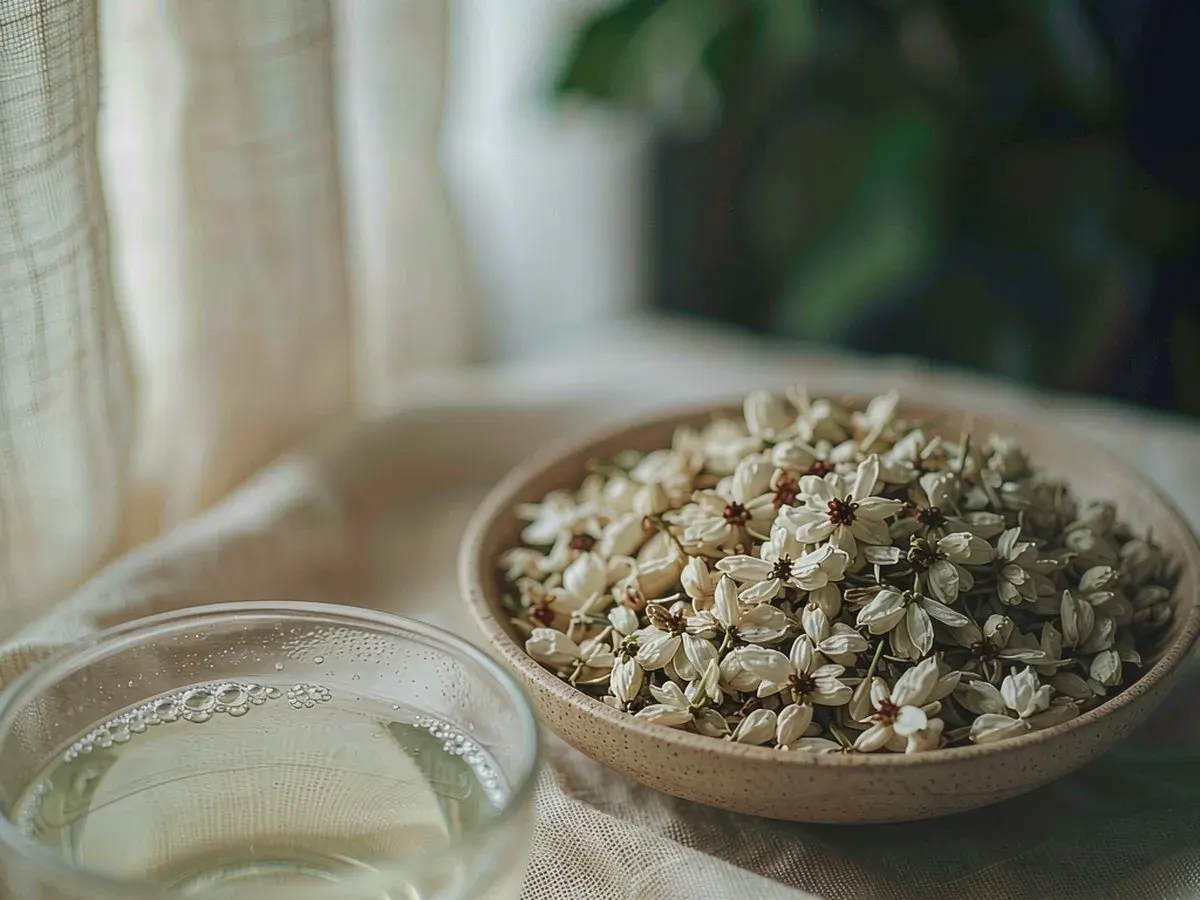
Jasmine flowers open in the evening, flood the air with scent for a few hours, and are gone by sunrise. Everything about how jasmine is used follows from that one fact: the flowers are picked in the small hours, layered with tea while still fragrant, and the tea absorbs their perfume overnight.
- Botanical
- Jasminum sambac — Arabian jasmine, evergreen, of the olive family (Oleaceae). Not the same plant as the jasmine of South Asian gardens, which is usually J. grandiflorum.
- Part used
- The opened flower, sometimes with the calyx, dried whole. In Fuzhou the flower is used fresh for scenting and dried for tea.
- Origin
- Fuzhou and Zhangzhou in Fujian, Guangxi, Yunnan and Guangdong for Chinese production; Iran, India, Egypt and Guatemala for the rest of the world.
- Flavour
- Intensely sweet and floral, honeyed, with a green-tea note underneath and a cooling finish.
- Use
- 3–5 flowers per cup. 80–85 °C water, never a rolling boil, 3 minutes. Jasmine is the one tea that gets worse when it is hotter.
- Keeps
- 12 months sealed and dark. The flowers fade in colour long before they lose scent.
Why temperature ruins jasmine
Jasmine’s scent comes from a volatile oil — chiefly linalool and its esters — that boils away. Water at 100 °C drives it off in the first thirty seconds, leaving a cup that tastes faintly of green tea and nothing like the flower.
The Chinese method of scenting tea solves this differently and much better. Fresh or dried jasmine flowers are layered with the tea leaves in a cool room, and the tea absorbs the scent over several hours. The leaves are then shaken free of the spent flowers, and the process is repeated with fresh flowers. That is how a jasmine pearl tea gets an aroma that is not merely present but integrated.
If you are brewing dried jasmine flowers directly, use water that has been off the boil for two full minutes, and pour it down the side of the cup so it cools further as it falls.
Choosing a jar
Good dried jasmine is pale cream to off-white with a few browned edges, and it should still smell strongly of jasmine when you open the jar. If it smells like dry grass or hay, the scent has gone and no amount of hot water will bring it back.
The wrong sign is green. Greenish-yellow flowers have been treated with sulphur, which fades the colour, and sulphur-fumed tea carries a faint chemical smell in the cup.
Jasmine is also sold as a blend rather than a pure flower — jasmine and osmanthus and green tea sold as jasmine pearl. That is a legitimate product but a different thing, and the price should tell you which you are buying.
Jasmine is a member of the olive family
Jasminum sambac is in the Oleaceae, the same family as olive, privet and ash. It is not related to the honeysuckle, and it is not the violet-scented plant of European memory either — that is the mock orange, Philadelphus, which has no relationship to this at all beyond the name.
For most people jasmine is entirely benign. A small number react to plants in the olive family, particularly to privet pollen, and if you have had that allergy before it is worth knowing which family your flower belongs to.
What it is used for
- Relaxation and evening ritual The traditional reason jasmine tea is drunk at night. The evidence for a sedative effect is limited, but the ritual of a warm, sweet-smelling cup in the evening is a real behavioural route to winding down.
- Mood and fragrance Aromatherapy research on jasmine oil suggests effects on mood and alertness; drinking it as tea is a gentler version of the same idea.
- Digestion A gentle, warming-after-meal cup is a common use, and jasmine appears in many Chinese blends for exactly this.
- Cooling in heat Classed as cooling in traditional Chinese practice and used in summer drinks, where the floral aroma makes plain cold water more interesting.
- Soothing the throat A warm, lightly sweet infusion is a traditional comfort for a dry or scratchy throat.
- Culinary fragrance The perfume of the flower is used to scent rice, syrups, sweets and tea.
In the kitchen
- Scented green tea Layer fresh flowers with loose green tea overnight, shake out the spent blossoms, repeat. The classic Fuzhou method and the only one that really works.
- Jasmine rice A handful of dried flowers folded into cooked rice, or infused into the cooking water for a scented pilaf.
- Jasmine syrup 20 flowers per 200 ml of hot sugar syrup, left four hours, strained. A base for sodas and cocktails.
- Jasmine and pear One or two flowers in a pot of pear tea or in a poaching liquid for poached pears.
- Blending Jasmine and osmanthus together are the classic Chinese pair; jasmine and goji is the standard sweet cup.
Jasmine flowers are small enough to be a choking hazard for a young child, and the dried ones are brittle and easily swallowed. Keep them out of reach and crush them if you are serving a child.
I
f
y
o
u
a
r
e
p
r
e
g
n
a
n
t
o
r
n
u
r
s
i
n
g
,
j
a
s
m
i
n
e
i
s
g
e
n
e
r
a
l
l
y
r
e
g
a
r
d
e
d
a
s
s
a
f
e
i
n
n
o
r
m
a
l
c
u
l
i
n
a
r
y
a
n
d
t
e
a
a
m
o
u
n
t
s
,
b
u
t
c
o
n
c
e
n
t
r
a
t
e
d
j
a
s
m
i
n
e
o
i
l
i
s
a
d
i
f
f
e
r
e
n
t
p
r
o
d
u
c
t
e
n
t
i
r
e
l
y
a
n
d
s
h
o
u
l
d
n
o
t
b
e
t
a
k
e
n
i
n
t
e
r
n
a
l
l
y
w
i
t
h
o
u
t
p
r
o
f
e
s
s
i
o
n
a
l
a
d
v
i
c
e
.
Disclaimer
The relaxation and mood effects of jasmine are supported by a small and mostly aromatherapy-based research literature, not by clinical trials of jasmine tea. Treat this article as an invitation to enjoy a fragrant cup, not as a description of a treatment. Do not use any herb in place of prescribed care for anxiety, insomnia or any other condition.