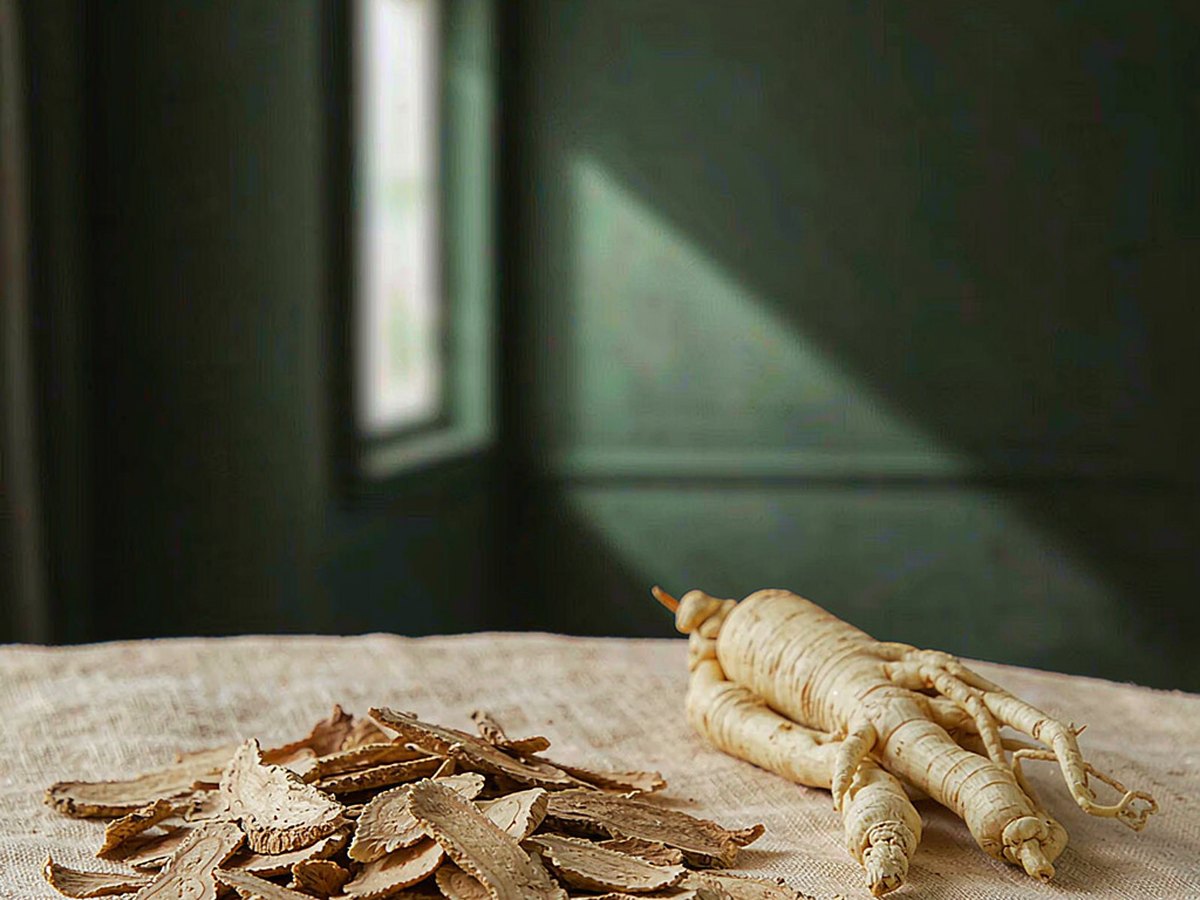
American ginseng is the most expensive herb in the Chinese pharmacopoeia by weight, and the most counter-intuitive. Chinese ginseng is warm and sedating; American ginseng is cool and stimulating. The tonic that makes you calm and ready for bed in one tradition makes you focused and wide awake in the other. That is not a marketing angle — it is a consistent difference in traditional action.
- Botanical
- Panax quinquefolius — American ginseng. The same genus as Chinese ginseng, Panax notoginseng, but a different species with a different thermal nature and a different traditional use.
- Part used
- The dried root, whole or sliced. Wild roots are worth many times more than cultivated ones, and the price reflects a genuine scarcity.
- Origin
- North America — Wisconsin, Minnesota, Pennsylvania, New York and the Appalachian states. It is also grown in Wisconsin and in China, in Jilin and Yunnan.
- Flavour
- Sweet and slightly bitter, with a warm, faintly woody note. The cut surface is pale cream and the aroma is mild.
- Use
- 2–4 g per 200 ml, simmered 30 minutes, taken in the morning. The traditional dose is small and the timing matters.
- Keeps
- 24 months sealed and dark. Slices lose their aroma faster than whole roots.
Warm root versus cool root
This is the single most important thing to understand about American ginseng, and the Chinese name reflects it. Chinese ginseng is Ren Shen and American ginseng is Xi Yang Shen — western ginseng. They are both classified as powerful qi tonics, and they are used in parallel in the classical literature, but they are described in opposite terms.
Chinese ginseng is warm and sweet, and it is used for a depleted, cold, tired person who needs warming and who will feel worse if they are given something cooling. American ginseng is cool and sweet, and it is used for a depleted but feverish person — someone with the same exhaustion, but with a hot flush, a rapid pulse, a thirst and a red tongue. Giving Chinese ginseng to that person makes it worse. Giving American ginseng to a cold, exhausted person also makes it worse, because it is cooling.
In practice this means the wrong ginseng can produce exactly the wrong result, and it is the single best argument for not buying a root by a generic word on a label.
The expensive problem
Wild American ginseng is worth more per gram than almost any other herb, and the reason is straightforward: it takes seven years to mature, it is slow to establish, and it has been harvested hard for two centuries. The populations in Quebec, Ontario and the north-eastern United States collapsed in the nineteenth century, and every remaining patch is protected.
Most of what is sold today is cultivated, and cultivated American ginseng is good — it is a real herb and it works the way the tradition says it works. It is simply less potent and much cheaper. The wild root has a much higher concentration of the ginsenosides, and it also has a distinctive twisted, human-like shape that comes from the root growing around obstructions in the forest floor.
The adulteration problem is real and well documented: white ginseng, dyed ginseng, and Chinese ginseng sold as American ginseng all appear in the trade. The clearest tell is the root’s structure — wild American ginseng is a single tapering root with fine roots attached, whereas Asian ginseng is usually a main root with two or three branches.
The pharmacology, and the stimulant surprise
Ginsenosides are the active compounds, and there are dozens of them, with genuinely contradictory effects. Some are stimulatory and some are sedative, which is why the traditional descriptions differ so much between the two species and why the herb’s reputation depends on which kind you take.
American ginseng in particular has a well-documented effect on working memory and on attention in the studies that have been done, and the most commonly reported side effect is insomnia. That is why the classical advice to take it in the morning exists, and why the advice is still sound.
There is also good evidence for American ginseng’s effect on blood glucose, which is a genuine double-edged finding: it is one of the better-studied herbs for post-meal blood sugar, and it is also one of the more likely to interfere with diabetes medication.
What it is used for
- Cooling qi tonic The principal classical use: for a depleted but feverish person, with fatigue, thirst, a rapid pulse and a red tongue.
- Fatigue and convalescence Traditionally used for recovery after illness, and for the fatigue that does not improve with rest.
- Blood sugar One of the better-studied herbs for post-meal blood glucose, with the corollary that it interacts with diabetes medication.
- Cognitive effects American ginseng specifically has been shown in trials to improve aspects of working memory and attention.
- Antifatigue activity Considerable preclinical evidence of an anti-fatigue effect, with some clinical support.
- Adaptogen framing A modern label for a classical idea: a herb that is taken over time to support the body’s response to stress. The framing is new; the practice is ancient.
In the kitchen
- The classical decoction 2–4 g of root simmered in 300 ml for 30 minutes, taken in the morning. The traditional dosing is small.
- Steamed red ginseng Steaming the fresh root turns its profile further towards warm and is the Korean preparation, used for the depleted and cold picture.
- In a chicken soup A slice or two in a long chicken broth for convalescence. A common Chinese and Korean home remedy.
- With jujube and ginger Jujube for the qi, ginger for the warmth, and the ginseng for the substance.
- Morning only Take it in the morning. If it keeps you awake, that is the herb working, not a dosing error.
American ginseng makes many people more alert, and insomnia is the most common complaint. Take it in the morning, not at night. It is also traditionally avoided in pregnancy and in people with a fever or an acute infection.
I
t
h
a
s
a
d
o
c
u
m
e
n
t
e
d
e
f
f
e
c
t
o
n
b
l
o
o
d
s
u
g
a
r
a
n
d
i
n
t
e
r
a
c
t
s
w
i
t
h
d
i
a
b
e
t
e
s
m
e
d
i
c
a
t
i
o
n
,
a
n
d
i
t
i
n
t
e
r
a
c
t
s
w
i
t
h
a
n
t
i
c
o
a
g
u
l
a
n
t
s
a
n
d
w
i
t
h
s
o
m
e
a
n
t
i
d
e
p
r
e
s
s
a
n
t
s
a
n
d
a
n
t
i
p
s
y
c
h
o
t
i
c
s
.
A
n
y
o
n
e
o
n
r
e
g
u
l
a
r
m
e
d
i
c
a
t
i
o
n
s
h
o
u
l
d
a
s
k
a
p
h
a
r
m
a
c
i
s
t
b
e
f
o
r
e
m
a
k
i
n
g
i
t
a
d
a
i
l
y
h
a
b
i
t
,
a
n
d
i
t
s
h
o
u
l
d
n
o
t
b
e
t
a
k
e
n
w
i
t
h
o
u
t
m
e
d
i
c
a
l
a
d
v
i
c
e
i
f
y
o
u
h
a
v
e
a
c
l
o
t
t
i
n
g
d
i
s
o
r
d
e
r
.
Disclaimer
This is a genuine medicine with a real pharmacology and a genuine tradition, and the choice between the two ginsengs matters more than most people realise. It is not a cure for fatigue, and it is not a substitute for investigating why you are tired. Anyone who wants to take it daily, or who takes medication, should discuss it with a clinician first.