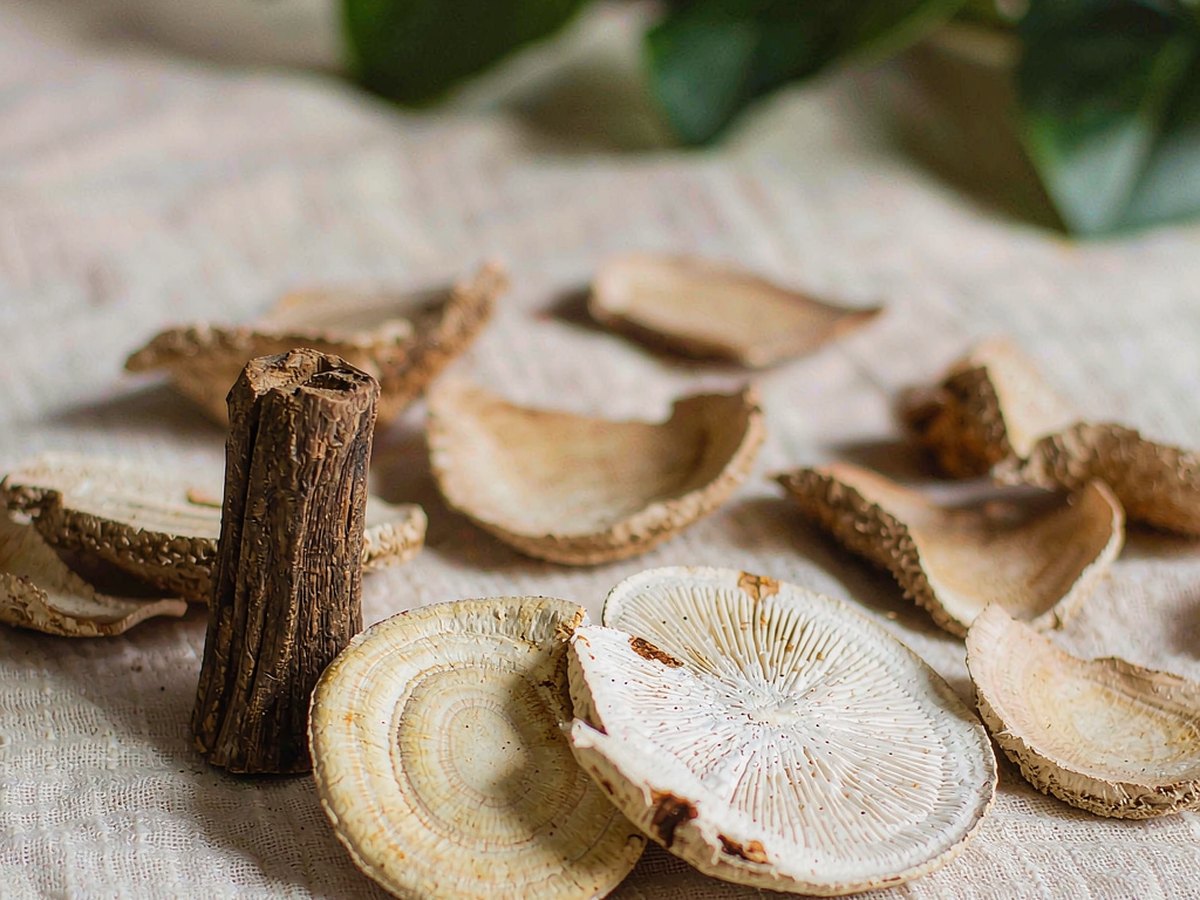
Zhu Ling explained: what it is, how to pick it, and what actually matters when you use it.
Polyporus umbellatus is a bracket fungus that grows at the base of beech trees, and it is one of the oldest entries in the Chinese pharmacopoeia. It was a standard diuretic for two thousand years, then largely abandoned, and it has recently become the subject of serious immunology research. It is also the only fungus in this whole collection.
- Botanical
- Polyporus umbellatus — a cluster-forming bracket fungus of the family Polyporaceae, growing on the ground at the base of decididuous trees, usually beech.
- Part used
- The whole fruiting body — the stalk and the caps — dried and sliced. The caps are the more substantial part.
- Origin
- It grows wild across the northern hemisphere — Europe, North America and East Asia — and the Chinese supply has historically come from the forests of Hebei, Shanxi, Shaanxi, Yunnan and Sichuan, much of it wild-gathered.
- Flavour
- Bland and slightly sweet, with a faint earthy, mushroomy smell and a tough, fibrous texture.
- Use
- 3–9 g per 200 ml, simmered 20–30 minutes. It is a decoction herb and always blended.
- Keeps
- 24 months sealed and dry. Dried fungi keep exceptionally well.
A fungus in a herbal pharmacy
Almost everything on this shelf is a plant. Zhu Ling is a fungus, and it is not a novelty item — it appears in the classical Chinese pharmacopoeia and in the modern one, and it was in continuous use for a very long time.
It is classified as neutral and slightly sweet, and its traditional action is to promote urination and to drain dampness — the same category that Japanese bush clover and the coix seed occupy. The classical picture is of fluid retention and of a heavy, sluggish, damp condition with oedema.
It is also classically used for what traditional medicine describes as difficult, painful urination, and it appears in the standard formulas for that alongside the aromatic herbs and the other diuretics.
What makes it interesting now is not the tradition but the research. Polyporus has been studied for its effects on the immune system, and the specific compound that has drawn attention is a beta-glucan called a specific active fraction. There is a large body of preclinical work on its effects on immune modulation and tumour-related mechanisms.
A short history of abandonment and return
Here is the interesting part of the story. Polyporus was a standard diuretic in Chinese medicine for two thousand years, and it was also, for most of that time, a common and cheap forest mushroom that ordinary people gathered. Then it became less common in some regions, the price rose, and it fell out of ordinary use and became something bought for specific complaints.
That price history shaped the trade in a way that matters for the buyer. Because the wild resource is limited and the cultivated product is a separate thing with a different profile, a lot of what is sold as Zhu Ling is cultivated on logs in China, and the cultivated version is a legitimate herb but not identical to the wild forest fungus that the classical texts describe.
Cultivated polyporus is grown on inoculated hardwood logs — the same way shiitake and other cultivated mushrooms are — and it is inexpensive, consistent and completely safe as a food. It is a good deal for the price, and it is the material you will usually find.
Why it is always in a formula
Zhu Ling has essentially no flavour and no aroma, which is typical of a dried fungus and means it needs support in a decoction. It is nearly always combined with other diuretic and dampness-clearing herbs — with the coix seed, with the plantain leaf, with the bush clover.
Those combinations are the ones that appear in the classical cooling and dampness-clearing blends sold in Chinese tea houses, and they are worth knowing for what they are: an intensely bland, mildly sweet, water-like decoction that is drunk for its pattern rather than for its taste.
One practical note on preparation. Dried polyporus rehydrates slowly and it stays tough even after a twenty-minute simmer. It is better simmered for thirty minutes, and it is better still if it is soaked in cold water overnight first, which softens the fibrous structure considerably.
What it is used for
- Promoting urination The classical and primary use: for fluid retention, oedema, and what traditional medicine calls difficult, painful urination.
- Draining dampness Used for the heavy, sluggish, damp condition with oedema, in the standard Chinese medicine category.
- Immune modulation Polyporus’s beta-glucans have been studied extensively for immune effects. This is a large preclinical literature and it is not an established clinical treatment.
- Anti-tumour research The same beta-glucan fraction has been the subject of a great deal of cancer-related laboratory work, including in combination with standard chemotherapy. It is a research subject, not a treatment.
- Traditional food use The fungus has been eaten as a vegetable across the northern hemisphere, and the cultivated version is a perfectly ordinary mushroom.
- Adaptogen framing Occasionally sold under that modern label, which is a Western framing rather than a classical one.
In the kitchen
- Soaked and simmered Soak overnight in cold water, then simmer 30 minutes. Softer and less tough than simmering straight from dry.
- The dampness-clearing blend With coix seed and plantain leaf, simmered together for the classical combination.
- In a soup With pork and dried dates, which is how it is used in Cantonese herbal soups.
- Cooked as a mushroom The cultivated form is an ordinary mushroom and can be stir-fried or added to a soup as a vegetable.
- Dried in stir-fry Sliced and fried briefly with garlic for a savoury, slightly chewy mushroom dish.
Zhu Ling is a diuretic, so it will increase urine output. Anyone on blood-pressure medication or on a diuretic already should be careful with it, and it is traditionally avoided in people who are easily fatigued by it.
I
t
i
s
t
r
a
d
i
t
i
o
n
a
l
l
y
a
v
o
i
d
e
d
i
n
p
r
e
g
n
a
n
c
y
a
n
d
i
n
p
e
o
p
l
e
w
i
t
h
a
s
p
l
e
e
n
d
e
f
i
c
i
e
n
c
y
.
B
e
c
a
u
s
e
a
l
a
r
g
e
p
a
r
t
o
f
t
h
e
m
o
d
e
r
n
i
n
t
e
r
e
s
t
i
s
i
n
i
t
s
i
m
m
u
n
e
e
f
f
e
c
t
s
,
p
e
o
p
l
e
o
n
i
m
m
u
n
o
s
u
p
p
r
e
s
s
a
n
t
s
o
r
o
n
c
a
n
c
e
r
t
r
e
a
t
m
e
n
t
s
h
o
u
l
d
d
i
s
c
u
s
s
i
t
w
i
t
h
t
h
e
i
r
o
n
c
o
l
o
g
i
s
t
o
r
p
h
a
r
m
a
c
i
s
t
r
a
t
h
e
r
t
h
a
n
a
d
d
i
n
g
i
t
t
h
e
m
s
e
l
v
e
s
.
Disclaimer
Polyporus has a large and genuinely interesting research literature on immune modulation, and it is also a fungus that people eat. Neither fact makes it a treatment for cancer or for any other condition, and anyone with cancer or an autoimmune condition should discuss it with their clinician rather than adding it to their treatment.