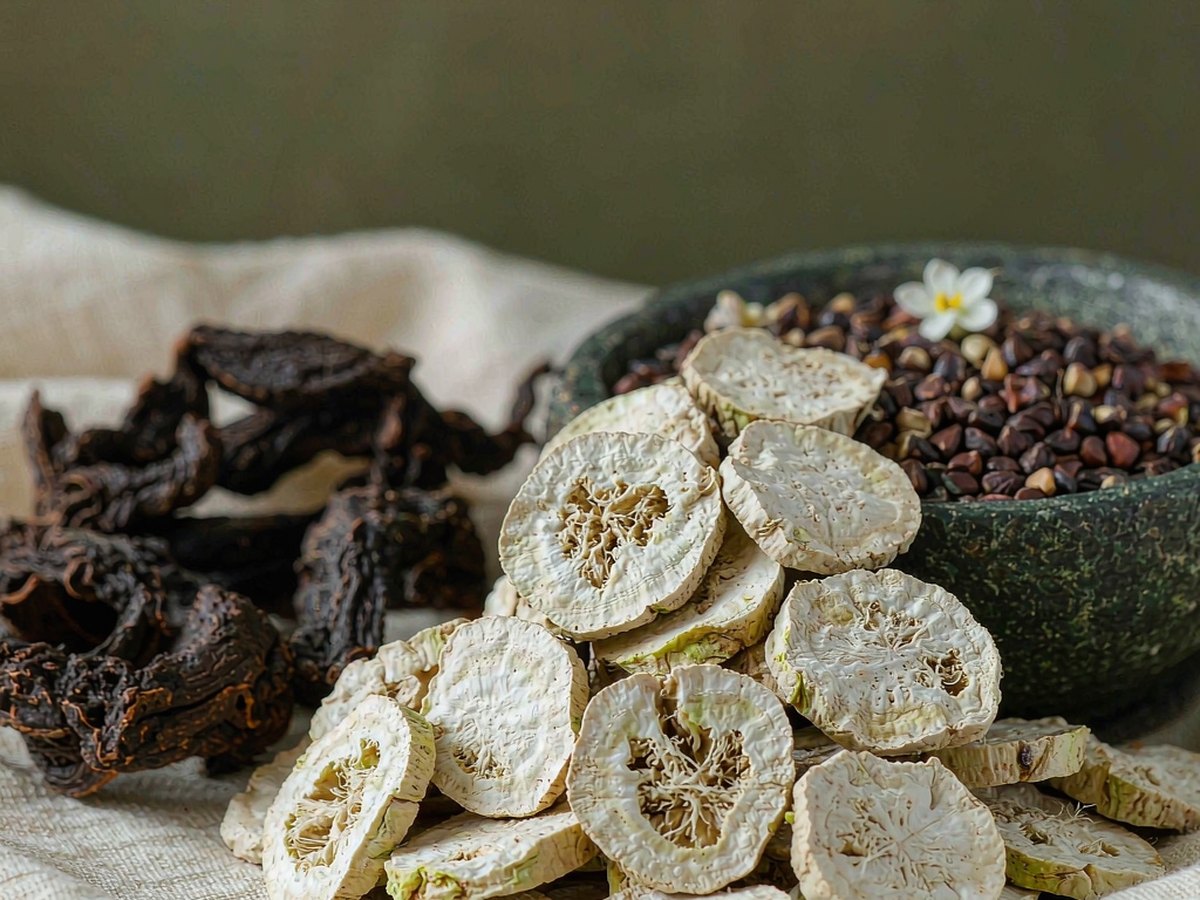
Wild buckwheat root is a single, hard, dark tuber, and in Chinese medicine it is used for a very specific and rather unusual picture — the kind of abdominal pain that comes with something twisted or obstructed. It is also one of the hardest materials on the shelf to buy with confidence, because the trade’s naming for it is inconsistent and the look-alikes are easy to buy by mistake.
- Botanical
- Fagopyrum dibes — the wild buckwheat, a member of the buckwheat family (Polygonaceae) and a relative of the crop buckwheat you eat. The root tuber is the medicinal part.
- Part used
- The dried root tuber, sliced. It is a single hard tuber the size of a small potato, dark outside and pale grey inside.
- Origin
- Yunnan, Guizhou, Sichuan, Guangxi and Hunan — the southwest, where the plant grows wild in mountain grassland.
- Flavour
- Bland to mildly bitter, with a faint earthy quality and no aroma. Not a memorable taste.
- Use
- 9–15 g per 200 ml, simmered 20–30 minutes. A decoction herb, and one that needs blending.
- Keeps
- 18–24 months sealed and dry.
The unusual classical indication
Wild buckwheat root is used in Chinese medicine for a specific and quite particular picture. The classical sources describe it as being for pain that is severe and localised, particularly in the lower abdomen, and they describe it as something that treats pain that comes with what is called a twisted or obstructed abdomen — the sense of something being stuck, twisted or knotted in the gut.
This is a genuinely odd indication, and it belongs to the part of the classical system that most modern readers find hardest to interpret. Rather than trying to translate it into a modern diagnosis, it is more useful to note the overall character: this is a pain-relieving, obstruction-focused herb, and it appears in classical formulas alongside the blood-moving herbs and the aromatic digestives.
It is also used for what traditional medicine calls abdominal masses and for a general picture of stubborn constipation with pain — again, a pattern description rather than a condition.
Identifying it, which is genuinely difficult
The tuber is a single, hard, roughly spherical or irregular mass, dark brown to black on the outside, with a pale grey to white interior. It does not look like a root, which is why it is sometimes sold under the name of a completely different plant — the Chinese trade has historically applied the name of the cultivated buckwheat’s root, which is not the same thing.
For that reason the botanical name matters more here than for most materials. Fagopyrum dibes is the wild buckwheat whose root is the traditional medicine. Other Fagopyrum species have roots that are used locally and are not the standard entry, and there are a number of unrelated roots sold under similar names.
In the cup the material is nearly inert on its own — bland, thin and slightly bitter. It is a formula herb, and you will always meet it blended.
A practical recommendation: if a supplier lists only a Chinese name with no botanical name, treat that as a reason to ask which species it is before you buy a large quantity.
The plant itself
Wild buckwheat is a handsome plant with small white flowers in summer and a red-brown seed that looks like a grain but is not a cereal. The seeds of the cultivated varieties are eaten; the wild species’ seed is small and not worth eating, and it is the root that the pharmacy uses.
It is a plant of mountain meadows and grassland, and it is gathered rather than farmed for the most part, which makes the supply irregular and the identification problem a recurring one.
It is also worth noting that the plant contains fagopyrin, and the seeds of some wild buckwheat species cause photosensitivity — a condition called fagopyrism in which sunlight causes a rash on the skin and, in severe cases, eye damage. This affects the seed and the plant material rather than the root tuber, and it is not a concern for a dried root, but it is a good reason to buy correctly identified material and not to brew with home-gathered wild buckwheat.
What it is used for
- Severe localised abdominal pain The principal classical use: for intense, localised pain in the lower abdomen, classically described as a twisted or obstructed gut.
- Obstruction and stagnation Used in formulas for what traditional medicine describes as abdominal masses and for stubborn constipation with pain.
- Pain-relieving character A classical pain-relieving herb that appears alongside the blood-moving and aromatic digestives.
- Identifying risk The trade’s naming for this tuber is inconsistent, and several unrelated roots are sold under similar names. Botanical naming is the only protection.
- Wild-gathered and irregular Most of the supply is gathered from mountain grassland rather than farmed, so quality and identity vary.
- Flavourless by nature Almost no taste and no aroma, so it is a formula herb and never a solo drink.
In the kitchen
- The classical abdominal formula Simmered with the blood-moving herbs and the aromatic digestives in the standard combination.
- With ginger and citrus A kitchen blend for the digestive picture — three slices, a thumb of ginger, a small piece of dried tangerine peel.
- With the aromatic digestives Sha Ren and aged chen pi, to give the otherwise flat root something to work with.
- Cold infusion A slow cold steep over several hours gives a gentler, less bitter cup than a hot decoction.
- Always blended This is not a herb to drink on its own; every classical formula pairs it.
Wild buckwheat root is a formula herb with a specific classical indication that needs a diagnosis. Buying the wrong species is the more practical risk here, and a supplier that does not state the botanical name is not one to order a large quantity from.
I
t
i
s
t
r
a
d
i
t
i
o
n
a
l
l
y
u
s
e
d
i
n
f
o
r
m
u
l
a
s
f
o
r
o
b
s
t
r
u
c
t
i
o
n
p
a
t
t
e
r
n
s
a
n
d
i
s
n
o
t
a
h
e
r
b
f
o
r
c
a
s
u
a
l
u
s
e
.
A
n
y
o
n
e
w
i
t
h
p
e
r
s
i
s
t
e
n
t
a
b
d
o
m
i
n
a
l
p
a
i
n
n
e
e
d
s
m
e
d
i
c
a
l
a
s
s
e
s
s
m
e
n
t
r
a
t
h
e
r
t
h
a
n
a
d
e
c
o
c
t
i
o
n
,
a
n
d
a
n
y
o
n
e
p
r
e
g
n
a
n
t
s
h
o
u
l
d
n
o
t
u
s
e
i
t
w
i
t
h
o
u
t
p
r
o
f
e
s
s
i
o
n
a
l
a
d
v
i
c
e
.
Disclaimer
This article describes a traditional herb and, more usefully, the difficulty of buying it. The classical indication for wild buckwheat root is a pattern that requires a qualified diagnosis, and abdominal pain of any severity should be assessed rather than treated with a root. No herb should be used in place of medical care.