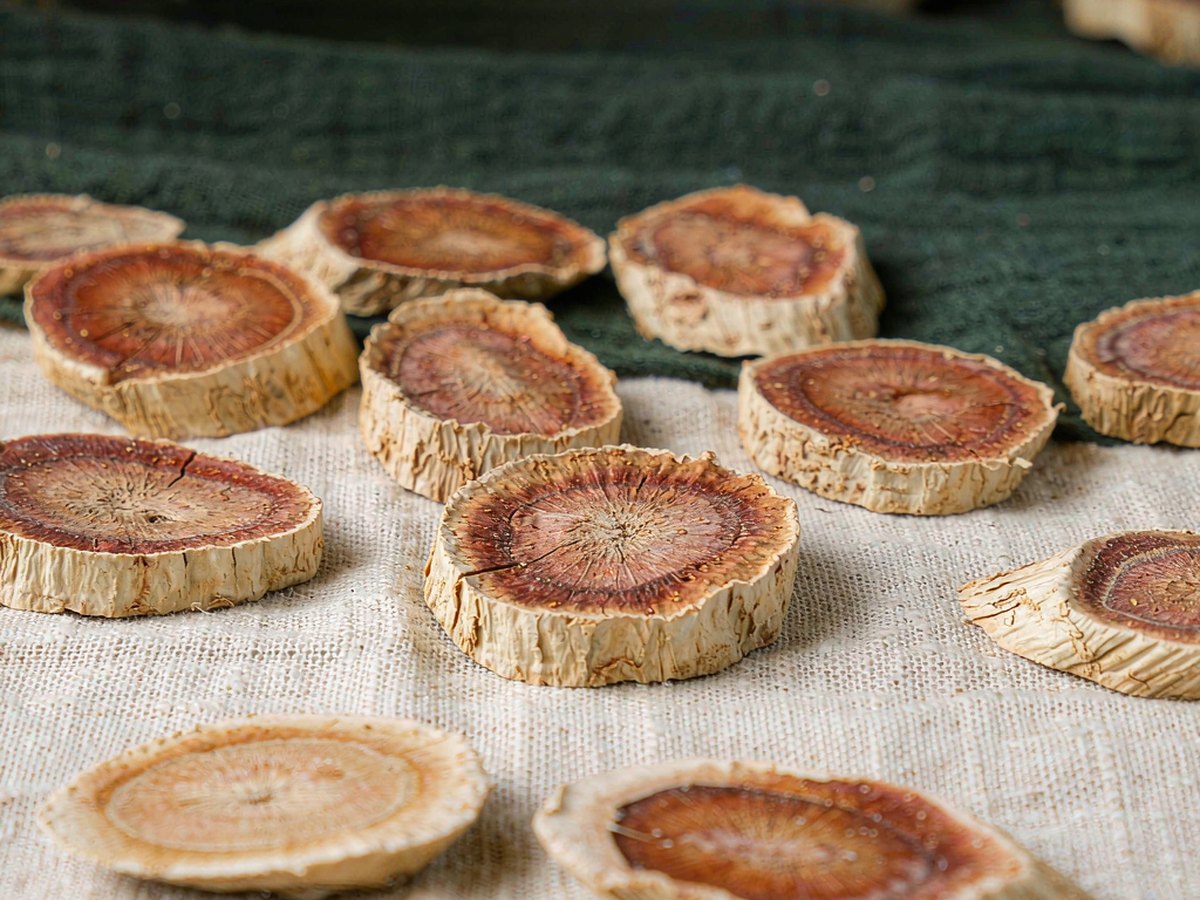
Teasel is a large, spiny-headed plant whose root is a genuine Chinese medicine and whose western reputation is entirely about hair. The root, Xu Duan, is one of the older entries in the Chinese pharmacopoeia, used classically for injuries and for blood stasis — and modern research on it has turned up a genuine and interesting anticoagulant effect.
- Botanical
- Dipsacus asper (the Asian teasel, the Chinese pharmacy species) and Dipsacus fullonum (the fuller’s teasel, the western species, which is the one used in hair preparations).
- Part used
- The dried root, cut into slices. The dried seed head, with its hooked bristles, is a separate and completely different product.
- Origin
- Sichuan, Hubei, Hunan and Yunnan for the Chinese crop. D. fullonum is grown commercially in Europe and the United States for the fulling industry and for herbal preparations.
- Flavour
- Bitter and slightly sweet, with a faint smoky, woody edge. Mild enough to drink but not pleasant enough to drink alone.
- Use
- 6–10 g per 200 ml, simmered 20–30 minutes. Usually blended with aromatic herbs.
- Keeps
- 18–24 months sealed and dry.
A bone-and-sinew herb
Xu Duan in the Chinese pharmacopoeia is classified as bitter, warm, and both an herb that enters the liver and kidney channels and one that moves blood. Its classical indications are all about injury: aching joints, a stiff and painful lower back, a weak waist, and a general picture of something that has been damaged and has not properly healed.
It is one of the herbs in the classical category known as “bone-setter’s herbs” — a group that includes the famous续断 Du Zhong (Eucommia bark), the dog’s-tongue root, and the achyranthes root. They are used together in formulas for chronic musculoskeletal problems and for recovery after injury.
Its warming and blood-moving nature is why it appears in formulas for blood stasis, including menstrual patterns. That is the more interesting thread for a modern reader, because teasel root has been found to have genuine anticoagulant activity.
The anticoagulant finding
Several studies, most of them in vitro and in animal models, have found that Dipsacus root extracts interfere with platelet aggregation and with clotting factor activity. It is a real finding and it is consistent across the literature.
This is exactly the kind of result that needs careful handling. Laboratory anticoagulant activity is not the same as a usable medicine: the effective dose, the absorption, the toxicity profile and the clinical evidence in people are all unestablished. And it is also exactly the kind of result that makes an herb dangerous for anyone already on a blood thinner.
Western herbalists have reached for teasel for bruises, sprains and swelling for a long time, and there is a reasonable traditional rationale for it in that use. But the same reasoning that makes it interesting for bruising makes it a poor choice for anyone on warfarin, aspirin, clopidogrel or any other anticoagulant, and for anyone about to have surgery.
The seed head is a different product
The teasel seed head — the brown, egg-shaped, bristly sphere — is a well-known craft and grooming material, used since the middle ages for raising the nap of woollen cloth, and now for scalp massage and hair care.
The mechanism is purely mechanical. The hooked bristles catch loose hair and scalp debris when drawn through the hair, which is why the practice works and why it feels good. There is no herb in it and no pharmacological effect; it is a comb made of plant.
So when a shop sells teasel root for tea and teasel heads for hair care, those are two entirely different materials from the same plant, and they should not be confused. The root is the medicine and the head is the tool.
What it is used for
- Injury and recovery The principal classical use: for aching joints, a stiff lower back and a weak waist, in the bone-setter’s herb group. This is a supervised, formula-based use.
- Blood stasis Traditionally used in formulas that move blood, including menstrual patterns, and it is classed as warming.
- Kidney and liver Entered into the liver and kidney channels in the classical system, and used for what is described as a weakness of the waist and knees.
- Anticoagulant activity Dipsacus root extracts have been shown in laboratory and animal studies to interfere with platelet aggregation and clotting factors. This is a real finding with real implications, and it is not a clinical treatment.
- Bruises and sprains A long-standing western herbal use for swelling and bruising, with a plausible mechanism behind it and no good clinical trials.
- Scalp and hair tool The dried seed head used as a physical scalp-massage tool. No herbal effect — it is a comb.
In the kitchen
- Bone-setter style decoction Teasel root simmered with Eucommia bark and achyranthes root — the classical combination for a stiff, aching lower back.
- With ginger and cinnamon A warming kitchen blend for a cold, stiff feeling in the back.
- Bruise tea Teasel with a little ginger and a pinch of rock sugar, taken warm. A modern western-folk preparation.
- Paired with Eucommia The other half of the classic pair, and a tea worth making for anyone who sits at a desk all day.
- The seed head as a tool Kept out of the pot entirely — drawn through the hair, never brewed.
This is the important one: teasel root interacts with blood-thinning medication and with antiplatelet drugs, and it should not be used before surgery. Anyone on warfarin, aspirin, clopidogrel, or any anticoagulant should not use it without asking a clinician.
I
t
i
s
a
l
s
o
t
r
a
d
i
t
i
o
n
a
l
l
y
a
v
o
i
d
e
d
i
n
p
r
e
g
n
a
n
c
y
,
a
n
d
b
e
c
a
u
s
e
i
t
i
s
a
w
a
r
m
i
n
g
,
m
o
v
i
n
g
h
e
r
b
i
t
c
a
n
a
g
g
r
a
v
a
t
e
h
e
a
t
–
t
y
p
e
c
o
n
d
i
t
i
o
n
s
.
A
n
y
o
n
e
w
i
t
h
a
b
l
e
e
d
i
n
g
d
i
s
o
r
d
e
r
,
o
r
a
b
o
u
t
t
o
h
a
v
e
a
n
y
p
r
o
c
e
d
u
r
e
,
s
h
o
u
l
d
s
p
e
a
k
t
o
a
d
o
c
t
o
r
f
i
r
s
t
.
Disclaimer
Teasel root’s anticoagulant activity is a genuine laboratory finding and it makes this herb genuinely worth understanding rather than avoiding or ignoring. It is not a treatment for clotting conditions and it is not a substitute for prescribed anticoagulants. Do not combine it with any blood-thinning medication without medical advice.