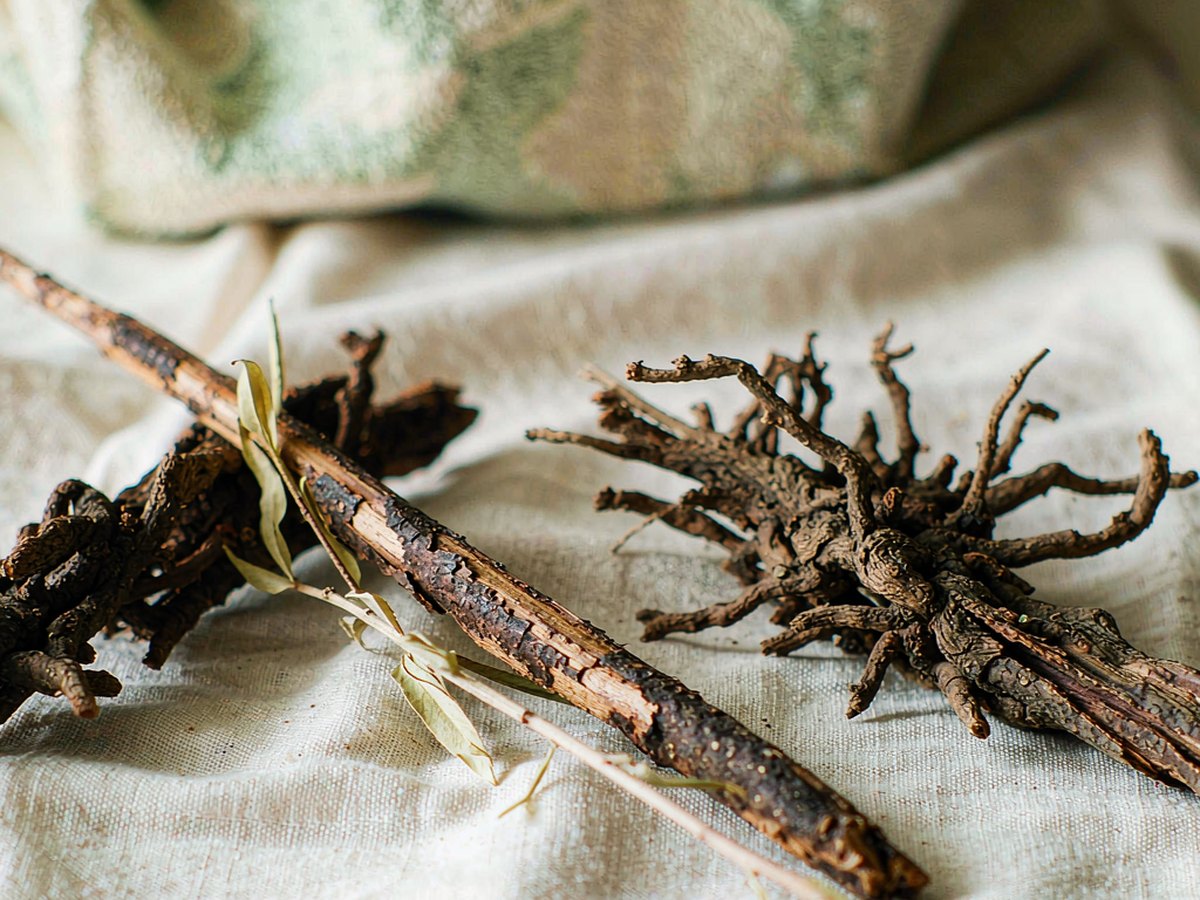
Shan zhao ren is a woody root from a spicy shrub, and it has a cinnamon-like aroma that makes it one of the few genuinely fragrant roots in the Chinese pharmacopoeia. Its classical use is for one very particular picture — cold that has settled into the lower body — and it is a good example of a herb whose flavour tells you what it does.
- Botanical
- Lindera aggregata — a shrub of the family Lauraceae, the same family as cinnamon, and one of the aromatic Chinese herbs. Also called the spice bush.
- Part used
- The dried root, or the dried twig, cut into lengths. The root is the standard pharmacy item.
- Origin
- Guangdong, Guangxi, Jiangxi, Zhejiang, Hubei and Sichuan. Grows wild in the hills of southern China.
- Flavour
- Pungent and warm, with a distinct cinnamon-like note and a slight sweetness, and a lingering aromatic heat in the throat.
- Use
- 3–9 g per 200 ml, simmered 20–30 minutes. Its aroma means it can be drunk more or less on its own.
- Keeps
- 18–24 months sealed and dry. The volatile oils fade in an open jar within months.
A root that tastes like a spice
Lindera belongs to the Lauraceae, the same family as Cinnamomum, and it behaves like one in a surprising number of ways. The root has a warm, sweet, pungent aroma very much in the cinnamon family, and Chinese practice classifies it as warm and pungent, with a dispersing action.
Its aromatic quality is not just a sensory curiosity. In the classical system, an herb that is pungent and aromatic is understood to move and to disperse, and that is exactly the action lindera is used for. Its traditional job is to warm the lower body and to disperse the cold that has settled there.
That is a genuinely specific indication, and it is not a modern one. The classical picture is of cold pain in the lower abdomen, in the waist, or in the joints, with a feeling of heaviness and cold, and it is often described as the kind of cold that is relieved by warmth. Lindera is the herb for that picture.
Root, twig and bark
The pharmacopoeia lists the root and the twig separately, and they are not interchangeable. The root, Shan Zhao Ren, is the standard item and the stronger of the two, used for cold pain in the abdomen and the waist.
The twig, Shan Zhao Ren Zhi, is lighter and less hot, and it is used where the cold is in the channels and the joints rather than deep in the abdomen. It also appears in the treatment of what traditional medicine calls wind-damp pain, alongside the other wind-dispelling herbs.
The bark is occasionally used too, and it is the most pungent of the three. For a kitchen, the root is the right starting point.
The shrub, and how to buy it
Lindera aggregata is an evergreen shrub that grows on hillsides through southern China, and it has a long history as a wild-collected spice as well as a medicine. The berries and the leaves have been used as a seasoning, and the wood has been used as incense wood.
Good dried lindera is a pale yellow-brown to grey-brown woody material, cut into short lengths, with a distinct warm spice smell that is obvious from a foot away. If a bag of root smells of nothing, it has been stored badly or is not lindera.
Slices that are grey and fibre-heavy rather than yellow and aromatic are usually the wrong part of the plant, and they are what most of the bulk trade is. A supplier that states the part used is worth the small extra cost.
What it is used for
- Warming the lower body The principal classical use: for cold pain in the lower abdomen and the waist, with a feeling of cold and heaviness.
- Dispersing cold Classed as warm and pungent, and used to move and disperse cold in the channels — the same logic that governs every pungent aromatic.
- Wind-damp joint pain The twig is used for painful, obstructed joints in the wind-damp category, with the other wind-damp herbs.
- Abdominal pain with cold Used where the abdominal pain comes with a cold character and is relieved by warmth.
- Aromatic action A genuine spice-family aroma, and the classical marker of a dispersing, moving herb.
- Menstrual pain with cold Appears in formulas for menstrual pain of the cold, dull, relieved-by-warmth kind.
In the kitchen
- Straight infusion Three lengths in 200 ml, simmered twenty minutes. It is one of the few roots you would drink without a blend.
- With ginger and cinnamon The warming version for a cold, heavy kind of ache.
- In a warming broth A couple of lengths in a mutton or beef broth, which is the classic winter soup use.
- With dried citrus peel The classical digestive pairing — lindera’s warmth with the citrus aromatic.
- As a spice The dried leaf and the berries are used as a seasoning in southern Chinese cooking, which is the same plant and a different use.
Lindera is warm and pungent, and traditional sources advise against it in people with a heat picture — feverishness, a red tongue, thirst or a sore throat — because it would make those worse. It is also avoided in pregnancy.
B
e
c
a
u
s
e
i
t
i
s
a
w
a
r
m
i
n
g
a
r
o
m
a
t
i
c
i
n
t
h
e
s
p
i
c
e
f
a
m
i
l
y
,
i
t
c
a
n
i
n
t
e
r
a
c
t
w
i
t
h
b
l
o
o
d
–
t
h
i
n
n
i
n
g
m
e
d
i
c
a
t
i
o
n
a
n
d
w
i
t
h
a
n
y
d
r
u
g
m
e
t
a
b
o
l
i
s
e
d
b
y
t
h
e
l
i
v
e
r
.
A
n
y
o
n
e
o
n
r
e
g
u
l
a
r
m
e
d
i
c
a
t
i
o
n
s
h
o
u
l
d
a
s
k
a
p
h
a
r
m
a
c
i
s
t
b
e
f
o
r
e
u
s
i
n
g
i
t
r
e
g
u
l
a
r
l
y
.
Disclaimer
The classical indication for lindera is a specific cold pattern — cold pain in the lower body relieved by warmth — and it requires a diagnosis to apply correctly. Do not use it to treat pain or any other condition in place of medical assessment, and do not use it in pregnancy.