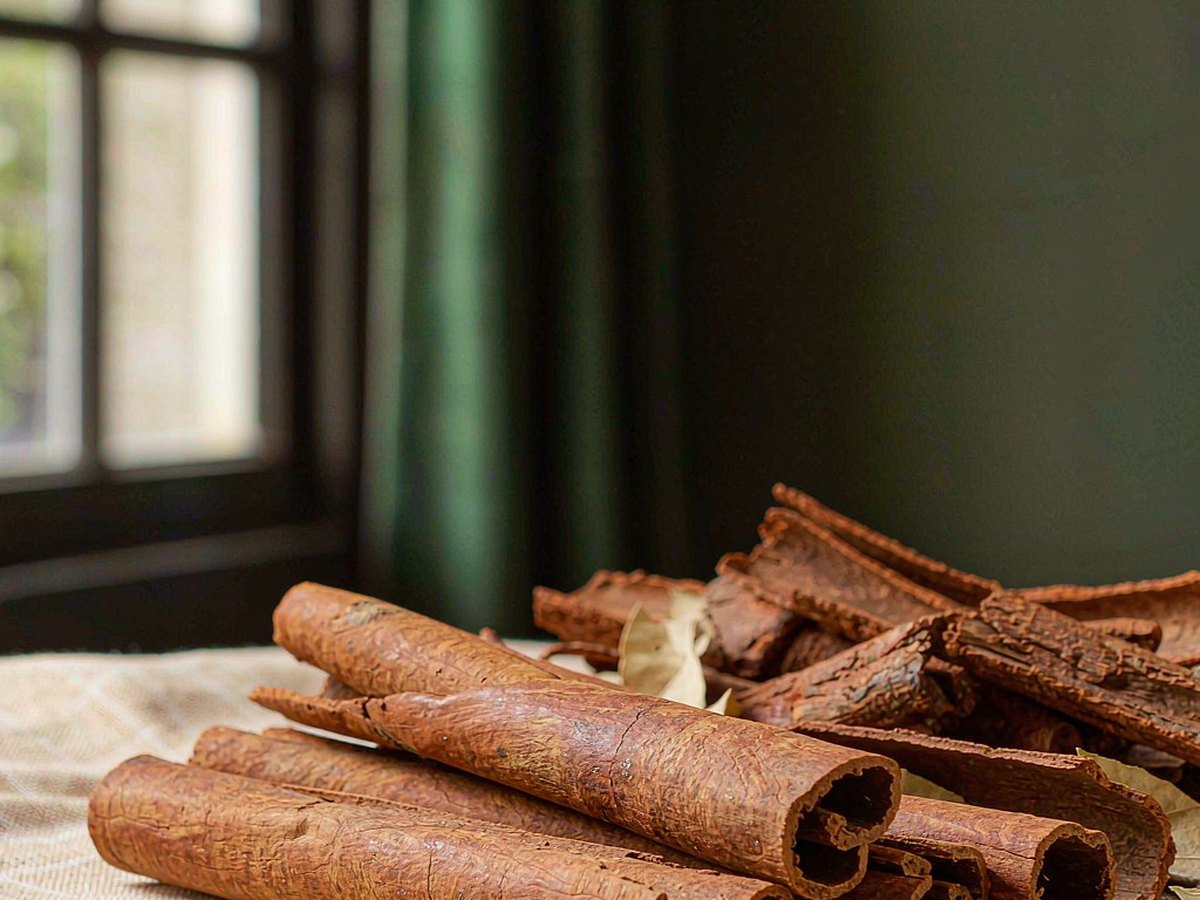
Almost everything sold as cinnamon in the world is Chinese cassia, Cinnamomum cassia, not the true Ceylon cinnamon most people picture. Cassia is cheaper, stronger and harder; true cinnamon is paler, softer and tastes more like citrus and less like a blunt woody heat. Both are worth keeping, and they are not interchangeable.
- Botanical
- Cinnamomum cassia (Chinese cinnamon, Rou Gui) and Cinnamomum verum (Ceylon cinnamon, Zhen Rou Gui). Two different species from the same family.
- Part used
- Inner bark, harvested from young branches and dried in quills that curl as they dry. Twig form is a coarser, more resinous grade.
- Origin
- Guangxi, Guangdong and Hainan for cassia; Sri Lanka, and increasingly Vietnam and Indonesia, for Ceylon.
- Flavour
- Cassia: hot, sweet, blunt, slightly woody, sticky. Ceylon: cleaner, lighter, lemon-wood and clove-adjacent, with real perfume.
- Use
- One small quill per 400 ml, or half a teaspoon of ground per pot. Ceylon quills are thin and break into several usable lengths — one quill often gives two or three cups.
- Keeps
- 3 years whole; ground cinnamon loses its volatile oil within a year and turns dull and dusty.
Two plants, one shelf
Chinese cassia is a thick, hard, single-curl bark with a dark reddish-brown outside and a dark brick-red inner face. Its flavour is dominated by cinnamaldehyde, and it is the bark used in Chinese pharmacy as Rou Gui, where the descriptors are specific: sweet, acrid, hot, and warming. In medicine it is a different ingredient from the kitchen spice, and it is dosed by weight, not by stick.
True Ceylon cinnamon, Cinnamomum verum, is grown mostly in Sri Lanka and is a thin, brittle, pale tan bark that curls into multiple separate quills within a single strip — you can see the layers like a cigar. It is more fragrant and far less sweet-sweet than cassia, and it is what most people mean when they describe cinnamon as delicate.
Grading and what it costs you
Ceylon is graded by stick length, and length here is not cosmetic: long quills are the outer bark of young branches and are the most aromatic. Grades run from “Alma” or “5 Queens” — very long, thick, pale, the top grade — down to “Feathers” and “Chips”, which are broken and short and are used for extraction and for tea.
Cassia is graded into “Select” and “Prime”, and its quality markers are different: colour and oil content. The best cassia is a deep even red-brown with visible fine grain on the outer curve. Pale, blotchy, or red-dyed bark is the thing to watch for — colouring is common in the bulk trade and does not change the flavour, only the price.
Coumarin is the real difference
Cassia contains substantially more coumarin than Ceylon cinnamon. Coumarin is a pleasant-smelling compound found in cinnamon, tonka beans and vanilla; in large amounts over time it is associated with liver irritation. European food-safety bodies set a tolerable daily intake for coumarin and it is low enough that a teaspoon of cassia a day will exceed it, while the same amount of Ceylon cinnamon usually will not.
This is the single strongest practical argument for choosing true cinnamon if you plan to drink it daily rather than use it once in a baked loaf. It is also why many Chinese pharmacy formulas specify Rou Gui and treat it as a medicinal ingredient that gets dosed, rather than as a sweetener.
What it is used for
- Digestion Traditionally used after meals to ease fullness and settle the stomach. Cassia is the warming version; Ceylon is the gentler one.
- Warmth and circulation A classic warming aromatic in Chinese medicine, used in cold conditions and in formulas for cold-type discomfort. This is a traditional concept, not a measurable physiological effect.
- Blood sugar Cinnamon has been studied extensively for its effect on post-meal blood sugar, with mixed results and no reliable clinical dosing. It is not a diabetes treatment and should never replace prescribed medication.
- Antimicrobial Cinnamaldehyde and the oil of cinnamon bark show broad antibacterial and antifungal activity in laboratory testing.
- Congestion The volatile oil has a mild expectorant quality, and cinnamon bark appears in many traditional warming blends for coughs and stuffiness.
- Flavour and aroma Its real job in most kitchens: depth in a stew, warmth in a braise, perfume in a tea blend.
In the kitchen
- Braised pork and red-cooked dishes One piece of cassia added with the soy sauce. It is the backbone of the red-braise aromatics alongside star anise.
- Rice and congee A stick in the pot for eight-ingredient congee or a millet congee with goji. Take it out before serving if the dish is delicate.
- Spiced tea and chai Ceylon in masala chai, where its lemon-wood note sits under the cardamom and ginger. Cassia makes the drink sweeter and heavier.
- Baking Ground cassia for buns and spice bread, Ceylon for lighter bakes where you want perfume without sugar-load.
- Fruit compote and mulled drinks Two sticks and a handful of cloves in a pot of simmering fruit.
Cassia is strong enough to take over a dish, and it is also the more caffeinated cousin of the pair — no, more precisely, the more coumarin-dense one. One quill per pot is enough; a cinnamon-heavy drink that numbs the mouth is over-steeped, not strong.
I
f
y
o
u
d
r
i
n
k
c
i
n
n
a
m
o
n
r
e
g
u
l
a
r
l
y
,
l
o
o
k
f
o
r
t
r
u
e
C
e
y
l
o
n
c
i
n
n
a
m
o
n
(
C
i
n
n
a
m
o
m
u
m
v
e
r
u
m
)
r
a
t
h
e
r
t
h
a
n
c
a
s
s
i
a
,
b
e
c
a
u
s
e
o
f
t
h
e
c
o
u
m
a
r
i
n
d
i
f
f
e
r
e
n
c
e
d
e
s
c
r
i
b
e
d
a
b
o
v
e
.
C
i
n
n
a
m
o
n
i
s
a
l
s
o
c
o
m
m
o
n
l
y
t
a
k
e
n
a
l
o
n
g
s
i
d
e
b
l
o
o
d
–
t
h
i
n
n
i
n
g
m
e
d
i
c
a
t
i
o
n
;
a
s
k
y
o
u
r
c
l
i
n
i
c
i
a
n
b
e
f
o
r
e
m
a
k
i
n
g
i
t
a
d
a
i
l
y
h
a
b
i
t
.
Disclaimer
Cinnamon bark is a genuine spice with a genuine culinary history, and this article describes traditional use rather than treatment. Anyone with diabetes, a bleeding disorder, or a pregnancy should speak to a clinician before using cinnamon medicinally or in large daily amounts. Do not use cinnamon as a substitute for prescribed blood-sugar or anticoagulant medication.