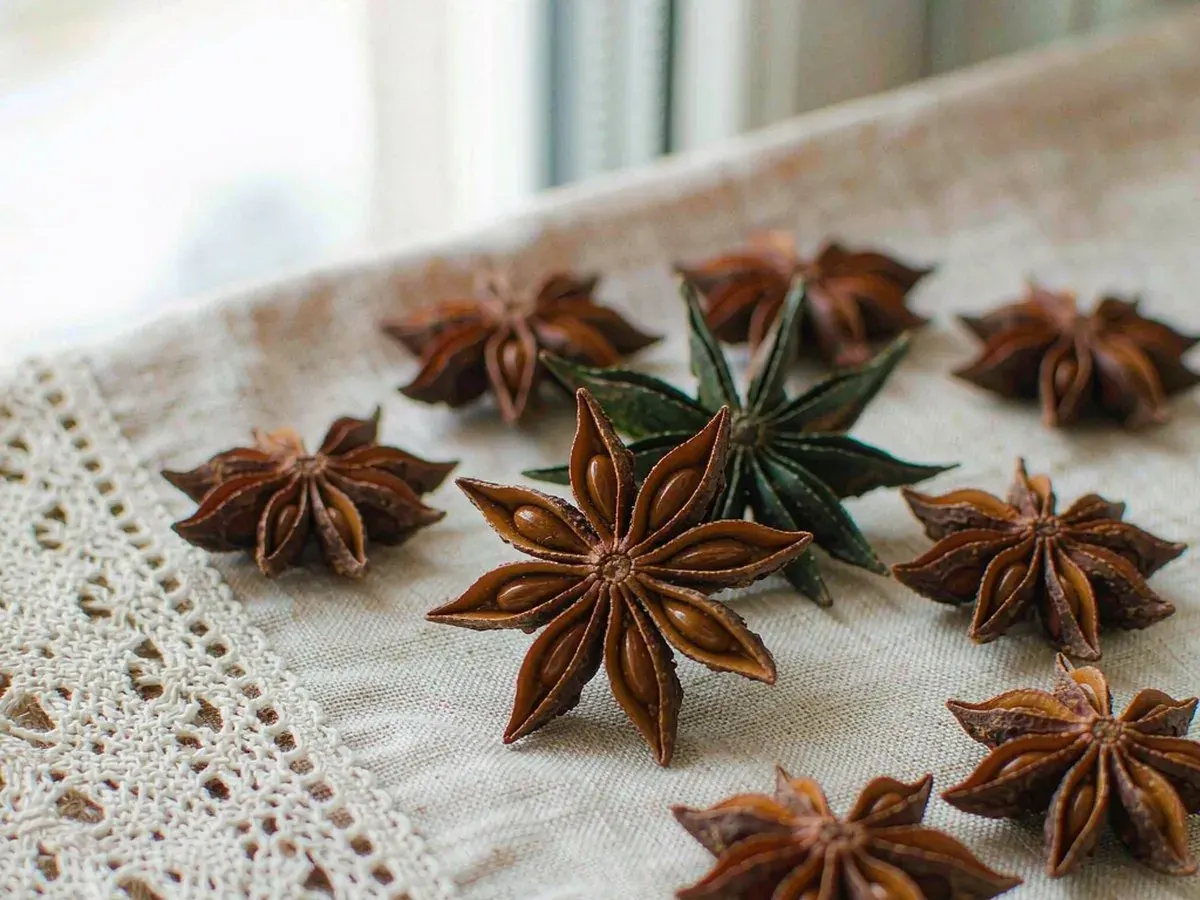
Star anise is the fruit of a small evergreen tree, harvested green and dried until the pod opens into a woody star. It is sweet, mild and faintly of liquorice, and it is the backbone of Chinese five-spice and Western star-anise biscuits. It also has a dangerous look-alike, and telling the two apart takes five seconds.
- Botanical
- Illicium verum — a small evergreen tree of the Schisandraceae family. The toxic look-alike is Illicium anisatum, the Japanese star anise.
- Part used
- Dried fruit, whole pod with seeds. Star anise oil is a separate product, distilled from the seed.
- Origin
- Guangxi, Fujian and Yunnan in China; Vietnam and Guangxi supply most of the world crop. Japanese star anise grows in southern Japan.
- Flavour
- Sweet and warm, anisic and faintly liquorice-like, with a gentle menthol lift. Nothing like the harsh, resinous smell of the Japanese species.
- Use
- One pod per 500 ml, whole, in braises and teas. Half a pod is plenty in a spice blend. Bruise it to release the oil.
- Keeps
- 2–3 years whole; the pods keep their aroma better than almost any other spice because the oil sits in the woody carpels.
Telling the two apart
Chinese star anise pods are usually seven or eight-pointed, and the individual carpels — the boat-shaped segments — are thick, rounded and open wide, like a fat wooden starfish. The seeds sit proud in the open cups, glossy and dark brown.
Japanese star anise has more points, usually nine to twelve, and the carpels are narrower and pointier. The pod looks more like a thin spiky star, and the seed sits in a tight cup rather than an open one. Chinese star anise also has a rounder, sweeter, more liquorice aroma; Japanese star anise smells harsher, more resinous, closer to camphor.
This matters because Japanese star anise contains shikimic acid levels high enough to cause poisoning, and because it is the species used industrially to produce shikimic acid for antiviral medication. It has been used as a deliberate adulterant of Chinese star anise, which is why the difference is worth knowing rather than assuming.
Where it sits in the kitchen
Star anise is a background aromatic rather than a foreground one. In a red-braised pork belly or a master stock it contributes a sweet, almost licorice depth that reads as “warm” rather than as “anise”. In Western baking it is the star of the tin, alongside cinnamon and clove, in biscuits and fruitcake.
The pods should generally go in whole. Bruising them with the flat of a knife before they go into the pot releases the oil faster, which matters in a short braise. And a pod used twice gives up less the second time — pull the first one out when the aroma has arrived.
The other half of the pod
Inside the star are the seeds, and they are the strongest part of the plant. The essential oil is distilled from them, and the shikimic acid is concentrated there. The seeds taste considerably sharper and more medicinal than the woody pod around them.
In the kitchen the seeds are usually left in the pod and discarded after the dish, which is the practical way to control their strength. If you are making a spiced syrup or a tea meant to be drunk rather than cooked in, a single seed is plenty — or remove them entirely and let the pod do the work.
What it is used for
- Digestion Traditionally used as a carminative for gas and fullness, and as a stomachic before meals.
- Warmth and circulation Classified as a warming aromatic in Chinese practice, used in cold conditions and in warming spice blends.
- Respiratory comfort Appears in many traditional blends for coughs and chest congestion, where its warming, aromatic quality is the point.
- Antimicrobial The essential oil shows antibacterial and antifungal activity in laboratory studies, including against some fungi that matter for food storage.
- Tonics The aniseed-flavoured principle of star anise (shikimic acid, and the related anisole fraction) is why it appears in a great many classic digestive and tonic tonics.
- Kitchen aroma Its real job on most tables: a sweet, woody warmth that makes a braise smell like it took all day.
In the kitchen
- Red-braised pork belly One or two pods with the soy sauce, the cinnamon and the bay. Remove before serving.
- Master stock and lu shui Two pods in a master stock that will be reused daily, refreshed monthly.
- Five-spice powder One part star anise to two parts cinnamon, one part clove, two parts Sichuan pepper, two parts fennel seed, all ground together.
- Tea blends One pod in a pot of black tea and dried citrus, or with cinnamon and ginger for a winter mulled pot.
- Bakery and fruitcake One or two pods in a pan of simmering fruit to poach pears and apples.
This is the most important safety note in this article: make sure you are buying Chinese star anise, Illicium verum, and not Japanese star anise, Illicium anisatum. Buy from a supplier that states the species, and check that the pods have broad, open carpels and rounded seeds.
S
t
a
r
a
n
i
s
e
i
s
o
n
e
o
f
t
h
e
i
n
g
r
e
d
i
e
n
t
s
i
n
C
h
i
n
e
s
e
f
i
v
e
–
s
p
i
c
e
a
n
d
i
s
c
o
m
m
o
n
l
y
t
a
k
e
n
i
n
d
i
g
e
s
t
i
v
e
b
l
e
n
d
s
.
I
f
y
o
u
a
r
e
p
r
e
g
n
a
n
t
,
n
u
r
s
i
n
g
,
o
r
o
n
m
e
d
i
c
a
t
i
o
n
,
c
h
e
c
k
w
i
t
h
a
c
l
i
n
i
c
i
a
n
b
e
f
o
r
e
u
s
i
n
g
i
t
r
e
g
u
l
a
r
l
y
,
a
n
d
k
e
e
p
t
h
e
w
h
o
l
e
p
o
d
o
u
t
o
f
r
e
a
c
h
o
f
c
h
i
l
d
r
e
n
—
i
t
i
s
a
c
h
o
k
i
n
g
h
a
z
a
r
d
.
Disclaimer
Traditional use is not evidence of efficacy, and this article does not recommend star anise for any medical condition. Never take star anise oil or shikimic acid supplements on the basis of reading about traditional uses, and never use any herb in place of prescribed treatment. If you suspect you have eaten Japanese star anise, seek medical advice rather than waiting it out.