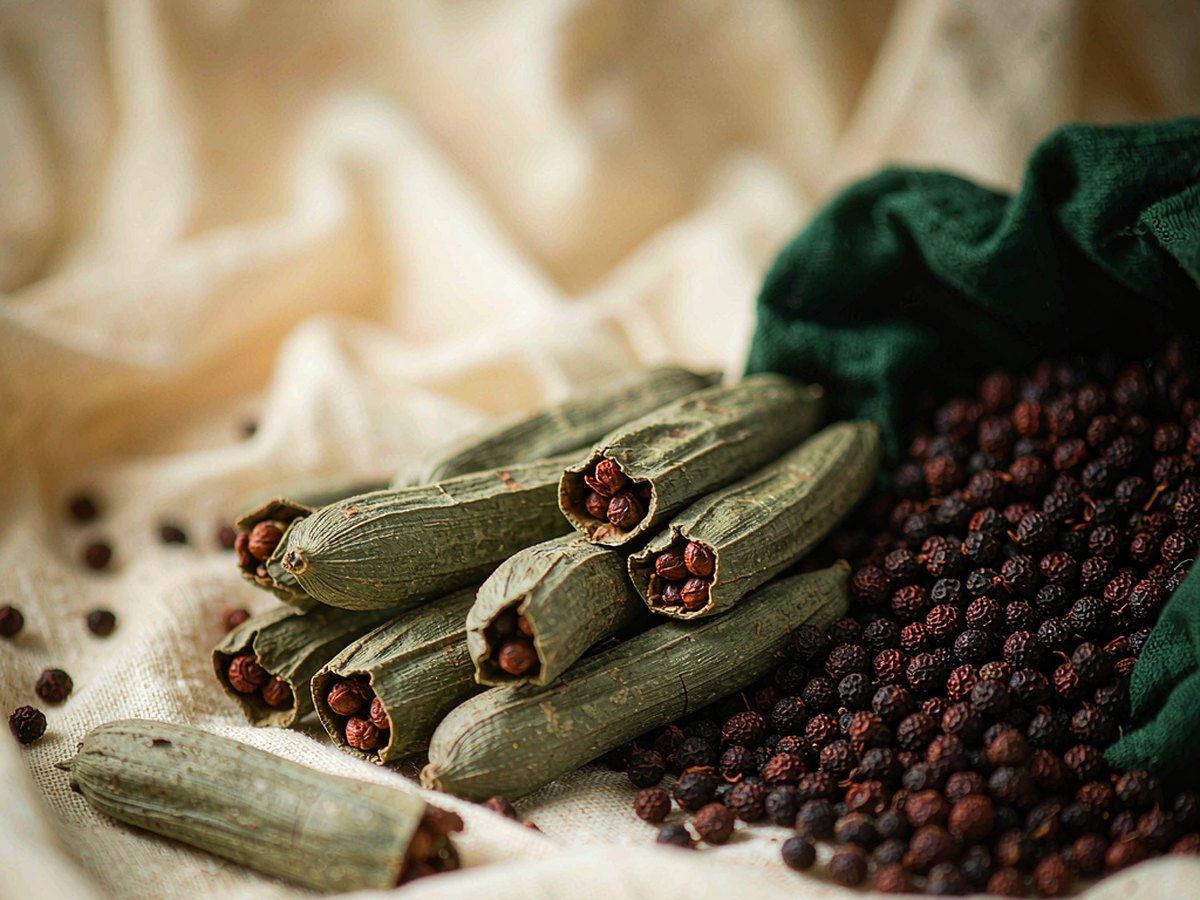
Tsaoko — cao guo to Mandarin, gowa to Tibetan cooks — is a dried fruit from the ginger family, and it is the quiet workhorse of the spice shelf. It has a warm, woody, camphor-ish aroma that does something to fatty meat that nothing else quite manages. It also has two persistent myths attached to it that are worth clearing up.
- Botanical
- Amomum tsao-ko, sometimes sold as Amomum villosum var. xanthioides. A member of the ginger family, Zingiberaceae, not a fruit of the nutmeg family.
- Part used
- The dried whole fruit, about the size and shape of a small plum, with a hard, wrinkled, dark brown shell and a dense seed mass inside.
- Origin
- Yunnan, Guangxi and Tibet in China; also grown in Vietnam, India and Bangladesh.
- Flavour
- Warm, woody, camphorous and slightly citrus, with a peppery heat underneath that arrives late.
- Use
- One fruit per kilogram of meat, cracked with the flat of a knife. In a tea or broth, half a fruit per pot is enough.
- Keeps
- 3 years whole. The shell protects the oils extremely well, which is why tsaoko keeps better than most ground spices.
Clearing up the two myths
The first myth is that tsaoko contains caffeine and should not be taken in the evening. It does not. It contains no caffeine at all. What it does contain is 1,8-cineole and other terpenes, and those are not stimulants in any way that affects sleep — the folk belief seems to be a confusion with the very real stimulant effect of another Tibetan staple, dried yak’s blood or highland barley.
The second myth is that tsaoko is a strong stimulant. It is a warming aromatic and a digestive, and it is genuinely used in Chinese and Tibetan practice to dispel cold and move stagnation. That is a description of a traditional warming quality, not of a stimulant that keeps you awake. If a cup of tsaoko keeps you up, it is more likely the quantity of hot water you drank at ten o’clock at night.
What it does to meat
Tsaoko’s particular gift is to fatty, gamey proteins. Lamb, mutton, yak, and also beef and pork all become less heavy when a little tsaoko goes into the pot. The mechanism in the kitchen is straightforward: the warm, camphoraceous, slightly bitter aroma cuts through the fat and gives the dish a dry, savoury depth that reads as clean rather than heavy.
In Yunnan and Tibetan cooking it is nearly always toasted before use — dry pan, low heat, until the fruit smells of the inside of a warm kitchen — and then cracked and added to the pot with the aromatics. Toasting drives off the raw, dusty top note and leaves the woody core.
The seed inside
Crack one open and you will find a dense mass of small seeds, hard and dark, packed into the hollow centre. In Chinese medicine the fruit and the seed are used differently: the seed is the stronger, more warming part and is what appears in digestive formulas, while the whole fruit is the culinary form.
For kitchen purposes the whole fruit is used and the seeds are cracked out with the shell, usually in a mortar or under the flat of a knife. For tea, one cracked fruit per pot is a full strength, and it is worth remembering that the seeds are where most of the strength lives — so removing them is a real way to soften the drink.
What it is used for
- Warming Classed as hot and warming in Chinese practice, used to dispel cold, move qi and settle a stomach that feels sluggish.
- Digestion A traditional digestive and antiemetic aromatic, especially associated with travel sickness and with feeling cold and nauseated.
- Heavy meats Its best-known use is culinary: it takes the gaminess and the weight out of lamb, mutton, yak and fatty pork.
- Respiratory comfort Appears in traditional blends for chest congestion, where its warming and dry quality is the point.
- Aroma A distinctive warm, woody, camphor note that reads as “alpine” in Western cooking and is central to Tibetan and Yunnan food.
- Antimicrobial The essential oil shows antibacterial and antifungal activity in laboratory studies.
In the kitchen
- Yunnan lamb One tsaoko per kilogram, cracked and toasted, with the garlic, ginger and chillies. The defining dish of the region.
- Tibetan-style beef and yak stews Added early, with a generous piece of ginger and a hot whole chilli.
- Hot pot base Crushed tsaoko in a chilli oil base adds the woody depth that plain chilli oil lacks.
- Braised beef One fruit in a two-hour red braise alongside cassia and star anise.
- Masala and Tibetan spice blends Toasted and ground with cumin, coriander and Sichuan pepper for a warming blend for meat.
Tsaoko is a hot spice and a strong aroma. One fruit per kilogram of meat is a full dose, and in a pot of tea half a cracked fruit is plenty — more and the camphor note takes over and the drink becomes medicinal rather than aromatic.
I
f
y
o
u
a
r
e
p
r
e
g
n
a
n
t
,
n
u
r
s
i
n
g
,
o
r
t
a
k
i
n
g
m
e
d
i
c
a
t
i
o
n
,
c
h
e
c
k
w
i
t
h
a
c
l
i
n
i
c
i
a
n
b
e
f
o
r
e
u
s
i
n
g
t
s
a
o
k
o
r
e
g
u
l
a
r
l
y
,
a
n
d
n
o
t
e
t
h
a
t
i
t
i
s
t
r
a
d
i
t
i
o
n
a
l
l
y
a
v
o
i
d
e
d
i
n
h
e
a
t
–
t
y
p
e
c
o
n
d
i
t
i
o
n
s
—
t
h
a
t
i
s
t
r
a
d
i
t
i
o
n
a
l
t
h
e
o
r
y
r
a
t
h
e
r
t
h
a
n
a
m
e
d
i
c
a
l
c
o
n
c
l
u
s
i
o
n
,
b
u
t
i
t
i
s
t
h
e
r
e
a
s
o
n
t
h
e
c
a
u
t
i
o
n
e
x
i
s
t
s
.
Disclaimer
Tsaoko is a food spice and the descriptions above are culinary and historical. Do not take tsaoko or its essential oil as a treatment for nausea, cough or any other condition, and do not use any herb in place of prescribed medication. Essential oil ingestion is a separate and considerably more serious matter than using the dried fruit in a dish.