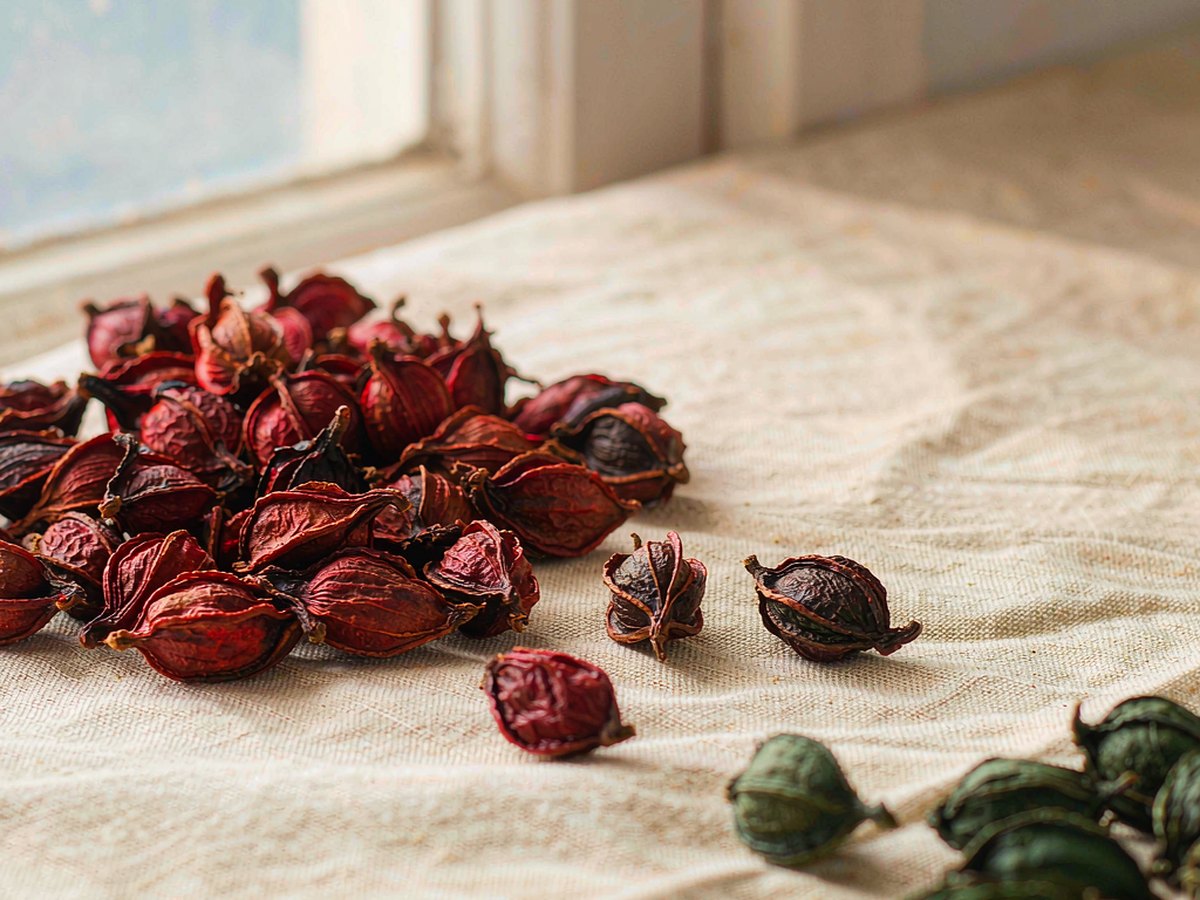
If you have ever drunk masala chai in Darjeeling, or tasted Tibetan butter tea, you have almost certainly had red cardamom and not the green pods in the supermarket. Red cardamom is bigger, darker, more wrinkled and unmistakably smoky, and it is the traditional cardamom of South Asia and Tibet. The green cardamom is a relative newcomer by comparison, and a completely different flavour.
- Botanical
- Amomum subulatum — the red cardamom, also called black cardamom or large cardamom, with the ribs running the length of the pod. Distinct from green cardamom, Elettaria cardamomum.
- Part used
- The dried whole pod, usually with the seeds left inside. The seeds are the strong part and the shell is the aromatic part.
- Origin
- The Himalayan foothills — Sikkim, Darjeeling, Bhutan, Nepal, and Tibet in China.
- Flavour
- Deep, smoky, earthy and camphorous, with a resinous warmth and a hint of pine. Nothing like the bright, floral, almost soapy green cardamom.
- Use
- One or two pods cracked per pot of chai. In a stew, two or three pods. The seeds can be bruised out for a stronger, faster-acting infusion.
- Keeps
- 3 years whole in an airtight jar; the pods are thick and protect the seeds well.
Two cardamoms, two worlds
Green cardamom, Elettaria cardamomum, is the pale green, softly hairy pod of the tropical Western ghats and Sri Lanka. Its flavour is bright, floral, sweet and slightly soapy — eucalyptus and lemon with a perfumed top note. It is the cardamom of Arabic coffee, of Scandinavian baking, and of the grocery shelf.
Red cardamom, Amomum subulatum, grows in the Himalayan foothills at 1,000 to 2,000 metres. The pod is larger, darker brown, more spindle-shaped, and heavily ribbed lengthwise. The aroma is deep, smoky and resinous. It is the cardamom of Tibetan butter tea, of chai brewed in Darjeeling, of Nepali and Bhutanese cooking, and of a great many Chinese medicinal blends.
Neither is better. They are not substitutes for one another, and swapping one for the other changes the dish completely.
What the smoke actually is
The smoky note is not from smoking or roasting the pod. It comes from the pod itself — the dried plant tissue contains a high concentration of volatile terpenes, and in the traditional drying method the pods are sun-dried close to the smoke of a fire. Some of the smoky quality is genuinely from the plant; some is from the drying.
Because of that, quality varies more than with green cardamom. A well-dried red cardamom pod has a hard shell, a dark reddish-brown colour and a powerful, clean aroma when you crack it. A pod that smells dusty or musty was dried badly and will taste of nothing.
The seeds are the point
Crack a red cardamom pod and you will find a cluster of small dark seeds, often still joined in a little bundle. These carry most of the aroma and most of the strength. In Tibetan and Himalayan cooking the seeds are frequently bruised out and used, while the shells go into the pot whole.
For tea, this is worth knowing: bruise the seeds against a flat surface before the pod goes into the pot and you will get a far stronger, faster cup. If you want the smoky depth without the intensity, put the whole pod in and take it out after two minutes.
What it is used for
- Digestion A warming aromatic digestive and carminative, used for fullness and for settling an unsettled stomach.
- Warming Classed as hot and warming in Chinese and Tibetan practice, used to dispel cold and move qi.
- Breath and throat The strong aromatic oil is used traditionally for freshness of the breath and for a scratchy throat.
- Respiratory comfort Appears in Tibetan and Himalayan blends for cough and chest congestion.
- Tibetan butter tea The signature use — pods are simmered with tea, salt and yak butter until the liquid churns.
- Tea blending The traditional cardamom of masala chai, added to the simmering milk and tea base.
In the kitchen
- Tibetan butter tea Pods simmered with a strong black tea and salt, then churned with yak butter. The pods go in whole and stay in for the whole simmer.
- Masala chai Crushed seeds and pods in the simmering milk-tea base with ginger and clove. Never boil the milk.
- Nepali and Bhutanese stews Two or three cracked pods in a meat or lentil stew, removed before serving.
- Rice and pilaf One pod in the pot for an aromatic, slightly smoky note that works especially well with lamb and with kidney beans.
- Infusions and blends Two pods in a pot of loose black tea with dried ginger, or with rock sugar and dried citrus peel.
Red cardamom is more assertive than green and more smoky. One pod per pot of tea is plenty, and in a small pot it can dominate completely. If a blend tastes like a campfire, it usually needs water rather than fewer spices.
C
a
r
d
a
m
o
m
i
s
a
w
a
r
m
i
n
g
a
r
o
m
a
t
i
c
a
n
d
i
s
t
r
a
d
i
t
i
o
n
a
l
l
y
a
v
o
i
d
e
d
i
n
h
e
a
t
–
t
y
p
e
c
o
n
d
i
t
i
o
n
s
.
A
n
y
o
n
e
p
r
e
g
n
a
n
t
,
n
u
r
s
i
n
g
,
o
r
o
n
m
e
d
i
c
a
t
i
o
n
s
h
o
u
l
d
a
s
k
a
c
l
i
n
i
c
i
a
n
b
e
f
o
r
e
u
s
i
n
g
i
t
r
e
g
u
l
a
r
l
y
,
a
n
d
i
t
i
s
w
o
r
t
h
k
n
o
w
i
n
g
t
h
a
t
c
a
r
d
a
m
o
m
o
i
l
i
s
a
s
e
p
a
r
a
t
e
,
m
u
c
h
m
o
r
e
c
o
n
c
e
n
t
r
a
t
e
d
p
r
o
d
u
c
t
.
Disclaimer
This article describes a culinary spice and its traditional use. Nothing here is a claim that cardamom treats digestive, respiratory or other conditions, and no herb should replace prescribed treatment. Please consult a clinician before using any spice or herb regularly for health reasons.