Alpinia Cardamom explained: what it is, how to pick it, and what actually matters when you use it.
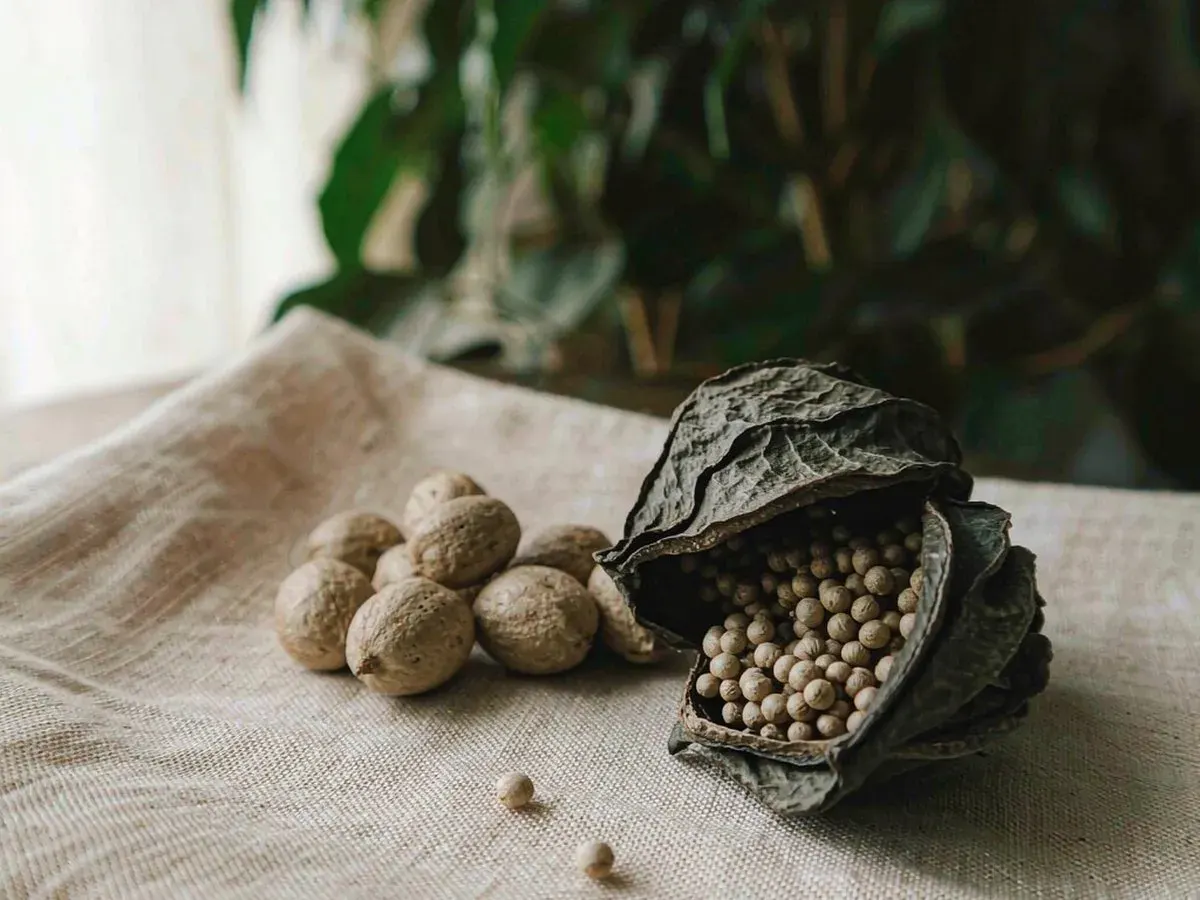
Chinese pharmacy knows three cardamoms, and none of them are the green pod from the supermarket. Sha Ren (砂仁) and Dou Kou (豆蔻) are the two that matter, both from the Amomum genus, both small, wrinkled and pale rather than green. They are warming aromatic drugs rather than confectionery spices, and they are dosed by weight.
- Botanical
- Amomum villosum (Sha Ren, the “big” cardamom of Chinese pharmacy) and Amomum kravanh / A. compactum (Dou Kou, “round” or “small” cardamom). Both differ from green cardamom, Elettaria cardamomum.
- Part used
- The dried ripe fruit, harvested before fully mature and dried whole so the seed remains inside. Both the pulp and the seed are used, and the seed is the more warming part.
- Origin
- Guangdong, Guangxi, Hainan and Yunnan in China; also Vietnam and Thailand for the Dou Kou type.
- Flavour
- Warm, camphorous and slightly sour, with a distinct resinous edge. Quite unlike the floral sweetness of green cardamom.
- Use
- 1–3 g of the crushed fruit per 200 ml decoction, simmered 15–20 minutes. In the kitchen, one or two fruits per pot.
- Keeps
- 2–3 years whole, and the husks protect the seed very well, which is why these fruits store far longer than they look like they should.
Sha Ren and Dou Kou
Sha Ren is usually larger, oval and slightly hairy, with a grey-brown husk and a dense dark seed. It is grown in the humid south — Guangdong and Guangxi — and it is the more strongly aromatic of the two, with a camphorous, slightly sour character.
Dou Kou is smaller, rounder, pale grey-cream and usually wrinkled at the shoulder, with a thin papery husk and a plump pale seed. It is milder, cleaner and slightly sweeter. When a Chinese recipe says dou kou it usually means the whole fruit used as a spice, and when it says sha ren it usually means the crushed fruit used as a medicine.
Both are sold in Chinese pharmacy as the whole dried fruit, and both are graded by size and by how full the seeds are. A good lot has heavy, hard fruit with a seed that fills the cavity completely.
How the Chinese pharmacy uses it
In classical Chinese medicine both are classified as warm, aromatic, and they are used to move qi, to calm a distended abdomen, to relieve nausea and vomiting, and to direct the action of other herbs toward the middle of the body. Sha Ren is the more powerful of the two for the last of these and appears in a great many formulas as a “guide” herb that is thought to lead other ingredients.
They are also used in the treatment of what traditional medicine calls dampness in the middle burner — a description of a heavy, sluggish digestion with a sticky mouth and loose stools. That is a traditional framework and not a modern diagnosis, and the practical kitchen version of it is simply that a small amount of Sha Ren in a broth makes a heavy broth feel lighter.
Using it in the kitchen
Outside the pharmacy these fruits turn up in Taiwanese and southern Chinese braises, in Cantonese herbal soups, in rice dishes and in some milk teas. The whole fruit is usually cracked lightly and added early, because its oils need time and heat to come out of the woody husk.
The shells are worth keeping for a second use. A spent husk can be simmered again for a light infusion, and the shells are the part that gives the pod its aroma, while the seed is the part that gives it its heat.
What it is used for
- Digestion The principal traditional use of both Sha Ren and Dou Kou: relieving fullness, distension and sluggish digestion, and easing nausea.
- Warming and aromatic Classed as warm and aromatic in Chinese medicine, used to dispel cold and to counteract the cloying effect of heavy, greasy or damp foods.
- Moving qi Traditionally used to move stagnant qi — a traditional concept describing a feeling of pressure, fullness and stagnation in the abdomen.
- Morning sickness A classical use for nausea and vomiting, including in pregnancy, under the supervision of a qualified practitioner.
- Sour and fragrant The fruit’s distinct sourness and aroma are used in cooking to brighten rich dishes and to cut through oil.
- Fragrance in blends The aroma carries through long simmers, which is why it appears in slow-cooked stocks and long-steeped herbal teas.
In the kitchen
- Cantonese herbal soup One fruit in a two-hour double-boiled soup with dates, chicken or pork. The canonical use.
- Taiwanese braised pork Two fruits cracked into the braising liquid with star anise and cassia.
- Congee and rice porridge One fruit in a pot of congee, removed before serving, for a warm, clean lift.
- Milk tea and savoury teas One crushed fruit in a pot of milk tea, or with oolong and dried citrus peel.
- Salt and spice rubs Crushed with salt for a warm rub on roasted duck or chicken.
Sha Ren and Dou Kou are aromatic and warm, and in a strong infusion they taste medicinal rather than pleasant. One to three grams is a normal dose per cup and one or two fruits is a normal amount for a pot for four people.
B
e
c
a
u
s
e
t
h
e
s
e
f
r
u
i
t
s
a
r
e
a
r
o
m
a
t
i
c
a
n
d
w
a
r
m
i
n
g
,
t
h
e
y
a
r
e
t
r
a
d
i
t
i
o
n
a
l
l
y
u
s
e
d
w
i
t
h
c
a
u
t
i
o
n
i
n
h
e
a
t
–
t
y
p
e
c
o
n
d
i
t
i
o
n
s
a
n
d
a
r
e
n
o
t
g
e
n
e
r
a
l
l
y
g
i
v
e
n
t
o
y
o
u
n
g
c
h
i
l
d
r
e
n
w
i
t
h
o
u
t
p
r
o
f
e
s
s
i
o
n
a
l
a
d
v
i
c
e
.
I
f
y
o
u
a
r
e
p
r
e
g
n
a
n
t
,
n
u
r
s
i
n
g
,
o
r
o
n
m
e
d
i
c
a
t
i
o
n
,
c
h
e
c
k
w
i
t
h
a
c
l
i
n
i
c
i
a
n
o
r
a
q
u
a
l
i
f
i
e
d
C
h
i
n
e
s
e
m
e
d
i
c
i
n
e
p
r
a
c
t
i
t
i
o
n
e
r
b
e
f
o
r
e
u
s
i
n
g
t
h
e
m
r
e
g
u
l
a
r
l
y
.
Disclaimer
The traditional uses described here are recorded in the Chinese pharmacopoeial tradition and in classical formula writing. They are not evidence of efficacy, and this article is not a recommendation to treat any condition with these herbs. Do not use any herb in place of prescribed treatment, and consult a qualified practitioner before using Sha Ren or Dou Kou medicinally.