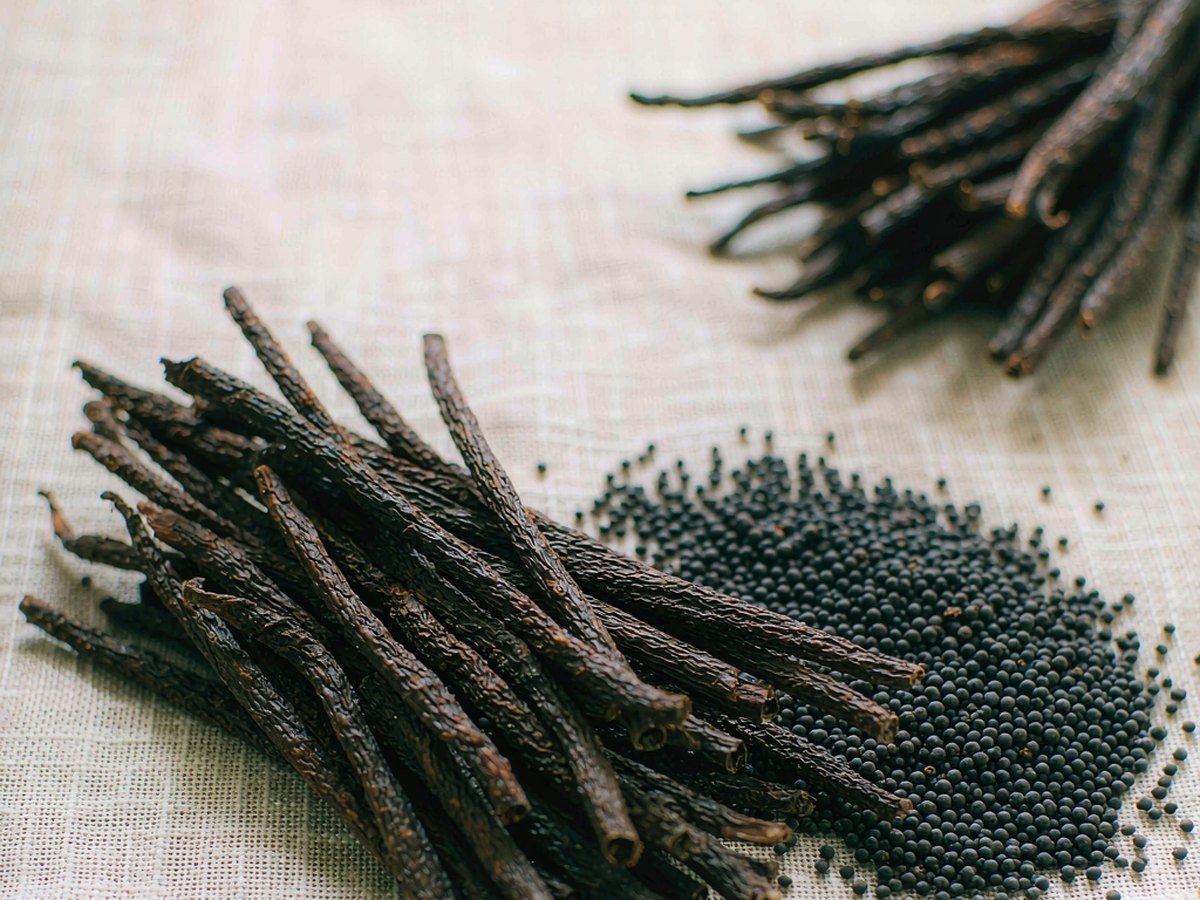
Long pepper is not a peppercorn. It is a dense, knobbly spike of tiny fruitlets on a hanging stalk, and it was the most valuable spice in the world for a few hundred years — the thing Roman and medieval cooks meant when they said pepper. It is hotter than black pepper, more floral, and considerably harder to find.
- Botanical
- Piper longum — a climbing vine related to black pepper, native to the Indian subcontinent and South-East Asia. Also called pippali, and in Chinese medicine it is Bi Ba.
- Part used
- The dried fruiting spike, whole, with the tiny immature fruitlets still attached. The root is a separate product.
- Origin
- Kerala and Karnataka in India; also grown in Vietnam, Bangladesh and Indonesia.
- Flavour
- Hot, slightly floral, with a piney resinous depth underneath and a lingering warmth that black pepper does not have.
- Use
- Half a spike per 400 ml, bruised, in decoctions and blends. A whole spike in a braise. Ground, a quarter teaspoon.
- Keeps
- 2–3 years whole; the spikes hold their oils better than black peppercorns.
What a spike actually is
The thing you buy is not a fruit but a fruiting spike — a central stalk studded with dozens of tiny one-seeded fruits, each about the size of a grain of rice, packed so tightly they form a knobbly cylinder. It looks like a miniature corn cob on a stem.
Breaking a spike open reveals the fruitlets and the woody core. Whole spikes are what the spice trade has always moved, because the structure protects the volatile oil so well that long pepper was shippable across oceans when loose peppercorns were not.
How it differs from black pepper
The heat of black pepper comes from piperine, and so does the heat of long pepper, along with several related alkaloids that give long pepper its extra resinous and floral quality. It is also noticeably stronger per gram: a quarter teaspoon of ground long pepper is roughly twice as assertive as the same measure of black pepper.
In Ayurvedic practice Pippali is not only a culinary spice but a classical digestive and respiratory herb, appearing in formulations such as Trikatu and used as a vehicle that is said to carry other ingredients. That tradition describes a warming, penetrating quality; whether it enhances absorption of other compounds in a measurable way is a research question rather than a kitchen one.
Where it belongs now
Long pepper is a cornerstone of Ayurvedic cooking, appearing in masala chai, in garam masala, in pickling spice and in the spice blends for vegetable curries, where its resinous warmth works in a way that black pepper’s sharper heat does not.
In Chinese kitchen use Bi Ba appears in braised meat dishes and in Sichuan spice powders. Its role there is similar to star anise: a background warmth that rounds out a dish without announcing itself. Its role in Chinese medicine is as a warming digestive that disperses cold and moves qi.
What it is used for
- Digestion One of the most-used digestive aromatics in Ayurvedic practice, taken for fullness, gas and sluggish digestion, often with ginger and black pepper.
- Respiratory comfort A classic warming herb for coughs and congestion in both Ayurvedic and Chinese practice, used to loosen phlegm and clear the chest.
- Warming and dispersing Classed as hot and penetrating in Chinese medicine — it is used to disperse cold and move stagnation rather than to nourish.
- Circulation Traditionally used to stimulate circulation and warm the limbs in cold weather.
- Absorption Long pepper extracts have been studied for their ability to increase the bioavailability of other compounds, which is part of its reputation as a “carrier” herb.
- Flavour A resinous depth that sits underneath black pepper and gives a braise or a chai blend something black pepper alone cannot.
In the kitchen
- Masala chai One spike bruised into the simmering milk-and-water base with ginger and cardamom.
- Garam masala and pickle spice Toasted and ground with cumin, coriander and fenugreek for the classic North Indian blends.
- Chinese braises One spike with star anise and cassia in a red-braised pork or beef dish.
- Decoctions Bruised in a pot of water with ginger and honey for a warming drink — the classical Ayurvedic preparation.
- Roasted snack spice Mixed with salt and roasted peanuts or chickpeas, a common street snack across South India.
Long pepper is hot and resinous, and it is easy to use too much of. A half spike per pot is a full dose, and the heat arrives after the sip rather than with it. It is also more irritant to an empty stomach than black pepper.
B
e
c
a
u
s
e
l
o
n
g
p
e
p
p
e
r
e
x
t
r
a
c
t
s
a
r
e
s
t
u
d
i
e
d
f
o
r
e
f
f
e
c
t
s
o
n
h
o
w
o
t
h
e
r
c
o
m
p
o
u
n
d
s
a
r
e
a
b
s
o
r
b
e
d
,
t
h
e
y
i
n
t
e
r
a
c
t
w
i
t
h
a
l
o
n
g
l
i
s
t
o
f
m
e
d
i
c
a
t
i
o
n
s
.
C
u
l
i
n
a
r
y
a
m
o
u
n
t
s
a
r
e
u
n
r
e
m
a
r
k
a
b
l
e
;
a
c
o
n
c
e
n
t
r
a
t
e
d
e
x
t
r
a
c
t
i
s
a
q
u
e
s
t
i
o
n
f
o
r
y
o
u
r
p
h
a
r
m
a
c
i
s
t
.
Disclaimer
This article describes a spice and its traditional use. Long pepper and its extracts are not a substitute for prescribed medication, and no herb here should be used to treat or prevent a condition. If you are pregnant, nursing, taking medication, or managing a health condition, ask a clinician before using any spice regularly as a remedy.