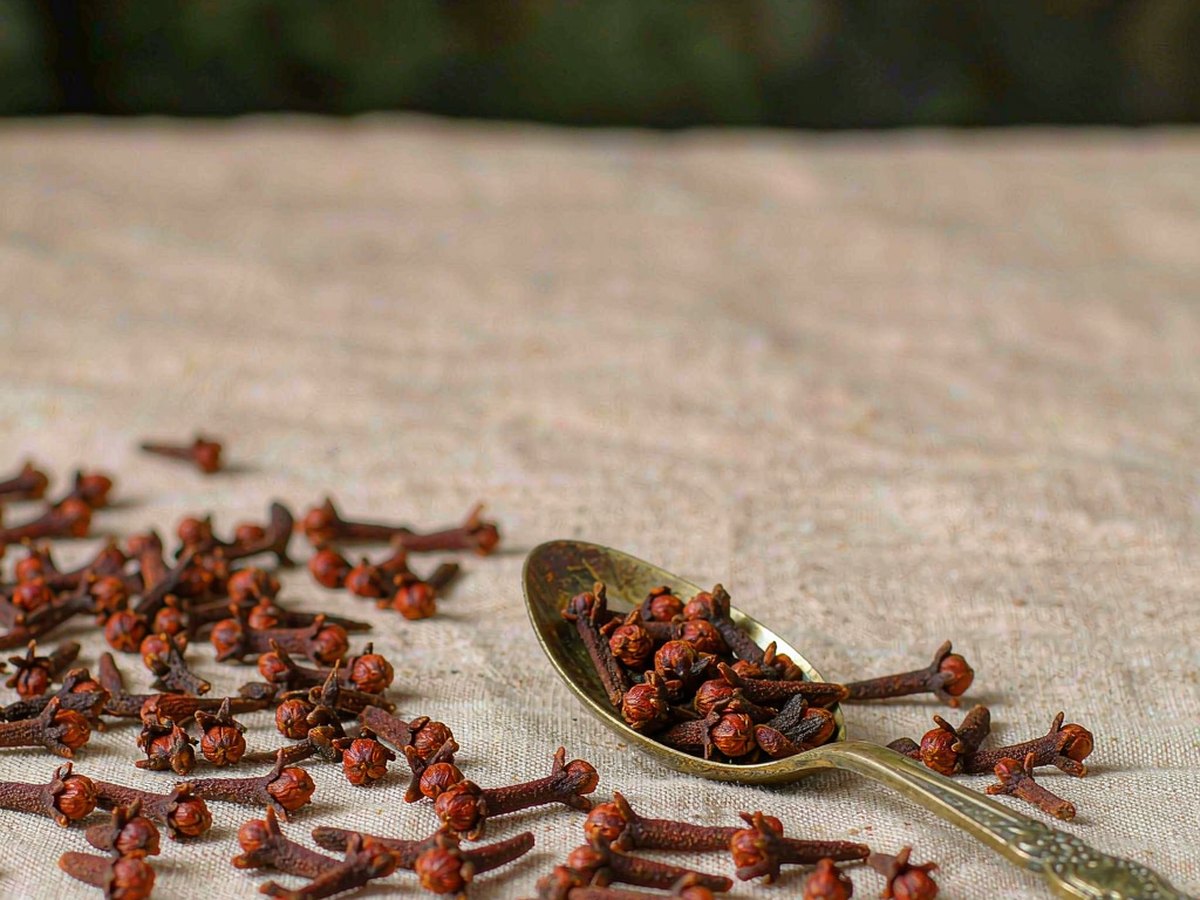
Clove is a dried flower bud — the unopened head of a small tree flower, picked before it ever opens. One bud carries more aromatic oil than a cup of most herbal tea, which is why it prices like perfume and why a pinch goes further than a handful. It is also the single most misused spice in the western cupboard: too much and it numbs, and the numbing is the point, not a fault.
- Botanical
- Syzygium aromaticum — the bud of a tropical evergreen. The word ‘clove’ comes from the Latin clavus, a nail, for the shape of the bud.
- Part used
- Unopened flower bud, picked green and dried until it darkens. Buds, “grass” buds and leaf are graded separately.
- Origin
- Maluku Islands and Zanzibar for the finest; Hainan and Yunnan for Chinese pharmacy lots; Brazil and Indonesia for volume.
- Flavour
- Sweet, warm and woody at the front, with a distinct numbing tingle and a resinous, almost medicinal edge behind it.
- Use
- 1–2 buds per 200 ml, water just off the boil, 3–4 minutes. Ground: a quarter teaspoon per pot. Whole buds bruise into the liquid; ground clove gives up its oil almost immediately.
- Keeps
- Whole buds 2–3 years in an airtight jar, ground 6–12 months before the oil fades.
What is actually in the bud
The head of the bud holds most of the oil, in tiny glands that show as a fine dust on a good specimen. The stalk below it is woody, tastes nearly nothing, and accounts for a startling share of the weight in cheap lots — which is why a jar that weighs the same can flavour a third as much.
Good cloves are plump, dark chocolate-brown, and still tacky with oil when you press them. They should snap cleanly rather than bend. If they are pale, dusty and light, they have lost their oil to age, and grinding will not bring it back — it will only make the dust more obvious.
Reading the grade
Clove is graded by size, and size is mostly about oil content, not length. The largest buds carry the most oil and are worth the most; the smallest, called “grass” or “爪哇” grade, are the ones most often ground and sold as flavouring rather than sold as a spice.
Two things to reject. A greyish bloom on the surface suggests the lot was stored damp and has started to go off. And a lot that smells of nothing at all in the shop has been exhausted — cloves that have been steam-distilled for oil and then dried out are sold as buds but behave like sawdust.
Why the tingle matters
The numbing comes from eugenol, the same compound that shows up in a dentist’s mouthwash. It is genuinely antimicrobial, which is part of why cloves ended up in a dentist’s chair rather than only in a pot. It also irritates an empty stomach, which is why a clove taken on an empty stomach can make you feel slightly unwell in a way that is easy to mistake for the spice being bad.
The traditional use is for digestion: the oil is a carminative, it relaxes the smooth muscle of the gut and reduces the feeling of fullness. The toothache use is older and more widespread — a whole clove pressed against an aching tooth and held in the cheek is still a common folk remedy across Asia and Europe alike.
What it is used for
- Digestive comfort Clove oil is a classic carminative — it eases the sensation of fullness and bloating after a heavy meal. One bud in a cup after dinner is the usual kitchen dose.
- Warmth and circulation Classed as a warming aromatic in Chinese and Unani practice, used to bring a feeling of heat to the extremities in cold weather. This is a traditional concept, not a measurable effect.
- Tooth and gum comfort Eugenol is the compound in clove oil used in dentistry for toothache and in mouthwashes. Chewing a bud or holding it against a sore spot is the traditional application.
- Antimicrobial Clove oil has well-documented antibacterial and antifungal activity in laboratory studies. Laboratory activity is not the same as a treatment, and it is not a reason to use essential oil internally.
- Breath The volatile oil masks and reduces the perception of odour, which is why it appears in breath fresheners, mouthwash and some dental chewing gums.
- Numbing The tingle is a genuine local effect on nerve signalling, used topically in traditional practice for minor pain. It is a sensation, not an anaesthetic, and it does not treat the cause of pain.
In the kitchen
- Five-spice powder Ground with star anise, fennel, Sichuan pepper and cinnamon. Clove is the loudest of the five, so a quarter teaspoon per tablespoon of blend is plenty.
- Braises and red cooking One or two buds dropped into the pot with the star anise. They should not be bruised if you want them to stay whole and lift out.
- Roast spice blends Clove, cinnamon and cardamom toasted together in a dry pan for a minute before grinding — this is the base of a masala chai.
- Mulled tea and spiced cider Two buds, one cinnamon quill and a strip of orange peel per pot. Simmer ten minutes, do not boil.
- Tomato and sauce work A single bud grated fine into a slow-cooked tomato sauce removes the flatness that long cooking leaves behind.
- Baking Ground clove in spice bread and gingerbread is a European borrowing that arrived via Dutch and English trade routes and never left.
Clove is one of the strongest common spices and it is easy to overshoot. More than two buds in a small pot will make the cup unpleasant, and a lot of oil on an empty stomach can cause nausea. Ground clove is far more concentrated than whole buds — treat a quarter teaspoon as a full bud.
E
u
g
e
n
o
l
h
a
s
d
o
c
u
m
e
n
t
e
d
e
f
f
e
c
t
s
o
n
b
l
o
o
d
c
l
o
t
t
i
n
g
,
a
n
d
c
l
o
v
e
i
s
n
o
t
u
s
u
a
l
l
y
r
e
c
o
m
m
e
n
d
e
d
a
l
o
n
g
s
i
d
e
a
n
t
i
c
o
a
g
u
l
a
n
t
m
e
d
i
c
a
t
i
o
n
.
I
f
y
o
u
a
r
e
p
r
e
g
n
a
n
t
,
o
n
b
l
o
o
d
t
h
i
n
n
e
r
s
,
o
r
a
b
o
u
t
t
o
h
a
v
e
s
u
r
g
e
r
y
,
a
s
k
y
o
u
r
c
l
i
n
i
c
i
a
n
b
e
f
o
r
e
u
s
i
n
g
i
t
r
e
g
u
l
a
r
l
y
.
Disclaimer
Clove is a concentrated essential-oil spice, and essential oils are not the same as the whole dried bud. Nothing in this article is a recommendation to take clove oil internally. Use the whole bud, use it sparingly, and keep it out of reach of children — one bud is a choking hazard for a small child.