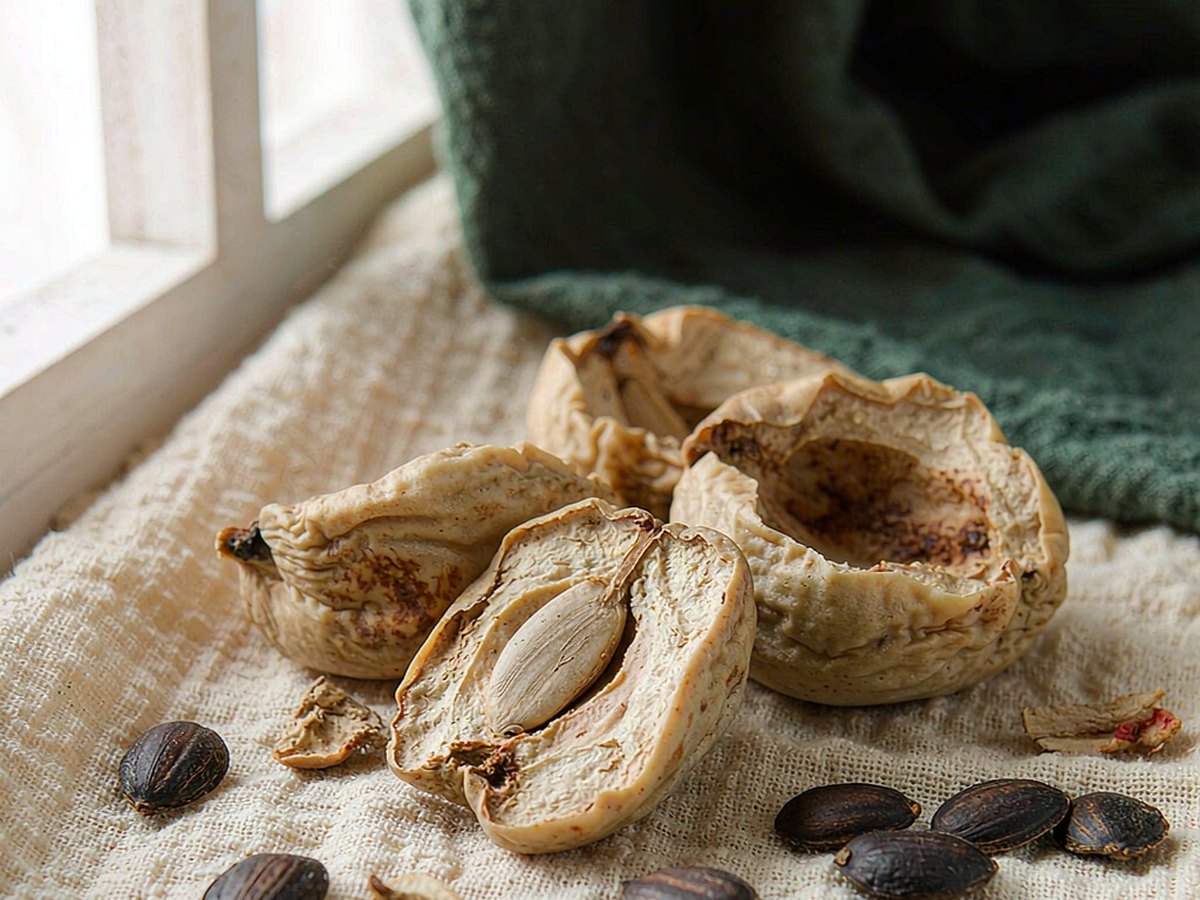
Sour jujube is one of the few herbal materials where the fruit and the seed are used for opposite things. The fruit — the small, red, sour jujube — is sharp, stimulating and sour. The seed inside it, Suan Zao Ren, is the classical Chinese medicine for calming the spirit and settling a restless, broken sleep.
- Botanical
- Ziziphus jujuba var. spinosa (also written Ziziphus mauritiana for the Indian jujube). The seed is Suan Zao Ren; the fruit is Suan Zao.
- Part used
- Two separate products: the dried fruit, and the separated, dried seed kernel. The seed is the medicine; the fruit is the food.
- Origin
- Hubei, Hebei, Shandong, Shanxi, Liaoning and Yunnan. The wild-harvested fruit of the spiny jujube is the classical source.
- Flavour
- The fruit is sour, slightly astringent and dark; the seed is flat, hard, dark brown and bitter-sweet, with a strong smell of burnt or roasted notes.
- Use
- Fruit: 3–5 pieces in a pot. Seed: 10–15 seeds, crushed, simmered 20 minutes. The seed needs decoction; it does not infuse.
- Keeps
- 12 months for the fruit, 18 months for the seed, both sealed and dry. The seed hardens with age and resists grinding.
The seed is the medicine
Suan Zao Ren is the kernel of the stone of the sour jujube, and it is one of the most used calming herbs in the entire Chinese pharmacopoeia. It appears in classical formulas for restlessness, for palpitations, for insomnia, and for the specific picture traditional medicine describes as an unanchored spirit — which in practice presents as lying awake, or waking easily, with an anxious or unsettled quality.
The traditional description of the seed’s action is interesting for a modern reader. It is called sour and sweet, and it is said to “constrain” or “gather” what is scattered — in practice, the seed has a pronounced calming and settling quality, and it is paired with herbs that nourish rather than herbs that move.
There is genuine modern research here, and it is unusually promising for a traditional herb: jujube seed extracts have been studied for anxiolytic and sleep effects in animal models, and there is a plausible mechanism involving GABA-related signalling. That is not the same as a clinical trial in people with insomnia, and it is not a reason to self-medicate.
The fruit is the opposite
The whole fruit of the sour jujube is sour, astringent and stimulating rather than calming. In traditional practice it is used for what is called food stagnation and for a heavy, sluggish digestion, and it also has a well-known traditional use in sweating — the classical formula for excessive sweating in Chinese medicine is Gui Zhi Tang, and a jujube ingredient appears in several sweating formulas.
The confusion between fruit and seed is genuinely common, because both are sold dried and both are called something jujube. They are also easy to tell apart once you look: the seed is a flat, hard, dark brown disc, and the fruit is a wrinkled, reddish-brown sphere.
For the kitchen, the sour jujube fruit is a good souring agent in its own right, sharper and less floral than dried tangerine peel and more herbaceous than lemon.
Sour jujube and the other jujubes
It is worth being clear about the family, because the shop shelves are crowded with jujubes. Red date, Hong Zao, is Ziziphus jujuba, the cultivated jujube, sweet and chewy and used in sweet soups and tonifying formulas. Sour jujube, Suan Zao, is the smaller, wilder relative of the same genus, and it is the one whose seed is a medicine.
The dried longan and dried jujube in the sweet-soup tradition are the cultivated fruits. The sour jujube is smaller, darker and much sharper, and it is the seed rather than the flesh that gets the attention.
If you are buying the seed, buy it whole and crush it yourself. Pre-ground seed loses its volatiles quickly, and the whole seed is easy to identify and hard to adulterate with anything that looks like it.
What it is used for
- Calming the spirit The principal classical use of the seed: for restlessness, an unsettled mind, palpitations and broken sleep.
- Insomnia Used in classical formulas for difficulty falling asleep and for waking in the night. Modern research on jujube seed extracts is promising but remains largely preclinical.
- Anxiety and palpitations Classically used for an anxious, restless quality with a fluttering heartbeat, usually with other nourishing and calming herbs.
- Sweating The fruit’s traditional use is in formulas for excessive sweating, which is a specific classical pattern rather than a general one.
- Digestion The fruit is used for a heavy, sluggish digestion and for food stagnation, and is sour and astringent.
- Nutritive The jujube family is a classical tonic food. Red date is the better-known member of that family.
In the kitchen
- Seed decoction Ten to fifteen crushed seeds simmered in 400 ml for twenty minutes, strained and taken in the evening. The classical preparation.
- Sour jujube and goji Three or four fruits with goji in a light sweet soup.
- Souring agent One fruit in a braise or a soup where a sharp, herbaceous acidity is wanted.
- Tea blend Crushed seed with chrysanthemum and a little licorice-free sweetness, for an evening cup.
- Distinguishing it The seed is a flat dark disc; the fruit is a wrinkled reddish-brown sphere. Keep them apart in the jar.
Jujube seed is generally considered gentle and is used in many household formulas. The main cautions are for pregnancy, where traditional sources advise against it, and for anyone taking medication that affects the nervous system or the heart.
J
u
j
u
b
e
a
l
s
o
h
a
s
a
d
o
c
u
m
e
n
t
e
d
i
n
t
e
r
a
c
t
i
o
n
w
i
t
h
a
n
u
m
b
e
r
o
f
d
r
u
g
s
b
e
c
a
u
s
e
i
t
a
f
f
e
c
t
s
t
h
e
e
n
z
y
m
e
s
t
h
a
t
m
e
t
a
b
o
l
i
s
e
t
h
e
m
.
I
f
y
o
u
t
a
k
e
a
n
y
r
e
g
u
l
a
r
m
e
d
i
c
a
t
i
o
n
,
a
s
k
a
p
h
a
r
m
a
c
i
s
t
b
e
f
o
r
e
m
a
k
i
n
g
j
u
j
u
b
e
s
e
e
d
a
n
i
g
h
t
l
y
d
r
i
n
k
,
a
n
d
n
e
v
e
r
c
o
m
b
i
n
e
i
t
w
i
t
h
p
r
e
s
c
r
i
b
e
d
s
e
d
a
t
i
v
e
s
w
i
t
h
o
u
t
a
d
v
i
c
e
.
Disclaimer
Jujube seed is a genuine traditional medicine with genuine research interest behind it, and it is still not a proven treatment for insomnia or anxiety. Do not use it in place of prescribed care for either, and speak to a clinician before using it regularly, particularly during pregnancy or alongside medication.