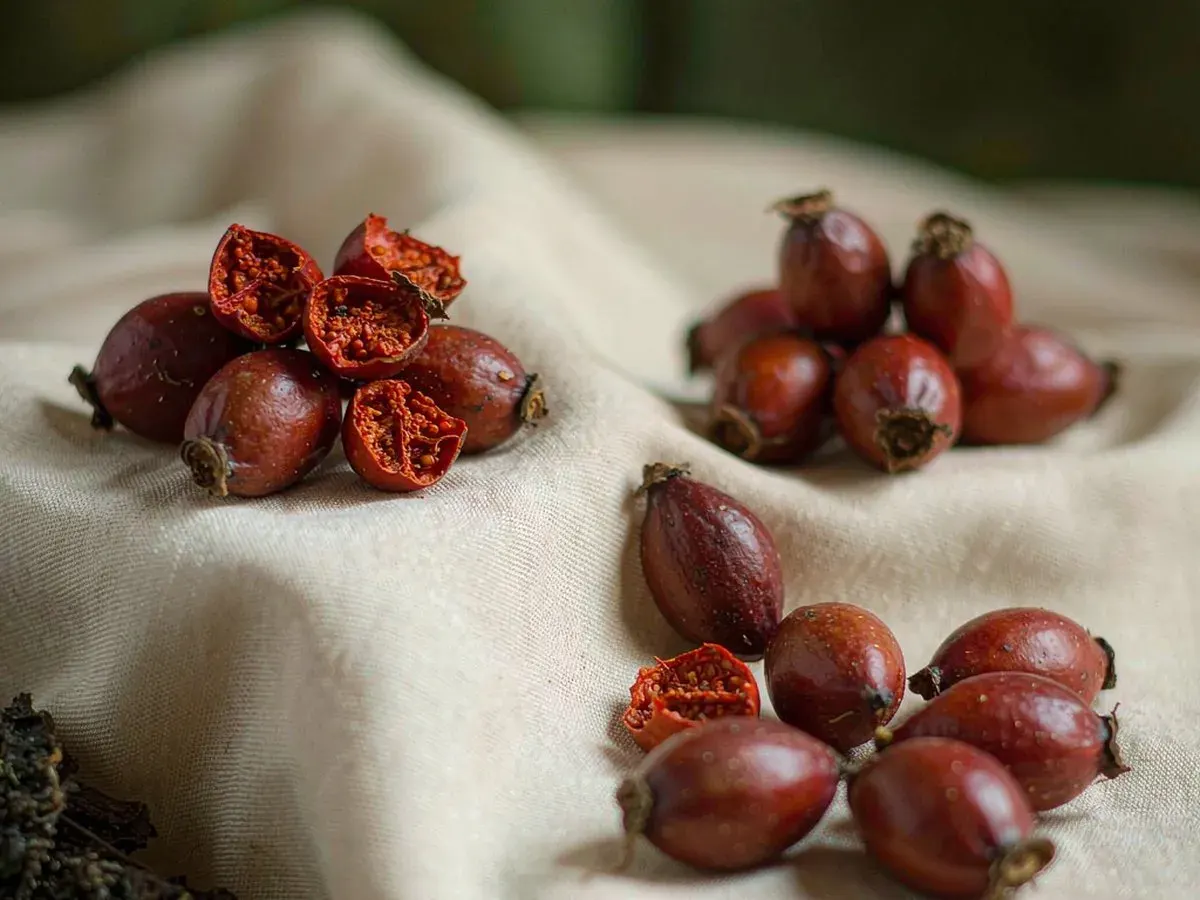
Chinese medicine uses two different species of rose fruit, and both are sold dried under names that are easy to confuse: the chestnut rose, Rosa roxburghii, and the Cherokee rose, Rosa laevigata. Both are digestive and blood-moving herbs. Both come with a catch — the inside of the hip is full of fine irritant hairs that must be removed before use.
- Botanical
- Rosa roxburghii (Ci Li Zi, chestnut rose) and Rosa laevigata (Ying Zi, Cherokee rose). Two distinct species, both in the rose family.
- Part used
- The dried ripe fruit, with the seeds and the inner hairs removed. In good Chinese material the hairs have been taken out by machine before drying.
- Origin
- Guizhou, Sichuan, Yunnan, Shaanxi and Gansu for the chestnut rose; the Cherokee rose is gathered in the wild across southern China and is now also cultivated.
- Flavour
- Sour and slightly astringent with a faint sweet aftertaste, closer to an unripe fruit than to an apple.
- Use
- 3–5 pieces per 200 ml, simmered 10–15 minutes. These are fruits and they need heat to give up their taste.
- Keeps
- 12–18 months sealed. The fruits are dense and keep well if they are properly dried.
The hairs are the whole story
Inside every rose hip is a cluster of achenes, each one wrapped in fine, stiff, itching hairs. These hairs are an irritant — genuinely, physically irritating to the throat and the digestive tract, and enough of them in a cup will make it unpleasant.
Traditional Chinese processing takes care of this. The fresh fruit is deseeded, the hairs are removed — historically with a rubbing and sieving process, now usually by machine — and only then is it dried. The result is a hollow, shell-like dried fruit with a hard, slightly hairy exterior but a clean interior.
Western rose hip tea is usually made with the whole hip, hairs and all, because it is a food tea and the risk is low. If you are using a Chinese pharmacy product, the hairs should already be out. If you are using a western whole hip product, straining it well through a fine mesh is worth the trouble.
Two species, two flavours
The chestnut rose, Rosa roxburghii, is named for the spiny, chestnut-like burrs that surround its hips. The fruit is small — around a centimetre — with a thin, dry shell and a very concentrated sourness. It is the more astringent of the two and the more strongly used in the Chinese pharmacy.
The Cherokee rose, Rosa laevigata, has a larger, fleshier fruit, softer and rounder, and a milder, fruitier sourness. It is the one that tastes most like something you would want to eat, and it is the one most often found in western herbal tea.
In traditional use they overlap considerably — both are digestive and both move blood — but the chestnut rose is the more drying and astringent, and the Cherokee rose the more nourishing and fruity.
What they are used for
The classical Chinese indications for both are digestion and blood movement. They appear in formulas for what traditional medicine describes as food stagnation — the heavy, clogged feeling after overeating — and in formulas for blood stasis, particularly menstrual ones.
Western herbal practice uses rose hip for the same digestive purpose and additionally for its vitamin C content, which is high in the fresh fruit and considerably reduced by drying. As with every dried fruit, the ascorbic acid does not survive well, and a cup of rose hip tea is not a meaningful vitamin C source.
There is also a long culinary tradition: rose hip jam, rose hip syrup, and the vitamin-rich rose hip cordial that was made in Britain during the war as a concentrated source of vitamin C for children.
What it is used for
- Digestion The principal classical use of both species: relieving the heavy, clogged feeling of food stagnation and moving stagnation in the abdomen.
- Blood movement Traditionally used in formulas for blood stasis, particularly menstrual patterns. This is a supervised, formula-based use.
- Vitamin C High in the fresh fruit, much reduced by drying. Rose hip syrup remains a traditional supplement.
- Astringency A firm, drying, tightening quality from the skin and the flesh.
- Cooling Classed as cool and sour, used where traditional medicine describes heat.
- Culinary use Jam, syrup, cordial, and the traditional children’s vitamin syrup of the British wartime kitchen.
In the kitchen
- Rose hip and ginger tea Three hips, bruised, with two slices of ginger, simmered fifteen minutes. The standard combination.
- Rose hip syrup The hips simmered in water and sugar for a cordial that keeps for months.
- Rose hip jam The classic use — hips, sugar and a little lemon, with the seeds and hairs painstakingly picked out.
- Blending With hibiscus and dried tart cherry for a tart, deep-red iced tea.
- Pomegranate seed replacement A few rose hips in a bowl of pomegranate seeds for the sourness and the texture.
The hairs are the caution. Good Chinese product has them removed; western whole-hip product usually does not, so strain it through a fine mesh, and do not grind the whole fruit. Eating a rose hip raw with the hairs still in is the classic way to get an irritated throat.
R
o
s
e
h
i
p
s
a
r
e
h
i
g
h
i
n
p
o
t
a
s
s
i
u
m
a
n
d
a
r
e
n
o
t
a
g
o
o
d
i
d
e
a
f
o
r
a
n
y
o
n
e
o
n
p
o
t
a
s
s
i
u
m
–
r
e
s
t
r
i
c
t
e
d
d
i
e
t
s
o
r
w
i
t
h
k
i
d
n
e
y
d
i
s
e
a
s
e
.
T
h
e
y
a
l
s
o
i
n
t
e
r
a
c
t
w
i
t
h
b
l
o
o
d
–
t
h
i
n
n
i
n
g
m
e
d
i
c
a
t
i
o
n
,
w
h
i
c
h
m
a
t
t
e
r
s
b
e
c
a
u
s
e
o
f
t
h
e
i
r
t
r
a
d
i
t
i
o
n
a
l
b
l
o
o
d
–
m
o
v
i
n
g
u
s
e
.
I
f
y
o
u
a
r
e
p
r
e
g
n
a
n
t
,
a
s
k
a
c
l
i
n
i
c
i
a
n
b
e
f
o
r
e
u
s
i
n
g
t
h
e
m
r
e
g
u
l
a
r
l
y
.
Disclaimer
This article describes two traditional herbs and their culinary history. Their classical indications in blood stasis and menstrual patterns are not established clinical treatments and belong in a supervised formula. Do not use rose hip to treat any condition or in place of prescribed care.