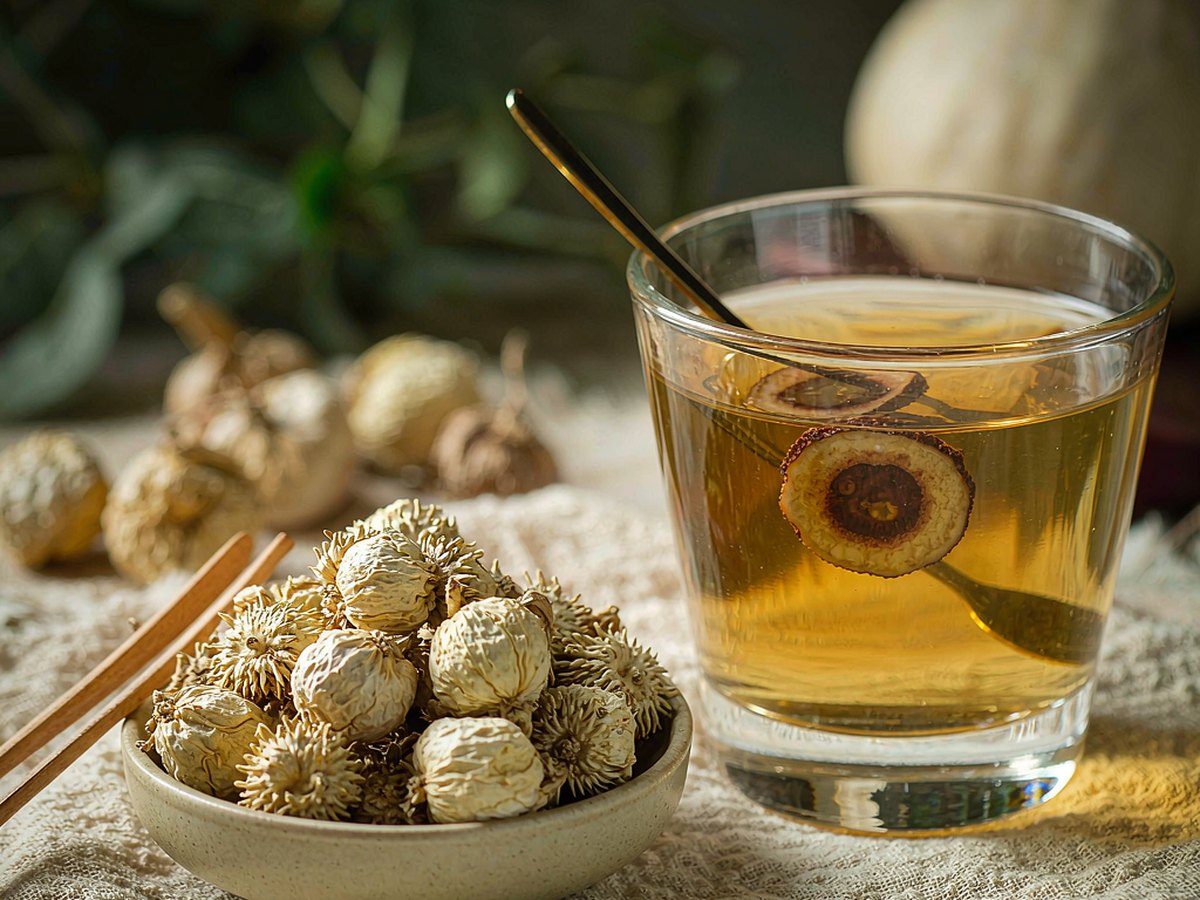
Monk fruit is a round, papery-shelled fruit that contains one of the sweetest compounds known in nature — mogroside — several hundred times sweeter than sugar by weight. It is used in the west as a sugar substitute for that reason. It is also used in Chinese medicine as a cooling herb for coughs and sore throats, and it has been drunk as a sweet tea in Guangdong and Guangxi for centuries.
- Botanical
- Siraitia grosvenorii — a climbing vine of the gourd family (Cucurbitaceae), related to gourds and cucumbers, not to any fruit you would expect.
- Part used
- The whole dried fruit, or the flesh and pith inside the brittle shell. Most commercial extracts are made from the flesh; the whole dried fruit is the traditional form.
- Origin
- Guangxi and Guangdong in southern China, where it grows wild in the limestone hills and is still largely gathered rather than farmed. Also now grown in Thailand.
- Flavour
- Very sweet with a clean, slightly cooling aftertaste. No sugar, no calorie, and no bitter note once the shell is removed.
- Use
- One dried fruit per 200 ml, or 2–3 g of the flesh. The fruit must be cracked or cut, and the hard seeds removed, or it will not brew.
- Keeps
- 12–18 months sealed. The brittle shell protects the contents extremely well.
The shell, and why it matters
The monk fruit shell is genuinely hard and brittle, more like a nut husk than fruit skin. Inside it is the pith, which is where the sweetness is, and inside that are flat black seeds. If you put a whole unbroken fruit in hot water, very little happens — the shell does not yield.
That is why every preparation cracks it first. Traditionally the shell is broken with a wooden mallet or the flat of a knife, the seeds are picked out, and the pith goes into the pot. It will not dissolve; it dissolves into the water as the sweet compounds disperse, leaving a pale amber drink.
The other traditional preparation is a decoction of the whole crushed fruit with a long simmer, which produces a darker, stronger liquid used for cough mixtures.
A cooling remedy for the throat
In Chinese medicine luo han guo is classed as cool and sweet, and it is used for exactly what you would expect from something sweet and cooling: a dry, irritated throat, a cough with phlegm, and heat in the lungs.
It is a genuine classical ingredient rather than a modern discovery. It appears in classical formulas for throat pain and for cough, and it is also the base of the widely sold Luo Han Guo throat lozenges and of the herbal drinks sold in Chinese supermarkets for summer heat.
The cooling quality is the reason it appears in so many summer drink blends alongside chrysanthemum, honeysuckle and the bean teas. On a hot day, a sweet, cool, non-caffeinated drink that actually tastes good is a genuine article rather than a compromise.
Why the west adopted it
The commercial interest in monk fruit arrived because it is intensely sweet and contains none of sugar and essentially no calories. The sweetness comes from mogrosides, and the best of them are many hundreds of times sweeter than sucrose by weight, so a tiny amount of a purified extract does the work of a large amount of sugar.
The practical advantages over sugar are real: it does not spike blood glucose the way sucrose does, it survives heat better than many artificial sweeteners, and it has a clean flavour rather than a metallic one. Its disadvantages are equally real: it is expensive, it does not brown or caramelise the way sugar does, and it has no structural role in baking, so a baked good made with it behaves differently.
None of that makes it a health food. It is a sweetener. Used in the quantity the label suggests, it is a reasonable swap; used by the spoonful, it is a lot of sweetness.
What it is used for
- Sweetening One of the few natural intense sweeteners that is not a sugar. Mogrosides are hundreds of times sweeter than sucrose by weight, so a small quantity does the work of a lot of sugar.
- Cough and sore throat A classical Chinese use: a cooling, moistening remedy for an irritated throat and for a cough with phlegm.
- Cooling in heat Used in the traditional summer cooling drinks of southern China, alongside chrysanthemum and honeysuckle.
- Blood glucose Because it does not raise blood glucose the way sugar does, it is used by people managing blood sugar. That is a dietary fact, not a treatment for diabetes.
- Antioxidant activity The fruit contains carotenoids and polyphenols with laboratory antioxidant activity.
- Digestive comfort Traditionally used for a heavy or unsettled digestion, and it is said to be easier on the stomach than sugar.
In the kitchen
- Straight infusion One cracked fruit, seeds removed, in 200 ml of hot water for three minutes. Sweet, cool, amber.
- Cooling summer drink Monk fruit with chrysanthemum and honeysuckle, served cold over ice.
- Cough decoction The crushed whole fruit simmered in 500 ml of water for 30 minutes, strained and taken warm. The classical preparation.
- Cocktail sweetener A syrup made from the pith, which dissolves the monk fruit sweetness into a syrup that keeps.
- Baking Use the syrup or the pureed pith rather than a powdered extract — the pith carries moisture and behaves more like sugar.
The main caution is the seeds. They are not meant to be eaten, they are bitter, and in a broken whole fruit they should be picked out before brewing. A cup brewed with the seeds in is unpleasant.
I
f
y
o
u
a
r
e
p
r
e
g
n
a
n
t
,
n
u
r
s
i
n
g
,
o
r
m
a
n
a
g
i
n
g
d
i
a
b
e
t
e
s
,
a
s
k
a
c
l
i
n
i
c
i
a
n
b
e
f
o
r
e
u
s
i
n
g
m
o
n
k
f
r
u
i
t
r
e
g
u
l
a
r
l
y
.
M
o
n
k
f
r
u
i
t
i
s
a
l
s
o
k
n
o
w
n
t
o
h
a
v
e
a
m
i
l
d
l
a
x
a
t
i
v
e
e
f
f
e
c
t
a
t
h
i
g
h
d
o
s
e
s
,
w
h
i
c
h
i
s
w
o
r
t
h
k
n
o
w
i
n
g
i
f
y
o
u
a
r
e
u
s
i
n
g
i
t
a
s
a
s
u
g
a
r
r
e
p
l
a
c
e
m
e
n
t
i
n
q
u
a
n
t
i
t
y
.
Disclaimer
This article describes a traditional herb and a modern sweetener. Monk fruit does not treat a cough, a sore throat or any other condition, and it is not a treatment for diabetes. If you have a persistent cough or throat pain, see a clinician. Speak to your doctor before changing your sugar intake if you are managing blood sugar.