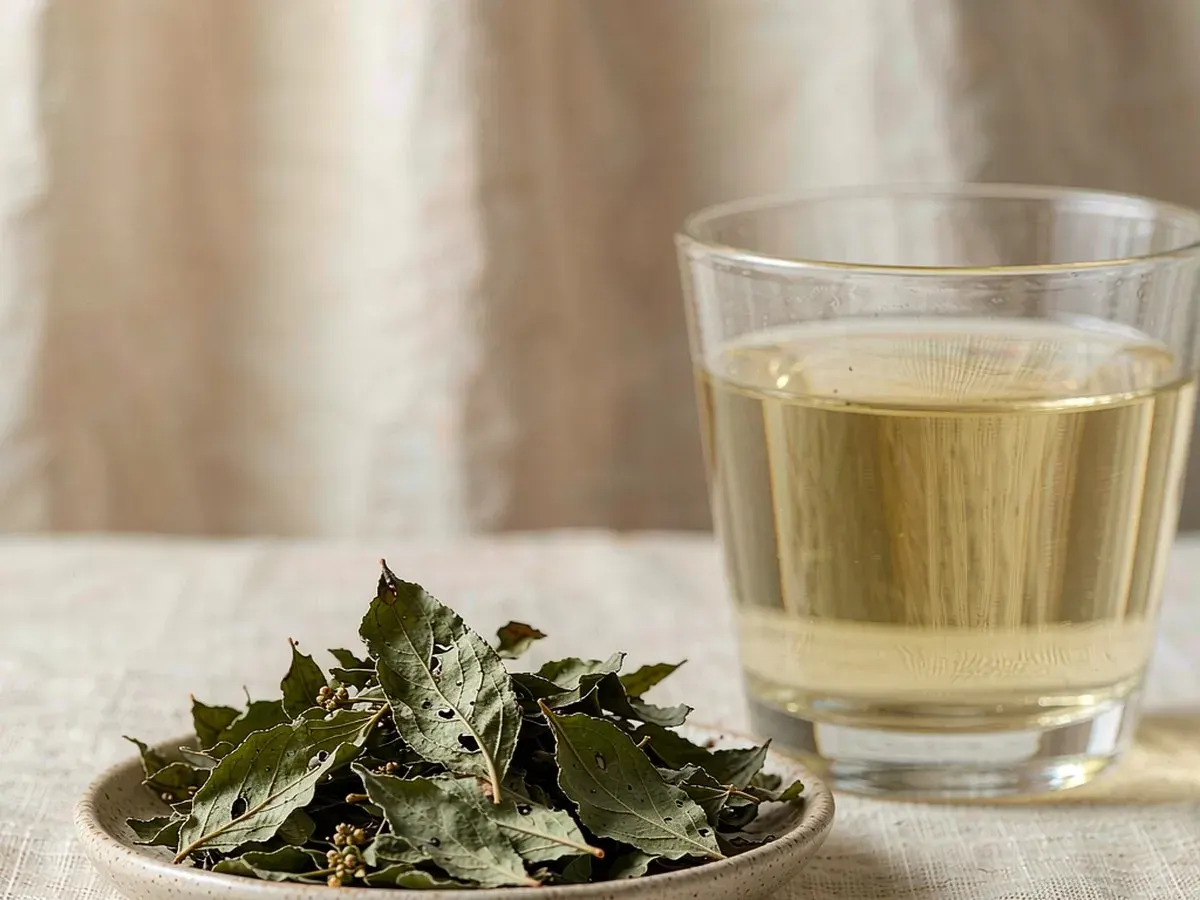
Stevia is the only sweet thing in this shop that is not a sugar, a syrup, or a honey. It is a South American leaf that the Guaraná people of Paraguay have used as a sweetener for centuries, and that most of the rest of the world met only in the 1970s. It is also, in the simplest sense, an unusual plant here: it is not a classical Chinese herb at all.
- Botanical
- Stevia rebaudiana — a perennial of the family Asteraceae, the same family as chrysanthemum and dandelion. It is a small, bushy, grey-green plant native to the highlands of northeastern Paraguay.
- Part used
- The dried leaf, whole or torn. This is the leaf, not the white crystalline extract sold as a sweetener powder.
- Origin
- Paraguay, where it grows wild in the Ipecamú region. Planted commercially in Paraguay, Brazil, China, India and Kenya since the 1970s.
- Flavour
- Intensely sweet, with a faint green bitterness and a trace of liquorice in the aftertaste. There is no sugar and no caramel note.
- Use
- 1–2 g of leaf per 200 ml, steeped 5–7 minutes in water just off the boil. Less is more; it is very easy to overdo it.
- Keeps
- 18–24 months sealed and dry. The leaf loses aroma faster than it loses sweetness.
A leaf, not a sweetener
The single most useful thing to know about stevia is the difference between the leaf and the extract. The leaf is a whole dried plant part, and it contains a mixture of glycosides — stevioside, rebaudioside A, rebaudioside B and others — along with chlorogenic acids, flavonoids and a whole set of aromatic compounds that a purified extract simply does not contain.
Refined stevia extract is typically 50 to 300 times sweeter than sugar, and it is the extract that most of the stevia in the supermarket is. Whole leaf is roughly 20 to 30 times sweeter than sugar, which is still extraordinary, and it tastes different: greener, more herbal, with a bitterness that the purified version has had stripped out.
This is why a whole stevia leaf infusion does not taste like a sweet drink with herbs in it, the way a granulated sweetener does. It tastes like a sweet herb. That is a feature, and it is also why stevia leaf is usually blended with something aromatic.
What Paraguay knew and the rest of the world did not
The Guaraná people of Paraguay and Brazil used the leaf long before it was written down, calling it kirundi, and they chewed it for sweetness and used it in a infusion they prepared for digestive complaints. When the plant was scientifically described in 1899 by Moisés Santiago Bertoni, a Swiss-born botanist working in Paraguay, the industrial world did not take much notice.
What changed everything was the 1970s, when Japanese researchers worked out how to extract the sweet glycosides efficiently and the compound was commercialised. Japan became the largest producer, and China, with its own wild stevia in the southwest, followed. What was a regional plant became an industrial crop in about twenty years.
Its place in the Chinese pharmacy is still marginal, and it is worth being honest about that: in the classical literature it simply does not appear. It is used in China today as a food additive and a sweetener, and in a small number of modern formulas as a flavouring. It is not one of the classical herbs, and anyone who tells you it has two thousand years of Chinese medicinal use is thinking of a different plant — usually liquorice.
What it is actually used for
Stevia is used for one thing above all others, and it does that one thing extremely well: it makes things taste sweet without contributing sugar, and therefore without contributing calories or a blood-glucose load.
Beyond that, traditional use divides into two traditions. In the South American herbal tradition, the leaf was used as a digestive and as a mild diuretic, taken as an infusion for stomach discomfort. In the modern Chinese food and herbal industry, it is used as a sweetener and flavouring, and it is the base sweetener of many low-sugar herbal drinks and confectioneries.
There is a substantial body of research on stevia and blood glucose, and it needs careful reading. Most of it is in cell cultures, most of it is in rodents, and the doses used in animals are usually far higher relative to body weight than the doses a person would drink. Human studies exist and are generally small and short. This is a genuine research area with interesting preliminary results, not a proven treatment for anything.
The bitterness, and how to live with it
Stevioside is the sweetest compound but it is also the one with the most bitterness, and it is the compound that dominates in a whole leaf. Rebaudioside A is sweeter and less bitter, and it is what the commercial purification processes concentrate.
This means a whole-leaf infusion is a balance you have to manage: more leaf means more sweetness but also more green bitterness, and the bitterness arrives first, because the glycosides are more water-soluble than the aromatic compounds that soften them. Steeping for a long time in very hot water makes it worse, not better.
Three practical adjustments. Use less leaf than you think — start at one gram per cup, not two. Steep in water a few degrees below boiling, for five minutes rather than ten. And pair it with something aromatic and slightly bitter that gives the green notes somewhere to go: a slice of dried ginger, a piece of chen pi, a few jasmine blossoms, or a spoon of the leaf steeped cold overnight.
What it is used for
- Natural sweetness The primary use: sweetening without sugar, without calories, and without a blood-glucose load. In a whole-leaf infusion the sweetness is gentler and more herb-like than a granulated sweetener.
- Digestive comfort, traditional use In the South American tradition, the leaf infusion was used for stomach discomfort and as a mild diuretic. This is a record of traditional practice, not a demonstrated clinical effect.
- Blood-glucose research Stevioside and rebaudioside A have been studied in cells and animals for glucose-handling effects. Human trials are small and short, and the results do not make stevia a treatment for diabetes or a replacement for medication.
- Weight and calorie management Because it adds sweetness without calories or sugar, it is used as a sugar replacement in weight-conscious formulations. This is a straightforward nutritional fact rather than a therapeutic claim.
- Oral and dental context Sugar-free use is relevant to dental health, since the sweetness comes without the fermentable sugar that oral bacteria act on. It is a useful property in a beverage blend, though it says nothing about the acidity of the drink it is added to.
- Modern Chinese food use In China it is a regulated food additive and a flavouring, used in low-sugar drinks, dairy products and confectionery. It is not one of the classical Chinese herbs and has no place in a classical formula.
In the kitchen
- Straight leaf infusion One gram of dried leaf per 200 ml of water just off the boil, steeped five minutes. Sweet, green, faintly liquorice.
- Cold steep overnight A gram or two in a bottle of cold water, left in the fridge overnight. Much better for the bitterness, and the sweet compounds come out slowly without the harsh green edge.
- With chen pi A small piece of aged tangerine peel with half a gram of stevia. The peel’s citrus oil carries the sweetness and hides the grass note — probably the best-known Chinese kitchen use of the plant.
- With dried ginger A slice of dried ginger and half a gram of stevia, simmered briefly. Warming, and it makes the leaf taste like a tea rather than a sweetener.
- As a sweetener in a herbal blend Used at roughly one part by weight in a leaf blend, which is enough to soften a bitter or astringent brew without taking it over.
- With jasmine Stevia leaf with a few jasmine blossoms. The floral fragrance covers the green edge particularly well.
Stevia is very widely consumed as a sweetener and is not a concerning substance for most people, but a few points deserve care. There is no well-established safe dose for concentrated extracts, and products vary enormously in strength. Anyone with a blood-glucose condition, or anyone on medication that affects blood sugar, should speak to a clinician before using stevia regularly.
P
r
e
g
n
a
n
c
y
a
n
d
n
u
r
s
i
n
g
a
r
e
t
h
e
a
r
e
a
s
w
h
e
r
e
t
h
e
l
e
a
s
t
i
s
k
n
o
w
n
,
a
n
d
t
h
e
p
r
u
d
e
n
t
c
o
u
r
s
e
i
s
t
o
k
e
e
p
i
t
t
o
o
r
d
i
n
a
r
y
f
o
o
d
–
l
e
v
e
l
u
s
e
r
a
t
h
e
r
t
h
a
n
m
a
k
i
n
g
i
t
a
d
a
i
l
y
h
a
b
i
t
.
A
s
m
a
l
l
n
u
m
b
e
r
o
f
p
e
o
p
l
e
r
e
p
o
r
t
d
i
g
e
s
t
i
v
e
d
i
s
c
o
m
f
o
r
t
o
r
,
w
i
t
h
h
i
g
h
i
n
t
a
k
e
s
o
f
c
e
r
t
a
i
n
e
x
t
r
a
c
t
s
,
n
a
u
s
e
a
.
I
f
y
o
u
a
r
e
g
i
v
i
n
g
i
t
t
o
a
c
h
i
l
d
,
n
o
t
e
t
h
a
t
c
o
n
c
e
n
t
r
a
t
e
d
s
t
e
v
i
a
p
r
o
d
u
c
t
s
a
r
e
a
d
i
f
f
e
r
e
n
t
c
a
t
e
g
o
r
y
f
r
o
m
a
l
e
a
f
i
n
f
u
s
i
o
n
.
Disclaimer
Stevia leaf is a sweet leaf, not a medicine, and the research interest around it does not make it a treatment for diabetes, weight loss, blood pressure or any other condition. Do not use it in place of prescribed care, and if you have diabetes, are pregnant or nursing, or take medication that affects blood sugar, ask your doctor or pharmacist before making it a daily drink.