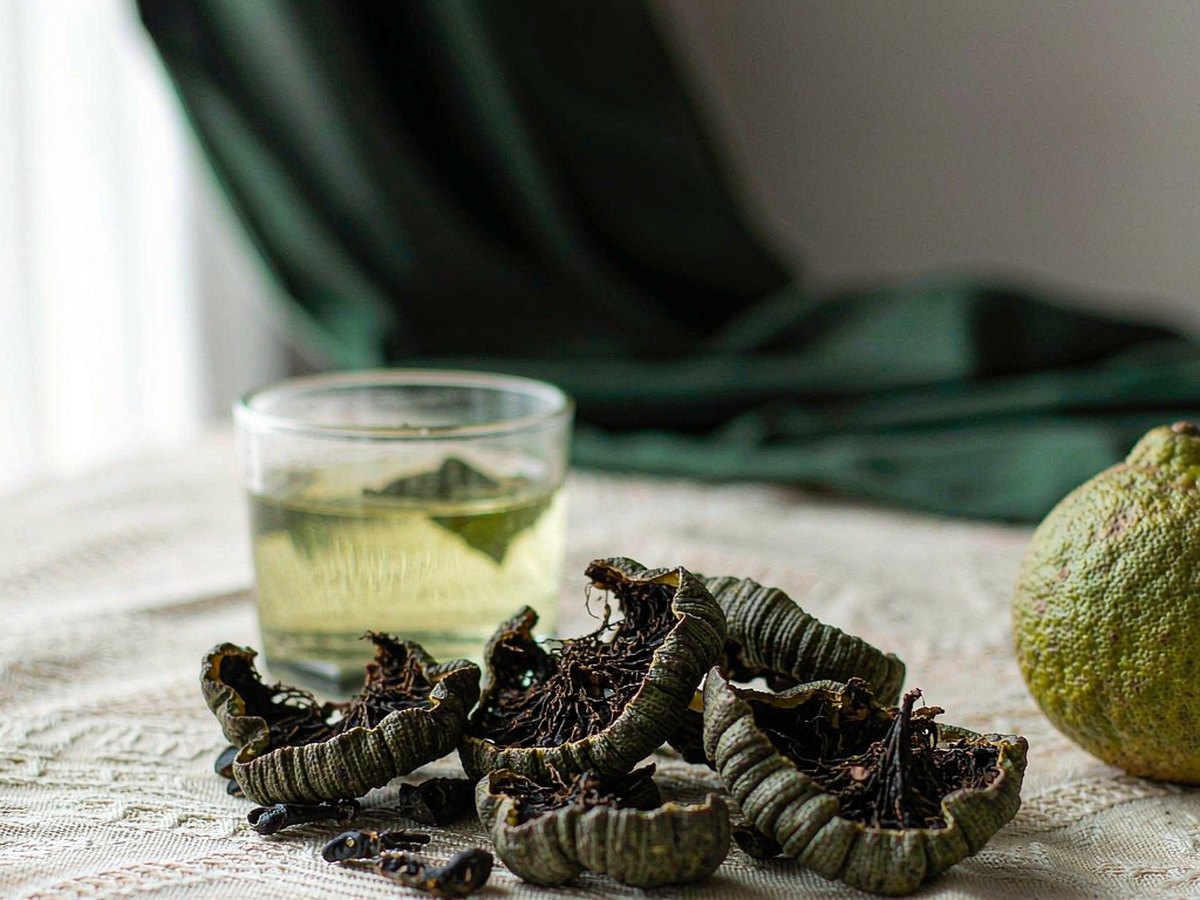
Zhi Shi is the immature fruit of the sour or bitter orange, harvested while still small and green and dried in cross-cut slices. In the Chinese pharmacy it is the most forceful of the qi-moving fruit herbs, and it is the ingredient at the centre of one of the great classical formulas of the digestive system.
- Botanical
- Citrus aurantium — the bitter or sour orange, and also Citrus reticulata immature fruit in some supply chains. The fruit is unripe when harvested.
- Part used
- The whole immature fruit, dried and cut into halves or thick cross-sections with the peel and pulp both intact.
- Origin
- Sichuan, Jiangxi, Hubei, Fujian and Hunan. Sichuan and Jiangxi are the traditional sources.
- Flavour
- Bitter and sharp, with a citrus acidity and a slight smoky edge from the peel, and no sweetness at all.
- Use
- 3–6 g per 200 ml, decocted and simmered 15–20 minutes. This is not a tea you can pour over and leave.
- Keeps
- 12–18 months sealed and dry. It is a dense, hard material and keeps better than most fruit herbs.
The difference between zhi shi and zhi ke
Chinese medicine uses two closely related immature citrus fruits, and they are not interchangeable. Zhi Ke is the immature peel of the Citrus reticulata, and it is the gentler of the two — aromatic, dispersing, and much less draining. Zhi Shi is the immature whole fruit of the bitter orange, with the pulp still inside, and it is markedly more powerful.
The reason is straightforward. Zhi Shi contains the pulp, and with it a quantity of organic acids that act on the gut. Zhi Ke is peel only. In traditional terms, zhi shi moves qi with force and pushes downward; zhi ke moves qi more gently and outward.
It is a distinction that matters in practice: a formula using zhi ke can be taken regularly, while zhi shi appears in formulas for acute, sharp, blocked situations, and is used for a shorter time.
The classical formula
Zhi Shi appears in Zhi Shi Dao Zhi Wan, the Intestinal Vitality Pill, which is one of the most widely used classical formulas in the Chinese pharmacy and one of the most readily available as a modern patent medicine. The formula is built around zhi shi and zhi ke together, with the supporting herbs rhubarb, moutan and mirabilite.
The traditional picture it addresses is a hard, stubborn blockage in the intestines — constipation with fullness and distension — and its action is described as breaking up what is accumulated and pushing it downward. This is genuinely powerful, and it is also genuinely not something to self-prescribe.
Zhi shi also appears in a great many formulas with a more modest role, and in classical dietary practice, where a slice of immature citrus was used as a digestive.
How it behaves in a kitchen
Outside the pharmacy, immature bitter orange is a real culinary ingredient in southern China and Taiwan, where it is preserved and used in braises and in hot and sour soups, where its sharp acidity is the point.
It is also used in the fruit-and-vegetable preserves that Chinese cooking relies on, and its dried form has a smoky, fermented edge that aged tangerine peel does not have.
In tea, the honest advice is that zhi shi is strong enough that it should be blended. One or two slices with a piece of aged chen pi, a little ginger and a pinch of rock sugar makes a genuinely good digestive cup that is aggressive without being unpleasant. A slice on its own in hot water tastes of almost nothing, because the active material is not water-soluble.
What it is used for
- Breaking up intestinal blockage The strongest traditional indication: for hard, stubborn constipation with fullness and distension, in the classical formula Zhi Shi Dao Zhi Wan. This is a supervised indication.
- Moving qi downward Classified as a strongly descending qi-moving herb, used for pressure and distension that will not resolve.
- Food stagnation Used with aromatic herbs for the heavy, clogged feeling after overeating.
- Phlegm Appears in formulas for chest congestion, with its descending action used to move phlegm downward.
- Digestive stimulation A strong bitter that stimulates gastric secretion and appetite.
- Culinary acidity Preserved in southern Chinese cooking for a sharp, smoky citrus acidity.
In the kitchen
- Digestive cup Two slices with a piece of aged chen pi, a slice of ginger and a pinch of rock sugar, simmered fifteen minutes.
- Hot and sour soup A slice in a hot-and-sour soup broth, where the acidity is the point.
- Preserved citrus The traditional southern Chinese method — slices preserved in salt or brine and used in braises.
- Braises A slice added to a pork or duck braise for a sharp, fermented lift.
- Blend discipline Never more than two or three slices in a pot, and never without something aromatic to balance it.
Zhi Shi is genuinely powerful and it genuinely drains. It is not a daily tea, and it is not something to take for a week because you liked it. Traditional sources advise against it during pregnancy, and it should not be used by anyone with a sensitive gut or a tendency towards diarrhoea.
B
e
c
a
u
s
e
i
t
a
c
t
s
o
n
t
h
e
g
u
t
a
n
d
p
u
s
h
e
s
d
o
w
n
w
a
r
d
,
i
t
i
n
t
e
r
a
c
t
s
w
i
t
h
a
r
a
n
g
e
o
f
m
e
d
i
c
a
t
i
o
n
s
,
i
n
c
l
u
d
i
n
g
l
a
x
a
t
i
v
e
s
,
b
l
o
o
d
–
p
r
e
s
s
u
r
e
d
r
u
g
s
a
n
d
s
o
m
e
a
n
t
i
b
i
o
t
i
c
s
.
I
f
y
o
u
a
r
e
o
n
a
n
y
r
e
g
u
l
a
r
m
e
d
i
c
a
t
i
o
n
,
a
s
k
a
c
l
i
n
i
c
i
a
n
b
e
f
o
r
e
u
s
i
n
g
i
t
.
Disclaimer
Zhi Shi is one of the most active herbs in the Chinese pharmacy and its classical indications involve acute, supervised treatment. This article is written for a kitchen and a tea tray. Do not use zhi shi to treat constipation or any other condition, do not use it in place of prescribed treatment, and consult a qualified practitioner before using it medicinally.