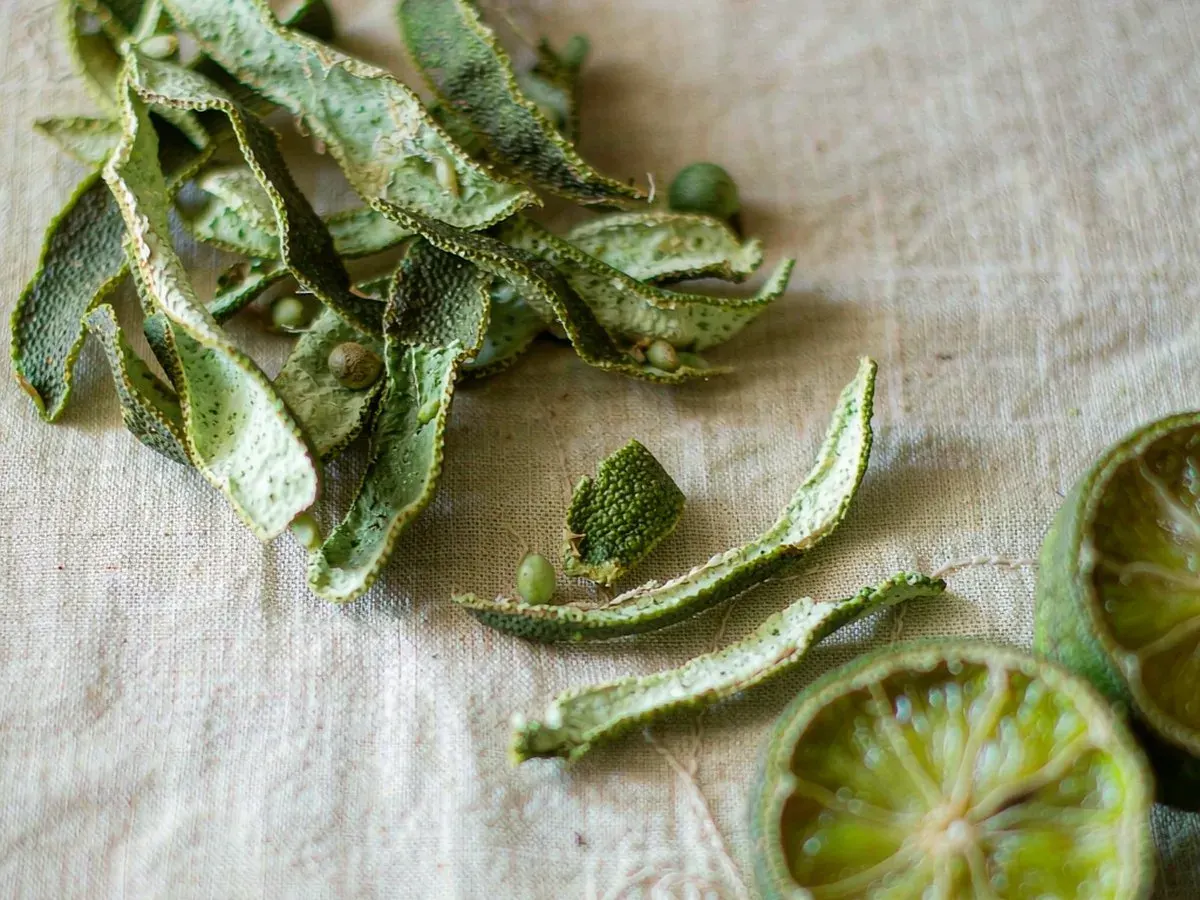
Green tangerine peel — qing pi — is the peel of an unripe tangerine, dried while still green. It is the most bitter and most forceful member of the Chinese citrus family, and it belongs to a completely different tradition from aged chen pi. Chen pi is a slow, sweet background note; qing pi is a sharp tool for cutting through rich, heavy food.
- Botanical
- Citrus reticulata immature fruit peel (Citri Reticulatae Pericarpium Viride). The same species as aged chen pi, harvested weeks or months earlier and dried differently.
- Part used
- The peel of the immature fruit, cut into strips or slices while fresh and green, then dried. The white pith is usually removed or largely excluded.
- Origin
- Guangdong, Guangxi, Sichuan, Fujian and Zhejiang. The traditional reference area for the fruit is Xinhui in Guangdong.
- Flavour
- Fiercely bitter, pungent and aromatic, with a green citrus edge and none of the honeyed warmth of aged peel.
- Use
- 1–2 g per 200 ml, and usually decocted rather than infused — simmered 10–15 minutes. In the kitchen, one small piece per pot.
- Keeps
- 18–24 months sealed and dark. It is more resilient than aged peel and less likely to mould if it is genuinely dry.
Green and mature are two different herbs
The Chinese pharmacopoeia lists both, and it is worth knowing which is which because they are used for entirely different purposes. Qing pi is the young peel and is described as pungent, bitter, warm, and strong in moving qi. Chen pi is the aged peel and is described as bitter, pungent, warm and gentle, with a much slower, more harmonious action.
The practical difference is the amount of white pith left on. Chen pi is dried and stored until the pith has sweetened and darkened into something dense and resinous. Qing pi is trimmed while it is still young and firm, so the material stays thin, oily, sharply aromatic and hard.
The consequence in a cup is stark. One small piece of qing pi will dominate a pot for a long time; a piece of aged chen pi will sit quietly in the background for an hour.
Why the bitterness is the point
In traditional practice qing pi is used to break up what is called food stagnation — the heavy, sluggish feeling that follows a rich meal — and to disperse what is called qi clumps. Its bitterness and pungency are the mechanism. A herb that does nothing would not be used for this.
It appears in one of the best-known digestive formulas in the entire pharmacopoeia, San Zi Yang Qin Tang, the Three-Seed Filial Piety Decoction, in which white mustard seed, radish seed and bitter orange seed are used together. That formula was designed for exactly the congested, heavy feeling of overeating, and it is still prescribed by practitioners today.
Because it is that strong, qing pi is not a casual daily tea. It is taken when needed, in small amounts, and it is one of the herbs that traditional sources advise against during pregnancy and in people with weak qi.
In the kitchen
The best-known culinary use is in Cantonese and Fujian cooking, where a small piece of green peel goes into a stir-fry of prawns or squid. The peel cuts the richness of the fat and the sharp citrus aroma against the sweetness of the shellfish.
It is also used in the sauce for steamed fish, and in marinades for fatty pork belly, where the bitterness is doing exactly what a little grated lemon would do in a western kitchen — except much more forcefully.
In tea, qing pi appears in the classic digestive blends alongside aged chen pi and Sha Ren, where the two peels play complementary roles: the aged peel for depth and warmth, the green peel for the sharp note that cuts through.
What it is used for
- Digestive stagnation The principal traditional use: breaking up the heavy, clogged feeling after rich or excessive food, and moving what Chinese medicine calls food stagnation.
- Moving qi Classed as a strong qi-moving herb, used for distension, pressure and a feeling of something stuck in the abdomen.
- Clearing dampness Used in combination with aromatic herbs in formulas for what traditional medicine calls damp accumulation — heaviness, sluggishness and a sticky mouth.
- Phlegm Appears in formulas for chest congestion and phlegm, always alongside aromatics that keep it moving.
- Fat-cutting in cooking Its culinary role: a sharp, bitter citrus note that takes the edge off rich meat and shellfish.
- Aromatic quality Strongly fragrant for a citrus peel, which is why it appears in so many of the aromatic digestive formulas.
In the kitchen
- Green peel prawns The canonical Cantonese dish: a small piece of green peel with the prawns, aromatic and sharp against the fat.
- Steamed fish A thin strip in the steaming liquid or in the hot oil poured over the fish at the end.
- Marinade for pork belly The bitterness cuts the fat in a red-braised or steamed belly.
- Digestive tea blend One piece each of green peel, aged chen pi and Sha Ren, simmered ten minutes and drunk after a heavy meal.
- Pickles and preserved vegetables A small piece in a brine for a sharp, clean lift.
Qing pi is genuinely strong and genuinely bitter, and it is easy to use too much. One small piece per pot, simmered rather than steeped, is a full dose. If a cup is aggressively bitter and numbing, use half a piece next time.
I
t
i
s
t
r
a
d
i
t
i
o
n
a
l
l
y
a
v
o
i
d
e
d
d
u
r
i
n
g
p
r
e
g
n
a
n
c
y
,
a
n
d
b
y
p
e
o
p
l
e
w
i
t
h
w
e
a
k
q
i
o
r
a
t
e
n
d
e
n
c
y
t
o
d
i
z
z
i
n
e
s
s
,
b
e
c
a
u
s
e
o
f
i
t
s
d
i
s
p
e
r
s
i
n
g
a
n
d
d
r
y
i
n
g
a
c
t
i
o
n
.
I
t
a
l
s
o
d
r
i
e
s
t
h
e
m
o
u
t
h
a
n
d
c
a
n
a
g
g
r
a
v
a
t
e
d
r
y
n
e
s
s
o
r
h
e
a
t
c
o
n
d
i
t
i
o
n
s
.
A
n
y
o
n
e
o
n
m
e
d
i
c
a
t
i
o
n
s
h
o
u
l
d
a
s
k
a
c
l
i
n
i
c
i
a
n
b
e
f
o
r
e
u
s
i
n
g
i
t
r
e
g
u
l
a
r
l
y
.
Disclaimer
Qing pi is a real medicine in Chinese practice and it is not a mild tea. This article describes traditional use and kitchen practice; it is not a recommendation to treat any condition with it. Do not use it in place of prescribed treatment, and consult a qualified practitioner before using qing pi medicinally, particularly during pregnancy.