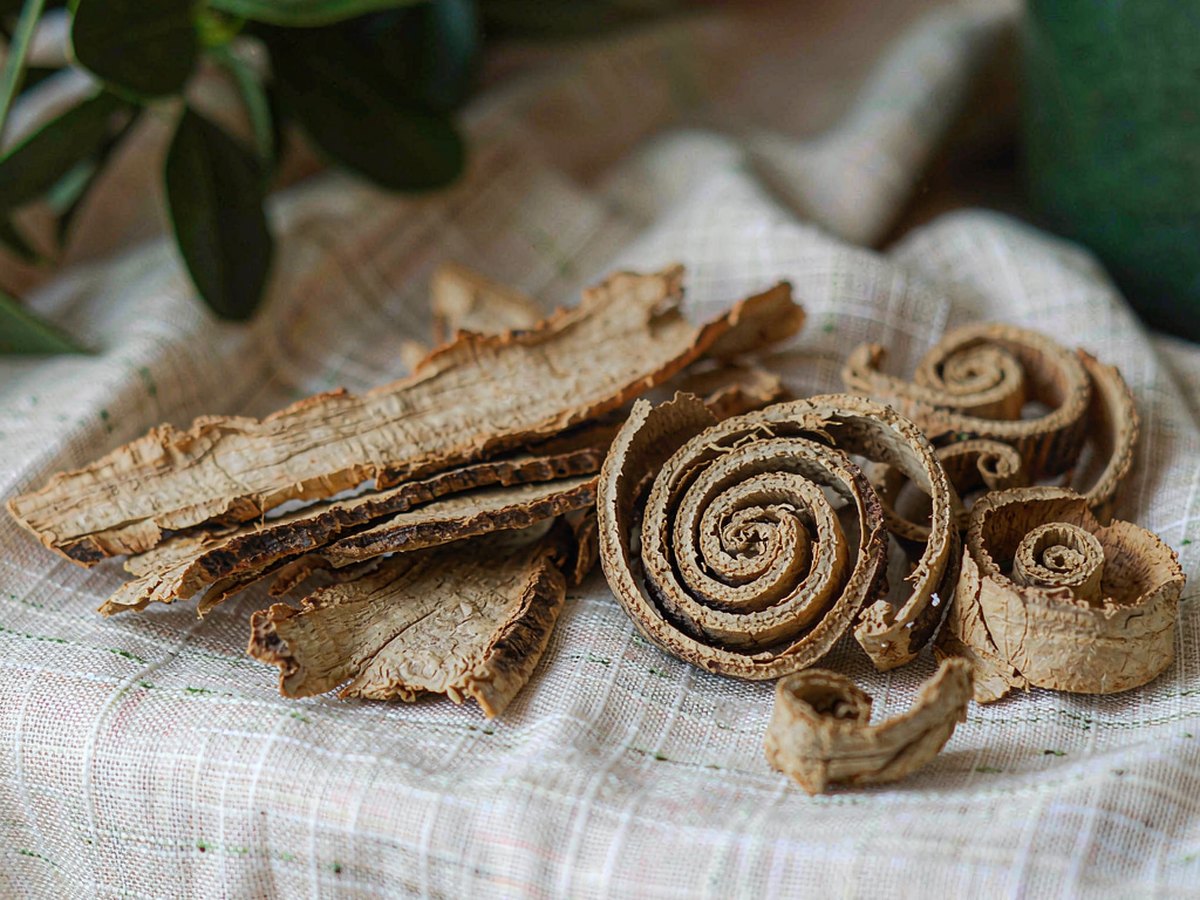
Sang Bai Pi is the inner bark of the white mulberry tree, stripped from the root and the lower trunk. It looks and tastes like nothing at all — pale, fibrous, almost flavourless — and it has been used in Chinese medicine for two thousand years for cough and for breathlessness. It is also one of the strangest materials in the whole herbal trade, because it works in a way that is hard to describe.
- Botanical
- Morus alba — the white mulberry, the tree whose leaves feed the silkworm. The bark of the root and the lower trunk is Sang Bai Pi.
- Part used
- The inner bark, stripped from the root and lower branches in spring, and the outer cork layer scraped away.
- Origin
- Anhui, Henan, Jiangsu, Zhejiang and Sichuan. Also grown in Korea and Japan, where it appears in the classical formulae of all three traditions.
- Flavour
- Almost nothing. Bland, faintly sweet, with no aroma at all. Its lack of flavour is one reason it is always decocted with aromatic herbs.
- Use
- 5–10 g per 200 ml, simmered 20–30 minutes. This is a decoction herb and no amount of steeping will extract it properly.
- Keeps
- 18–24 months sealed and dry. Fibrous bark stores very well and does not go musty if it is kept dry.
How mulberry bark is taken
This is the part that surprises people who have only met mulberry in tea. The material is not the whole bark and it is not the root. It is the inner bark, the whitish layer just beneath the grey cork, and it is taken from the root and the lower trunk in spring, when the sap is rising and the bark separates most easily.
Stripping it is a slow, skilled job: the outer cork is scraped away with a curved blade and the inner bark is peeled off in long ribbons, which dry into pale, slightly curled, tough strips. A well-prepared lot is a warm cream to pale straw colour with a fibrous, satin sheen. Grey-brown bark with cork still on it is a badly prepared lot and it will decoct slowly and disappointingly.
The plant it comes from is the white mulberry, Morus alba, the species whose leaves feed the silkworm and which is one of the most widely cultivated trees in China. Nothing about the tree is exotic; the tree is in every village.
What it is classically used for
Sang Bai Pi appears in one of the most recognisable classical formulas in the entire Chinese pharmacopoeia: Sang Bai Tang, which is two ingredients — mulberry bark and jujube — and is used for a cough with fever and a heavy, restricted feeling in the chest.
Its classical description is of a herb that descends lung qi and promotes urination, and it is described as being especially suitable for a cough that is accompanied by oedema — a picture that translates loosely to a wet-sounding cough with some swelling. It appears in a great many formulas where the aim is to clear the lungs without being harsh, and it is usually paired with an aromatic or a cooling herb to keep it balanced.
It is a good example of a herb whose traditional description is coherent and whose modern clinical use is thin. There is pharmacological work on mulberry bark’s flavonoids and on its effects on glucose metabolism, but the honest position is that Sang Bai Pi is a classical medicine used on the authority of a two-thousand-year text rather than on the strength of modern trials.
Why it is a decoction and not a tea
Mulberry root bark is nearly flavourless and its active constituents are not efficiently extracted by a short steep. A traditional decoction of 5 to 10 g in 200 ml, simmered for twenty to thirty minutes, produces a pale yellow liquid with a faint sweetness and a slightly slippery texture.
Because there is no aroma of its own, mulberry bark is almost always combined with something aromatic in a formula — with apricot kernel, with ginger, with licorice, with a citrus peel. That is not just for taste: in the classical system the combination is deliberate, and the blend is what makes the decoction pleasant enough to drink.
If you are making one at home, the ratio to remember is one third aromatic to two thirds mulberry bark by weight, and a twenty-minute simmer. It should taste like something, not like warm water.
What it is used for
- Cough with chest heaviness The principal classical use: for a cough accompanied by fever and a heavy, restricted feeling in the chest, classically in the formula Sang Bai Tang.
- Descending lung qi A herb used to make the breath move downward and outward, which in traditional terms describes what it does in a cough.
- Promoting urination Used to move fluid, and specifically for a picture where a cough comes with swelling. This is the second half of the classical action.
- Cooling without being cold Classed as cool but gentle, which is why it appears in formulas for lung heat rather than for lung cold.
- Glucose metabolism Mulberry bark contains 1-deoxynojirimycin, which inhibits alpha-glucosidase and is the basis of the acarbose drug class. That is a genuine pharmacological fact, but it is not a licence to use bark as a diabetes treatment.
- Blending A flavourless base that carries the aromatics it is combined with.
In the kitchen
- Sang Bai Tang The classical decoction: mulberry bark with jujube, simmered, taken warm.
- With ginger and jujube The version most people can actually drink — the bark provides the body and the ginger the warmth.
- Bark in a winter soup A few grams of bark in a long, gentle stock with dried dates and a slice of ginger.
- Paired with apricot kernel The other classical pairing, for a dry, irritating cough.
- Blending rule Never on its own. One third aromatic, two thirds bark, twenty minutes of simmering.
Sang Bai Pi is a cooling herb and a diuretic, and traditional sources advise against it in people with a cold, deficient constitution or with loose, watery stools. It is a decoction herb and not a casual drink.
B
e
c
a
u
s
e
i
t
a
f
f
e
c
t
s
f
l
u
i
d
b
a
l
a
n
c
e
a
n
d
g
l
u
c
o
s
e
m
e
t
a
b
o
l
i
s
m
,
i
t
i
n
t
e
r
a
c
t
s
w
i
t
h
d
i
u
r
e
t
i
c
s
a
n
d
d
i
a
b
e
t
e
s
m
e
d
i
c
a
t
i
o
n
,
a
n
d
i
t
m
a
y
a
g
g
r
a
v
a
t
e
t
h
e
e
f
f
e
c
t
s
o
f
b
l
o
o
d
–
p
r
e
s
s
u
r
e
d
r
u
g
s
.
A
n
y
o
n
e
o
n
m
e
d
i
c
a
t
i
o
n
,
o
r
w
i
t
h
k
i
d
n
e
y
c
o
n
d
i
t
i
o
n
s
,
s
h
o
u
l
d
a
s
k
a
c
l
i
n
i
c
i
a
n
b
e
f
o
r
e
u
s
i
n
g
m
u
l
b
e
r
r
y
b
a
r
k
.
Disclaimer
Sang Bai Pi is a genuine classical medicine with a real place in Chinese practice, and the indications described here are classical rather than clinically established. Do not use mulberry bark to treat a cough, diabetes, or any other condition, and do not use it in place of prescribed care.