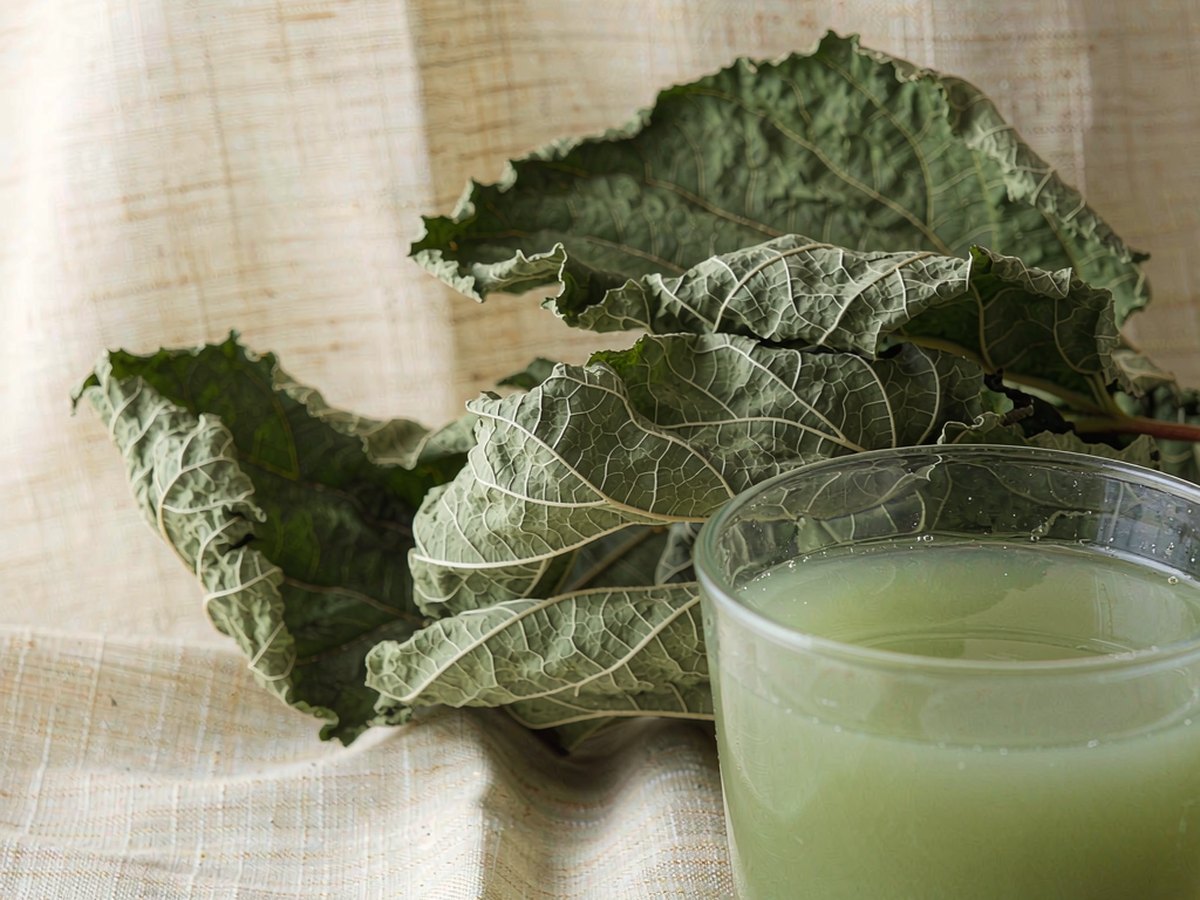
Mulberry leaf is a mild, faintly grassy green tea that happens to contain one of the better-studied plant compounds in the herbal world. It has been drunk in China for a thousand years as a remedy for fever and for the liver, and it is one of the very few traditional herbs whose mechanism of action is properly characterised.
- Botanical
- Morus alba — the white mulberry, the silkworm’s tree. The leaf, not the fruit, not the bark.
- Part used
- The dried leaf, usually whole and crumpled, or cut. Leaves picked before the fruit ripens are the most valued.
- Origin
- Anhui, Zhejiang, Jiangsu, Hubei, Sichuan and Guangdong, with Guangdong and Zhejiang producing the tea-grade crop.
- Flavour
- Mild and slightly grassy, with a faint sweetness and no bitterness. It tastes more like a green tea than like a medicinal decoction.
- Use
- 3–5 g per 200 ml, 80–85 °C, 2–3 minutes. Infused, not decocted — it is a leaf.
- Keeps
- 12 months sealed, dark and cool. The colour fades from a bright grey-green to a dull olive over that year.
The compound that makes it interesting
Mulberry leaf contains 1-deoxynojirimycin, a compound that inhibits alpha-glucosidase, the enzyme in the gut that breaks down starch into absorbable sugar. That is precisely the mechanism of the prescription drug acarbose, and it is why mulberry leaf has been studied more carefully than most traditional herbs.
The studies are extensive and mostly involve animals or small human trials, and they generally show reduced post-meal blood sugar. What they do not amount to is evidence that drinking mulberry leaf tea is an effective diabetes treatment, and the effect from a cup of tea is modest compared with a pharmaceutical dose.
The useful framing is this: mulberry leaf tea is a pleasant, low-sugar drink with a real and measurable effect on carbohydrate absorption — which is a genuinely different thing from saying it treats diabetes.
Why the leaves are picked young
The composition of the leaf changes as the plant moves towards fruiting. Young leaves, picked before the fruit develops, are higher in the flavonoids and lower in the more astringent components, and they are also simply better to drink.
In Chinese practice, mulberry leaf for fever is picked from the upper part of the branch, and there is a specific instruction attached: the stem should be removed. Stems are more fibrous and more bitter, and they make a distinctly worse infusion.
It is also worth knowing that mulberry leaf for tea is a different use from mulberry leaf for fever. The classical herb is mulberry leaf, and it is used for fever, for wind, and for the eyes. The tea use is a modern southern Chinese habit — it is drunk as a cooling drink through the summer and as a daily green-tea substitute.
The food connection
Mulberry leaves are the feed for silkworms, and the tree is grown for that reason as much as for any other. But the leaves of the white mulberry are also eaten, and they are good.
In Shandong and Jiangsu, a distinct noodle dish is made from mulberry leaf — the leaves are blanched, ground, and mixed with flour to make a green, faintly herbal noodle. In Korea, the leaves are used in a soup with tofu and garlic. In parts of southern China the young shoots are blanched and served cold.
The flavour is grassy and slightly sweet, and it works particularly well with sesame oil, garlic and a little salt. Fresh mulberry leaf is a genuine seasonal green, not a fallback.
What it is used for
- Blood sugar after meals Mulberry leaf’s alpha-glucosidase inhibition is real and well characterised, and it modestly slows the digestion of starch. It is a dietary effect, not a treatment for diabetes.
- Fever and wind in Chinese practice The classical use of Sang Ye: for fever, for the early stages of a cold, and for a red or itchy eye. This is a supervised, traditional indication.
- Cooling in summer Drunk as a cooling green drink through the hot months in southern China.
- Antioxidant activity The leaf is rich in flavonoids, including rutin and isorhamnetin, with well-documented laboratory antioxidant activity.
- Liver support in traditional use Classed as cool and as clearing liver heat, and used for a red, irritated eye.
- Nutritional value A genuinely good source of minerals, and a well-known leaf vegetable where it grows.
In the kitchen
- Mulberry leaf tea Four leaves in 200 ml at 80 °C for two minutes, re-steeped once. The stems are picked out.
- Mulberry leaf noodles Blanched leaves, ground, mixed with flour — a green, faintly herbal noodle from Shandong.
- Mulberry leaf soup With tofu, garlic and sesame oil, the Korean preparation.
- Blanched greens Young leaves blanched for thirty seconds and dressed with sesame oil, garlic and a little salt.
- Blending With goji, or with a light oolong. It takes the edge off a slightly heavy roasted tea.
Mulberry leaf is safe as a food and as a tea. The caution is entirely about the medication question: because it affects how carbohydrates are broken down and how the liver handles other compounds, it interacts with diabetes drugs, and it can cause low blood sugar if taken with them.
A
n
y
o
n
e
o
n
m
e
d
i
c
a
t
i
o
n
f
o
r
d
i
a
b
e
t
e
s
o
r
b
l
o
o
d
p
r
e
s
s
u
r
e
s
h
o
u
l
d
a
s
k
a
c
l
i
n
i
c
i
a
n
b
e
f
o
r
e
m
a
k
i
n
g
m
u
l
b
e
r
r
y
l
e
a
f
t
e
a
a
d
a
i
l
y
h
a
b
i
t
.
I
t
i
s
a
l
s
o
t
r
a
d
i
t
i
o
n
a
l
l
y
a
v
o
i
d
e
d
i
n
p
r
e
g
n
a
n
c
y
,
a
n
d
i
n
p
e
o
p
l
e
w
i
t
h
a
c
o
l
d
,
d
e
f
i
c
i
e
n
t
c
o
n
s
t
i
t
u
t
i
o
n
.
Disclaimer
Mulberry leaf has a real and documented effect on carbohydrate digestion, and that is a genuinely interesting thing about a plant. It is still not a diabetes treatment and it must not be used in place of prescribed medication. Anyone managing blood sugar should discuss it with their doctor rather than substituting a cup of tea for their treatment.