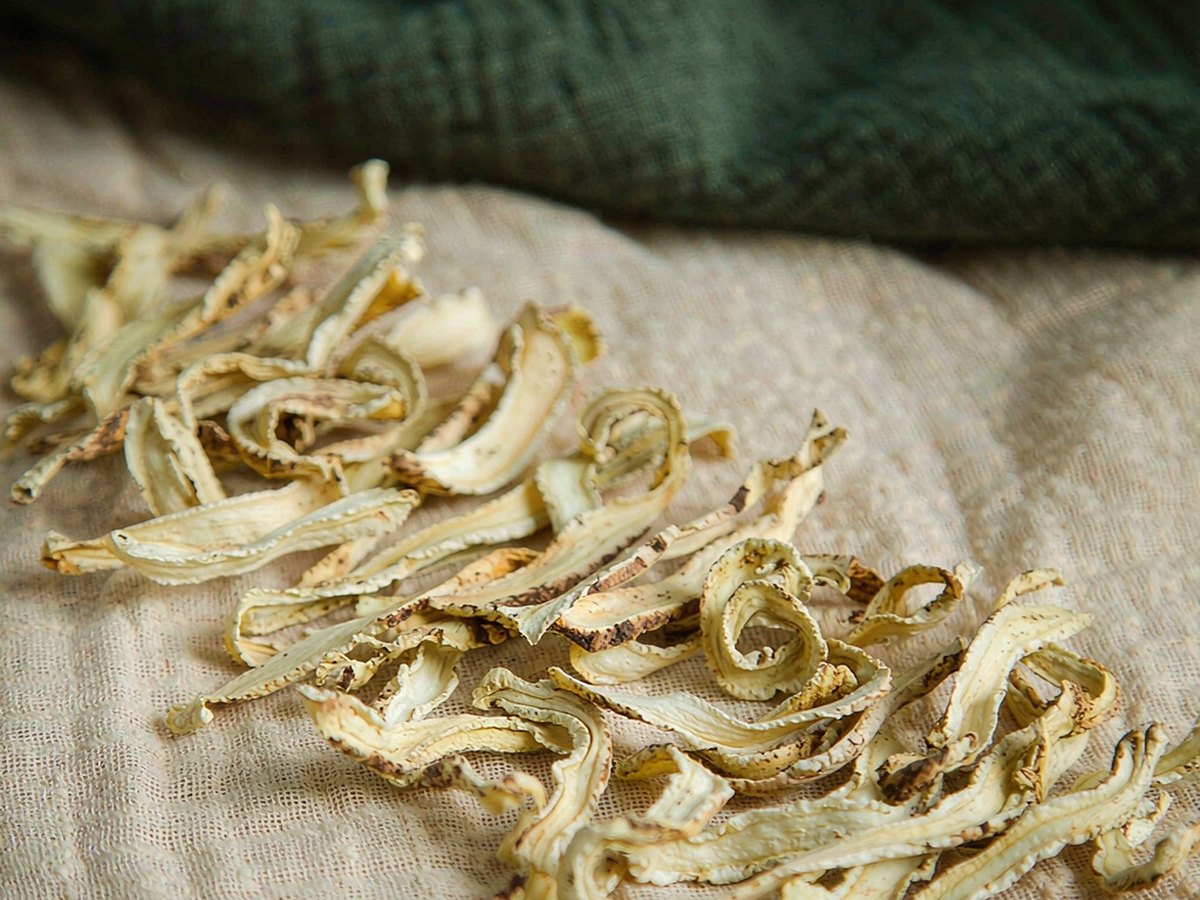
The goji berry is a household ingredient in half the world. Almost nobody knows about the root bark of the same shrub, which in Chinese medicine is Di Gu Pi — a cooling, unusual herb used for exactly the opposite purpose to the berry. The berry tonifies and warms; the root bark cools and clears.
- Botanical
- Lycium barbarum and Lycium chinense — the wolfberry or goji shrub. The fruit is the familiar goji; the root bark is Di Gu Pi.
- Part used
- The dried root bark, scraped off the roots and dried. It is a simple, pale, fibrous material.
- Origin
- Ningxia, Gansu, Xinjiang, Hebei and Shandong. Ningxia goji is the famous fruit region, and the bark comes from the same rootstock.
- Flavour
- Bland, faintly sweet, with no aroma. Like mulberry bark, it is nearly flavourless and is always combined.
- Use
- 5–10 g per 200 ml, simmered 20–30 minutes. A decoction herb.
- Keeps
- 18–24 months sealed and dry. Root bark keeps extremely well.
Two herbs from one shrub
The goji plant gives two of the most contrasting herbs in the Chinese pharmacopoeia. The fruit, Gou Qi, is classified as neutral to slightly cool and sweet, and it is a tonifying food-medicine that nourishes the liver and kidney and is used for a long list of deficiency pictures.
The root bark, Di Gu Pi, is classified as cold, and it clears deficiency heat. Where the fruit is a slow build, the bark is a fast clear — it is used for the specific picture of a person who is tired and run down but also feverish, flushed and irritable, with sweating, thirst and a rapid pulse.
The traditional rule is that they should not be used together, because the fruit’s tonifying action and the bark’s cooling action pull in opposite directions. That is a classical contraindication, and it is a good example of how specific the Chinese system is about combinations.
How the bark is taken
The bark is taken from the roots in the spring or the autumn, scraped and dried. It comes in strips of pale, thin, fibrous bark, yellowish to greyish white, and the strips curl slightly as they dry.
Good material is clean, thin and fibrous, and it breaks with a fibrous snap. Bark with soil clinging to it, or with the woody root still attached, is badly prepared, and the woody part is not the medicine.
Like mulberry root bark, it has almost no flavour and almost no aroma. Everything about how it is used follows from that: it is never drunk on its own, and in a classical formula it is always paired with an aromatic — with moutan, with anemarrhena, with a citrus peel.
The cooling use
Di Gu Pi is used for what traditional medicine calls deficiency heat, and the picture it describes is specific: someone who is fundamentally depleted — tired, thin, short of breath — but running hot. Feverish in the afternoon, flushed, sweating at night, thirsty, irritable, with a rapid, thin pulse.
That is a strange combination to a modern reader, and it is one of the more interesting ideas in the classical system: that a person can be weak and hot at the same time, and that cooling them without strengthening them is the correct approach. The herb is the cooling instrument in that situation, and it is usually used alongside herbs that nourish.
Modern research on Di Gu Pi is thin. What does exist concerns its flavonoids and its effects on glucose metabolism and on inflammatory markers, mostly in animal models. The clinical tradition here is old and coherent; the modern evidence base for it is not there.
What it is used for
- Clearing deficiency heat The principal classical use: for a depleted but feverish and flushed picture, with night sweating, thirst and a rapid pulse.
- Cooling without tonifying Classed as cold, and used deliberately where the tonifying herbs would make things worse. It is the cooling counterweight to the goji berry.
- Night sweating Traditionally used for the sweating that comes with the deficiency-heat pattern, particularly in combination with anemarrhena.
- Bone steaming Di Gu Pi is the classical herb in the practice called bone steaming, a Yuan-dynasty method of treating chronic illness with herbs and warm vapour. It is an odd and interesting piece of history.
- Antidiabetic research Lycium root bark extracts have been studied for effects on glucose metabolism and on inflammatory markers, mostly in animal models.
- Flavourless by design It is a neutral base herb, valued for what it does rather than for what it tastes like.
In the kitchen
- Di Gu Pi decoction 6–10 g simmered in 400 ml for 25 minutes. The classical preparation, and it needs an aromatic to be drinkable.
- With moutan and anemarrhena The classical pairing for the deficiency-heat picture.
- With a citrus peel A simpler blend for a kitchen — the peel makes it drinkable and keeps the cooling action.
- Not a cooking ingredient Unlike mulberry bark, this is not used in soups. It is a decoction herb and should be treated as one.
- Blending Half a teaspoon of bark in a pot of white tea with dried citrus, simmered rather than steeped.
Di Gu Pi is a cold herb with a clearing action, and traditional sources specifically warn against combining it with the goji berry, which is a warm, tonifying food-medicine. Using both together defeats the purpose of each.
B
e
c
a
u
s
e
i
t
c
l
e
a
r
s
h
e
a
t
a
n
d
c
o
o
l
s
,
i
t
i
s
t
r
a
d
i
t
i
o
n
a
l
l
y
a
v
o
i
d
e
d
i
n
p
e
o
p
l
e
w
i
t
h
a
c
o
l
d
,
d
e
f
i
c
i
e
n
t
c
o
n
s
t
i
t
u
t
i
o
n
,
w
i
t
h
l
o
o
s
e
s
t
o
o
l
s
,
o
r
w
i
t
h
c
o
l
d
h
a
n
d
s
a
n
d
f
e
e
t
.
A
n
y
o
n
e
o
n
m
e
d
i
c
a
t
i
o
n
s
h
o
u
l
d
a
s
k
a
c
l
i
n
i
c
i
a
n
b
e
f
o
r
e
u
s
i
n
g
i
t
r
e
g
u
l
a
r
l
y
.
Disclaimer
Di Gu Pi is a genuine classical herb with a coherent traditional logic and a thin modern evidence base. The indications described here are pattern-based and belong in a supervised practice. Do not use goji root bark to treat fever, diabetes or any other condition, and do not use it in place of prescribed care.