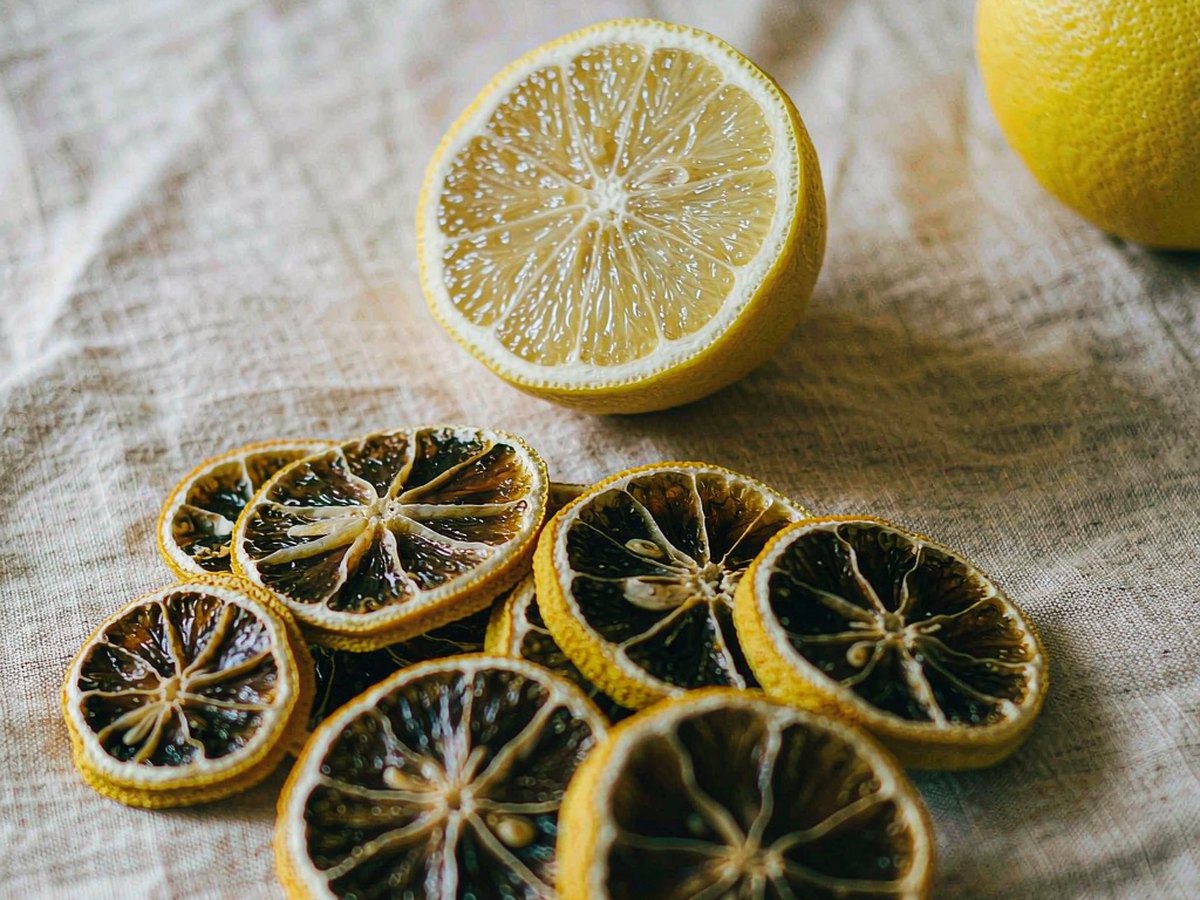
A dried lemon slice is a pleasant object that is often sold on the strength of something it no longer contains. Almost all the vitamin C in a lemon is gone once it has been dried, and most of the fresh, sharp top note goes with it. What remains — the pith, the dried oils, the gentler acidity — is still useful. It is just useful in different ways from a fresh lemon.
- Botanical
- Citrus limon — the true lemon, a hybrid of Citrus medica and Citrus aurantifolia. Mandarin and lime are not lemons and dry differently.
- Part used
- The whole fruit, sliced into rounds or into segments and dried. A dried peel-only product is a different material with a different use.
- Origin
- Sichuan and Hunan in China for the Chinese crop; Italy, Spain, Turkey and California for the rest. Dried Chinese lemon often uses the small, thick-skinned cultivar sold as 香水柠檬.
- Flavour
- Milder and rounder than fresh lemon, with a sweet-bitter edge and a clear citrus note that survives drying better than the acidity does.
- Use
- 2–3 slices per cup, 85–90 °C, 3 minutes. A whole slice in a pot of tea is a full-strength lemon tea, not a subtle one.
- Keeps
- 12 months sealed. The colour fades from bright yellow to dull tan over that year, and the aroma fades with it.
What drying actually does
Vitamin C is fragile: it is destroyed by heat, by oxygen, and by light, and a lemon slice dried at 55 °C for eight hours has lost essentially all of it. The much larger quantities of the flavanones in lemon — the hesperidin and nobiletin — are considerably more stable and do survive drying, and they are what gives dried lemon its bitter edge.
The volatile oils in the peel are more durable than the juice but still lose the brightest top notes. What comes out of a dried slice is a rounder, sweeter, slightly bitter citrus aroma rather than the sharp top note of a fresh lemon. This is why dried lemon and fresh lemon are not interchangeable in a recipe, and why lemon zest is a separate product.
The white pith is the most heat-stable part of the fruit and makes up much of the weight of a dried slice. It is also where a lot of the bitterness lives, which is why dried lemon can taste harsher than the fresh fruit it started as.
Slices, peel and powder
Sliced rounds are the most useful form because they show you what you have: you can see the pith thickness, the seed count and the colour. A slice with a thick white ring and a thin band of yellow rind is mostly pith and will taste bitter and weak.
Dried peel is a different product. It is concentrated — a tablespoon of dried peel has the aroma of several lemons — and it is the right form for tea and for seasoning, where a slice would be too mild.
Lemon powder is mostly what is left after the oil has been used for something else, and it is worth a paragraph of caution: lemon oil is a concentrated extract and the powder is often made from spent peel. It tastes flat, and it is not the same product as dried lemon.
Where dried lemon is genuinely useful
The strongest practical case for dried lemon is storage and use. A dried slice keeps for a year, travels, and gives a controllable amount of citrus to a pot of tea or a braise. A fresh lemon does not.
It is also the form that survives cooking. A slice of lemon added at the start of a long braise contributes aroma and a little bitterness that a fresh lemon squeezed at the end cannot, because the pith has already released what it has.
For a garnish, a fresh lemon is still better and dried lemon is a poor substitute. It is worth saying plainly: dried lemon is not a shelf-stable replacement for a fresh lemon. It is a different ingredient with its own strengths.
What it is used for
- Digestive A mild carminative and aromatic. Dried lemon in a hot cup after a heavy meal is a light, pleasant digestive drink.
- Vitamin C content Very little. If vitamin C is why you want lemon, dried lemon will not deliver it; the flavanoids survive but the ascorbic acid largely does not.
- Mild astringency A slight drying and tightening quality from the pith, which is why lemon and dried tangerine peel feature together in digestion blends.
- Aroma in cooking A long, slow release of citrus aroma in braises, stews and teas that a squeeze of fresh juice cannot provide.
- Cleaning and scenting Dried lemon peel in a bowl with salt for cleaning, and the whole dried slice as a room fragrance.
- Flavour extraction The dried peel used for candying and for making lemon salt, where the oils are what is wanted.
In the kitchen
- Lemon tea Two or three slices in 200 ml at 85 °C for three minutes. Pairs with dried ginger and rock sugar.
- Braises and stews A slice added at the start of a long braise for aroma rather than for acid.
- Lemon salt Finely ground dried peel mixed with flaky salt. A staple in many kitchens.
- Candied peel The dried peel simmered in sugar syrup until translucent — a traditional preserve and a genuine use for the material.
- Rice and grain A slice in the cooking water for a plain rice, giving a very light lift.
Dried lemon is a food and is generally safe. The caution that matters is about what you are substituting it for: if a recipe calls for lemon juice, dried lemon will not do the job, and if you are relying on lemon for vitamin C, dried lemon will not deliver it either.
I
f
y
o
u
a
r
e
t
a
k
i
n
g
m
e
d
i
c
a
t
i
o
n
t
h
a
t
i
n
t
e
r
a
c
t
s
w
i
t
h
c
i
t
r
u
s
—
a
n
d
a
f
e
w
d
o
,
i
n
c
l
u
d
i
n
g
s
o
m
e
c
a
l
c
i
u
m
–
c
h
a
n
n
e
l
b
l
o
c
k
e
r
s
a
n
d
s
o
m
e
a
n
t
i
b
i
o
t
i
c
s
—
c
h
e
c
k
w
i
t
h
a
p
h
a
r
m
a
c
i
s
t
,
t
h
o
u
g
h
t
h
e
a
m
o
u
n
t
s
i
n
a
c
u
p
o
f
t
e
a
a
r
e
v
e
r
y
u
n
l
i
k
e
l
y
t
o
m
a
t
t
e
r
.
Disclaimer
This article describes a dried fruit and its culinary uses. Nothing here is a claim that dried lemon treats any condition, and no herb should be used in place of prescribed treatment. If you want reliable vitamin C, eat fresh fruit.