Japanese bush clover is the plant that covers the hillsides of Japan in late summer with a low purple haze. It is also a member of the legume family that Chinese herbalism has used for what it calls damp-heat complaints — the category that covers jaundice, urinary problems and a coated tongue. The two facts have almost nothing to do with each other, and both are true.
- Botanical
- Kummerowia striata — a small perennial legume in the family Fabaceae, related to clover, vetch and the rest. The Chinese name is Ji Yan Cao, meaning chicken-eye grass, from the shape of its leaflets.
- Part used
- The dried whole herb — stems, leaves and flowers together, cut and dried while the plant is in flower.
- Origin
- Widely distributed across China, Japan and Korea, and a common roadside weed across much of East Asia. It is gathered rather than cultivated.
- Flavour
- Bland, faintly astringent and slightly grassy. Very close to tasting of nothing, which is typical of a whole dried herb.
- Use
- 9–15 g per 200 ml, simmered 20 minutes. It is a decoction herb and it needs heat.
- Keeps
- 12–18 months sealed and dry. Whole herbs like this keep well as long as they are dry.
What damp-heat means
Damp-heat is one of the most-used diagnostic categories in Chinese medicine, and it is worth understanding because it explains a large share of what the herbal shelf looks like. It describes a combination of heaviness and heat: a sticky mouth and tongue coating, a feeling of heaviness in the head and limbs, and heat signs such as a yellow tongue coating, thirst, and dark scanty urine.
It is a pattern rather than a diagnosis, and it is the classical explanation for a set of conditions that modern medicine would approach from several different directions — liver and gallbladder disorders, urinary infections, some skin conditions, and some digestive complaints.
What is worth saying plainly is that this framework is internally consistent and has been applied consistently for two thousand years, and that it is not the same thing as a modern medical diagnosis. Where a herb is used for damp-heat, it is usually with the explicit understanding that someone else is doing the diagnosing.
Ji Yan Cao in that framework
Japanese bush clover is classified as slightly cold, and as clearing heat and dampness. Its classical indications are precisely the damp-heat picture: jaundice, urinary difficulty, a burning sensation, and some inflammatory conditions.
It is a mild herb rather than a powerful one, and in classical formulas it appears as a supporting ingredient rather than as the lead. That is a common pattern for the whole-herb legume group — the herbs are considered gentle and are used in quantity, or in combination.
It is also classically used as a mild diuretic, in the same category as the other damp-clearing herbs that appear in the treatment of what traditional medicine calls liver dampness. The legume family has a strong representation in that category, and some of them — the soy-bean sprouts, the mung bean, the coix seed — are also foods.
The plant itself
In Japan, bush clover is the plant of late summer and early autumn, blooming over the hillsides in a low purple-pink haze, and it is used as a grazing crop for goats and sheep. Its name, hagi, is a word with a long cultural history in Japan, and the tree species Cercis — the Judas tree — shares it.
In China it is an ordinary roadside and field-margin weed, gathered for the herbal trade. It is not a cultivated crop and it does not have a luxury story attached to it, which is part of why it is inexpensive.
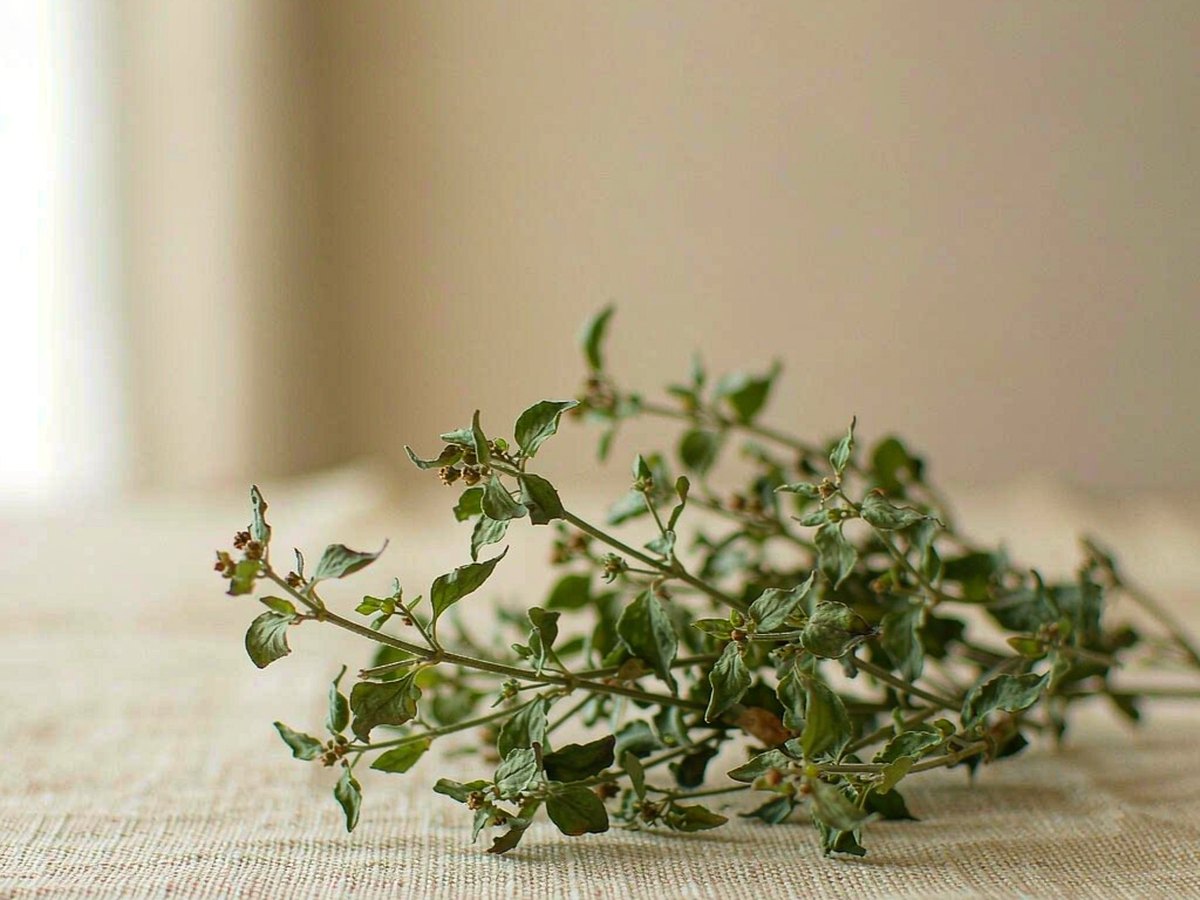
The dried whole herb is a mixture of thin, slightly woody stems, small oval leaflets and small pale flowers. It should smell green and slightly sweet when you break it open. A lot that smells of hay was harvested after it had dried in the field rather than being cut and dried.
What it is used for
- Clearing damp-heat The classical indication: for the damp-heat picture of jaundice, urinary difficulty and a coated tongue, in the standard Chinese medicine category.
- Mild diuretic Used for urinary difficulty and for promoting the flow of fluid — a gentle version of the category’s more forceful members.
- Jaundice A classical use, always within a formula and always with someone supervising the diagnosis.
- Anti-inflammatory Used in classical formulas for inflammatory swellings and sores in the damp-heat category.
- Famine food A legume with an edible quality — the whole plant is browsed by livestock and was eaten as a wild green.
- Mildness It is a gentle herb, and the reason so many of these herbs are edible is that mildness is the point.
In the kitchen
- Whole-herb decoction 10 g simmered in 400 ml for 20 minutes, taken warm. Bland enough to blend without fuss.
- With mung bean The classic damp-heat clearing combination — mung bean and this herb together in a sweet soup.
- With coix seed Another classical pairing, in the well-known dampness-clearing blends sold in Chinese tea houses.
- Light green drink A weak infusion of the whole herb, which is pleasant and very gentle.
- Wild green Fresh, blanched, and dressed like any other wild green.
Japanese bush clover is a mild herb and is generally well tolerated. The caution is the same one that applies to the whole damp-clearing category: if you are pregnant, nursing, or on medication, ask a clinician before using it regularly.
I
t
i
s
c
l
a
s
s
i
f
i
e
d
a
s
c
o
l
d
,
s
o
t
r
a
d
i
t
i
o
n
a
l
s
o
u
r
c
e
s
a
d
v
i
s
e
c
a
u
t
i
o
n
i
n
p
e
o
p
l
e
w
i
t
h
a
c
o
l
d
,
d
e
f
i
c
i
e
n
t
c
o
n
s
t
i
t
u
t
i
o
n
o
r
w
i
t
h
l
o
o
s
e
s
t
o
o
l
s
.
A
n
y
o
n
e
w
i
t
h
a
c
h
r
o
n
i
c
l
i
v
e
r
o
r
k
i
d
n
e
y
c
o
n
d
i
t
i
o
n
s
h
o
u
l
d
s
p
e
a
k
t
o
a
d
o
c
t
o
r
b
e
f
o
r
e
u
s
i
n
g
a
n
y
d
a
m
p
–
c
l
e
a
r
i
n
g
h
e
r
b
.
Disclaimer
The damp-heat framework described here is a traditional pattern and not a medical diagnosis, and the conditions it covers span several modern specialities. Do not use Japanese bush clover to treat jaundice, a urinary infection or any other condition, and do not use it in place of prescribed care.