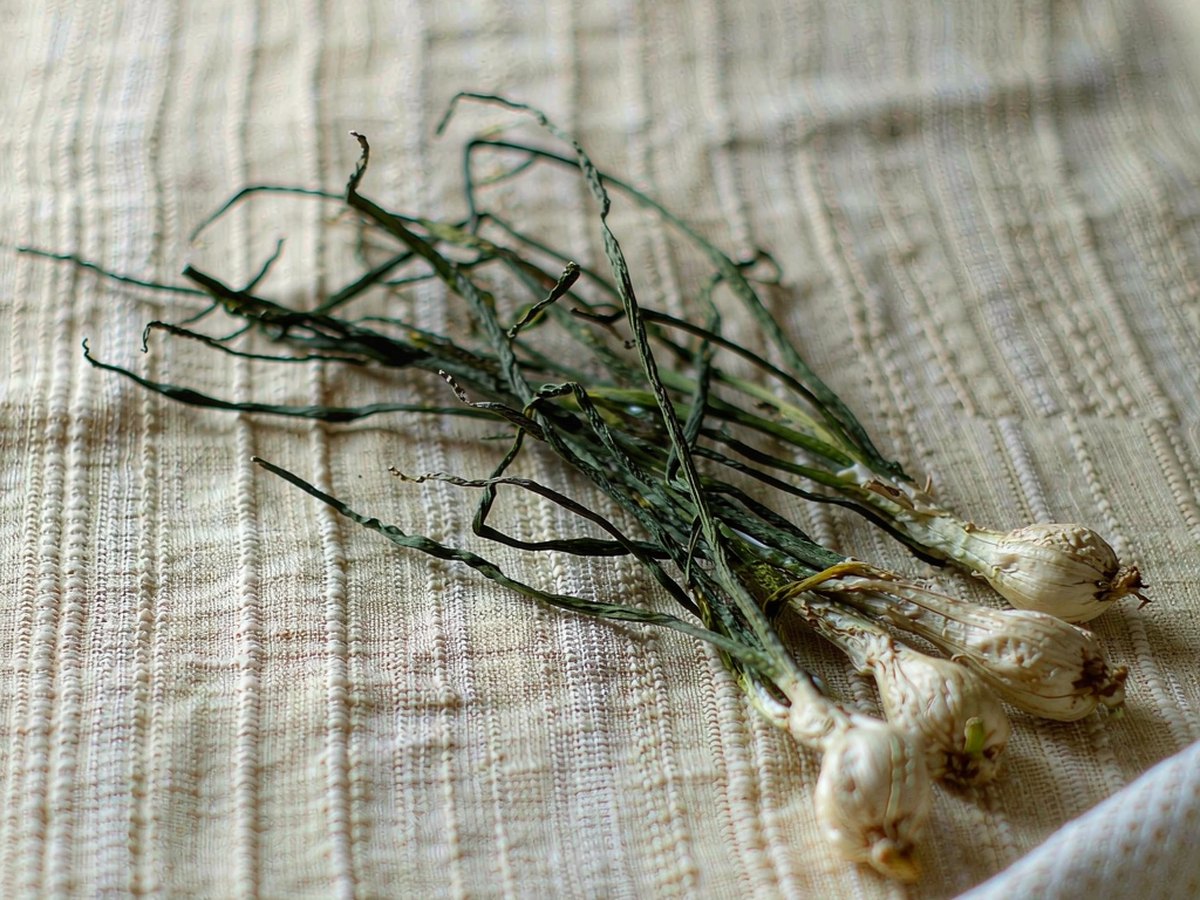
Chinese chive is not garlic chives, although it is often called that in English, and it is not ordinary chives either. It is Allium tuberosum, with flat, solid, dark green leaves that taste of a cross between garlic and chives. It is the most aggressively flavoured green in the Chinese kitchen, and it is also the one that is most often ruined by being cooked gently.
- Botanical
- Allium tuberosum — Chinese chive, garlic chive, or in Mandarin, jiu cai. Distinct from Allium schoenoprasum (chives) and from Allium chinense (the flowering chive sold as flowering garlic chives).
- Part used
- The leaf. In the kitchen, fresh or blanched; dried and chopped for stocks and for the Chinese pharmacy seed, which is a separate item.
- Origin
- China, where it has been cultivated for over two thousand years, and now across East and Southeast Asia. Also naturalised in parts of Europe and North America.
- Flavour
- Garlicky, green and pungent, with a lingering heat that is closer to garlic than to onion. Dried, it keeps most of that character.
- Use
- Fresh: a small handful, added at the very end of cooking. Dried: 1–2 g in a pot, added in the last five minutes.
- Keeps
- 6 months dried, and only if it is kept completely airtight and dark — it loses its colour and aroma quickly otherwise.
Three plants with one English name
The English language has muddled three different Alliums into one word. Ordinary chives, Allium schoenoprasum, have hollow tubular leaves and a mild onion flavour. Chinese chive, A. tuberosum, has flat solid leaves and a much stronger, garlicky flavour, and it is the one that flowers with a starry white umbel in late summer. Flowering garlic chive, A. chinense, has broader leaves and edible flower buds that are a delicacy in their own right.
Chinese chive is the one to buy for cooking if you want the garlic flavour, and the one to plant if you want a perennial crop that comes back every year. The leaves are flat, dark green and hollow-looking when young, and they grow in clumps.
The dried product sold in Chinese tea and herbal shops is usually chopped, dried leaf, and it is worth understanding that this is a concentrated flavour rather than a vegetable. A teaspoon is not the equivalent of a bunch of fresh leaves.
The cooking rule
Chinese chive goes in at the end, and this is not a preference. The volatile oils that give it its character are destroyed by prolonged heat, and the leaves themselves are thin enough that they will go from raw to burnt in under a minute over a high flame.
The canonical uses all follow from that. The famous Chinese chive and egg dish — scrambled eggs with chives — is finished with the chives folded in off the heat, so they wilt for a few seconds and keep their green. Chive dumplings are finished with a scattering of raw chopped chive after the dumplings come out of the steamer. Chive pancakes mix the raw chopped leaf straight into the batter.
Blanching is the other classic technique, and it is the one that suits the dried material best: thirty seconds in boiling water and the raw, aggressive edge becomes a sweet green vegetable, which is how Chinese chive is served cold in Chinese restaurants.
The seed, which is the pharmacy item
In Chinese medicine the part that is used is the seed, not the leaf — Jiu Zi, the dried seed of Allium tuberosum. It is a small, grey-black, kidney-shaped seed and it is one of the more unusual entries in the pharmacopoeia.
Its classical use is quite specific and points in one direction only: it is used for what traditional medicine describes as a weakness of the kidney yang and a loss of essence, and it is famously used for impotence and for spermatorrhoea. It is taken as a tonic, often combined with other kidney-tonifying herbs.
It is also used as a warming aromatic for cough with cold, and for a weak, loose cough. But the defining use is the one that made it famous in classical China, and it is worth knowing that the seed is a different ingredient from the leaf, with a different use entirely.
What it is used for
- Garlic-chive flavour The dominant use of the leaf, fresh or dried. A pungent green note that survives cooking better than it has any right to.
- Digestive Traditionally used as an aromatic that warms the middle and settles a stomach, and as a carminative.
- Warming and dispersing Classed as warm, and used to move cold and disperse what traditional medicine calls stagnation.
- Kidney yang and essence For the seed: the classical use is as a tonic for what is described as kidney yang deficiency, including impotence and spermatorrhoea. A supervised, formula-based use.
- Cough with cold The seed is used for a weak, loose cough with clear phlegm, and for cold in the lungs.
- Vegetable Fresh chives are a genuinely good seasonal green, blanched or briefly wilted.
In the kitchen
- Chinese chive and egg The classic: soft scrambled eggs, chives folded in off the heat so they stay green and sharp.
- Chive dumplings Raw chopped chive mixed into the filling, with a scattering on top after steaming.
- Blanched and cold Thirty seconds in boiling water, then dressed with sesame oil, soy and a little vinegar. The restaurant version.
- Dried chive in stock A teaspoon of dried chopped leaf in a chicken or pork stock, added in the last five minutes.
- Chive pancake Chopped raw leaf straight into a flour and egg batter.
The dried leaf is strong. A teaspoon is roughly equivalent to a small bunch of fresh chives, so it is easy to use three times too much in a soup and end up with something that tastes of raw garlic.
I
f
y
o
u
a
r
e
p
r
e
g
n
a
n
t
,
n
u
r
s
i
n
g
,
o
r
t
a
k
i
n
g
m
e
d
i
c
a
t
i
o
n
,
a
s
k
a
c
l
i
n
i
c
i
a
n
b
e
f
o
r
e
u
s
i
n
g
t
h
e
s
e
e
d
m
e
d
i
c
i
n
a
l
l
y
.
T
h
e
s
e
e
d
i
s
a
g
e
n
u
i
n
e
r
e
m
e
d
y
w
i
t
h
a
s
p
e
c
i
f
i
c
c
l
a
s
s
i
c
a
l
u
s
e
a
n
d
i
t
s
h
o
u
l
d
n
o
t
b
e
s
e
l
f
–
p
r
e
s
c
r
i
b
e
d
.
Disclaimer
This article describes a vegetable, a dried flavouring and a classical seed remedy, which are three different materials. The traditional indications for the seed are classical rather than clinically established, and they concern specific health patterns that require a qualified practitioner. Do not use the seed to treat any condition, and do not use it in place of prescribed care.