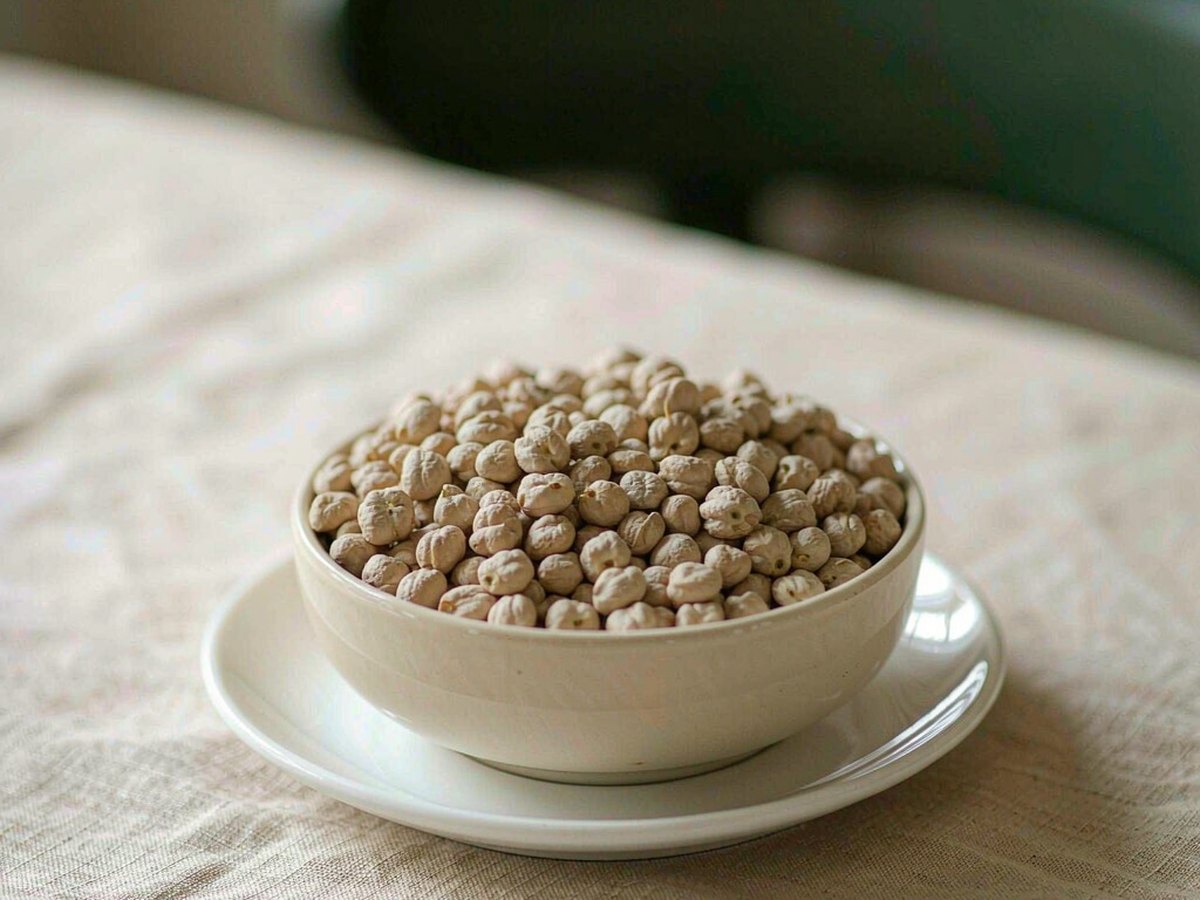
Dried chickpeas are a genuinely good food with a long history in the Mediterranean and the Middle East, and they have a place on a tea shop’s shelf mainly because they are useful for making things other than tea. What they do not have is a classical herbal tradition behind them, and a shop that lists them among the dried herbs should tell you what they are actually for.
- Botanical
- Cicer arietinum — the chickpea, a legume of the family Fabaceae. Also called the gram, and garbanzo in much of the world.
- Part used
- The dried seed, whole. There is no herbal preparation from it and no leaf, root or flower material.
- Origin
- The Middle East and the Mediterranean — the Fertile Crescent — and cultivated since the Neolithic. Now a major crop in India, which is the largest producer.
- Flavour
- Nutty, earthy and faintly sweet, with the slightly chalky note that all dried legumes have until they are cooked.
- Use
- In the kitchen: soaked overnight, then simmered for 90 minutes, or cooked in a pressure cooker for 25 minutes. In tea, a small handful in a pot with cinnamon and citrus.
- Keeps
- Indefinitely if kept dry and airtight — this is a hard seed designed to survive. Two to three years in a sealed jar in a cool kitchen.
A food, not a herb
Every other item on this shelf has a documented traditional use that goes back centuries. Dried chickpeas have a documented traditional use too, but it is a culinary one: they are one of the oldest cultivated crops on earth, with archaeological finds of chickpea remains dating back thousands of years in the Fertile Crescent, and they are a staple across the Middle East, North Africa, India and the Mediterranean.
Some herbal traditions do use the plant — the sprouts, the shoots and the roasted seed have all been used as folk remedies for cough, constipation and as a poultice. None of that is a classical pharmacopoeial entry, and no part of it justifies putting a chickpea in a cup of hot water and calling it a herbal tea.
So the honest framing is: this is a cooking ingredient that happens to be sold in a dried-goods shop, not a medicinal herb. That is not a criticism — it is a clarification.
Buying them well
Dried chickpeas should be pale beige to tan, roughly the size of a large pea, with a slightly angular, wrinkled shape. They should be hard and dry and should rattle in the jar.
The things to avoid are dark spots, a musty smell, and any evidence of webbing or insect damage. Good chickpeas have been stored properly and will keep for years; chickpeas that have been damply stored will not.
A quick note on a common label confusion: split peas, chickpeas and the yellow split pea used in dal are three different things and are not interchangeable without adjusting cooking time and liquid. A bag that says “chickpeas” and contains round, smooth, pale yellow split peas has been mislabelled.
Why they belong on a tea shop’s shelf
There is a legitimate reason, and it is a good one. Chickpeas are one of the base ingredients of aquafaba — the starchy water left over from cooking them — and aquafaba has become a genuinely useful kitchen ingredient in its own right. It whips into a meringue, it makes a good vegan batter, and it is used in a great many modern baking recipes.
There is also a much older use worth knowing: the water in which chickpeas have been simmered is a classic European and Middle Eastern remedy for a cough and for chest complaints, and it was given as a drink to children. It is mild, salty and faintly sweet, and it is genuinely soothing.
And there is a third reason, which is simply that a good tea shop sells the ingredients for a good kitchen, and a pantry full of dried herbs is a pantry that needs a legume in it.
What it is used for
- Protein and fibre One of the most nutrient-dense plant proteins available, with a high fibre content and a low glycaemic index. Chickpea flour is used to bind and thicken.
- Aquafaba The cooking water, which whips like egg white and is used as an egg substitute in baking.
- Digestive regularity A traditional food use for constipation, supported by the fibre content.
- Blood sugar Chickpeas are a low-glycaemic food with a well-documented beneficial effect on post-meal blood sugar when eaten in place of refined carbohydrate.
- Folk chest remedy The simmered water has a long history as a mild soothing drink for coughs in European and Middle Eastern households.
- Culinary building block Hummus, falafel, chana masala, and a great deal else.
In the kitchen
- Cooking from dry Soak overnight, drain, simmer in fresh water for 90 minutes with a spoon of bicarbonate of soda, or 25 minutes in a pressure cooker.
- Hummus The classic: chickpeas, tahini, lemon, garlic, olive oil, and a lot of blending.
- Chana masala Chickpeas in a tomato and onion masala with amchur, ginger and green chilli.
- Roasted chickpeas Dried chickpeas simmered until soft, then roasted with oil and salt until they crackle.
- Chickpea broth Simmer the cooking water with cinnamon, cardamom and dried citrus, and drink it as a mild savoury broth.
There is no herbal caution here, because this is a food. The practical warnings are the ordinary ones: soak and cook them properly, because undercooked chickpeas contain phytohaemagglutinin, which is toxic raw and is destroyed by adequate cooking.
I
f
y
o
u
a
r
e
o
n
m
e
d
i
c
a
t
i
o
n
,
n
o
t
e
t
h
a
t
c
h
i
c
k
p
e
a
i
s
a
c
o
m
m
o
n
f
o
o
d
a
l
l
e
r
g
e
n
,
a
n
d
t
h
a
t
r
e
g
u
l
a
r
c
o
n
s
u
m
p
t
i
o
n
o
f
l
a
r
g
e
a
m
o
u
n
t
s
o
f
p
u
l
s
e
s
c
a
n
i
n
t
e
r
a
c
t
w
i
t
h
s
o
m
e
d
r
u
g
s
t
h
r
o
u
g
h
t
h
e
i
r
e
f
f
e
c
t
o
n
g
u
t
b
a
c
t
e
r
i
a
a
n
d
o
n
t
h
e
e
n
z
y
m
e
s
t
h
a
t
m
e
t
a
b
o
l
i
s
e
t
h
e
m
.
I
f
y
o
u
a
r
e
s
t
a
r
t
i
n
g
a
l
e
g
u
m
e
–
h
e
a
v
y
d
i
e
t
w
h
i
l
e
o
n
m
e
d
i
c
a
t
i
o
n
,
m
e
n
t
i
o
n
i
t
t
o
y
o
u
r
p
h
a
r
m
a
c
i
s
t
.
Disclaimer
This is a food article, not a medicinal one, and it is in the Herb Library because the ingredient is sold here and because knowing what a product actually is prevents a great deal of confusion. Chickpeas do not treat any condition, and no food should be used in place of prescribed care.