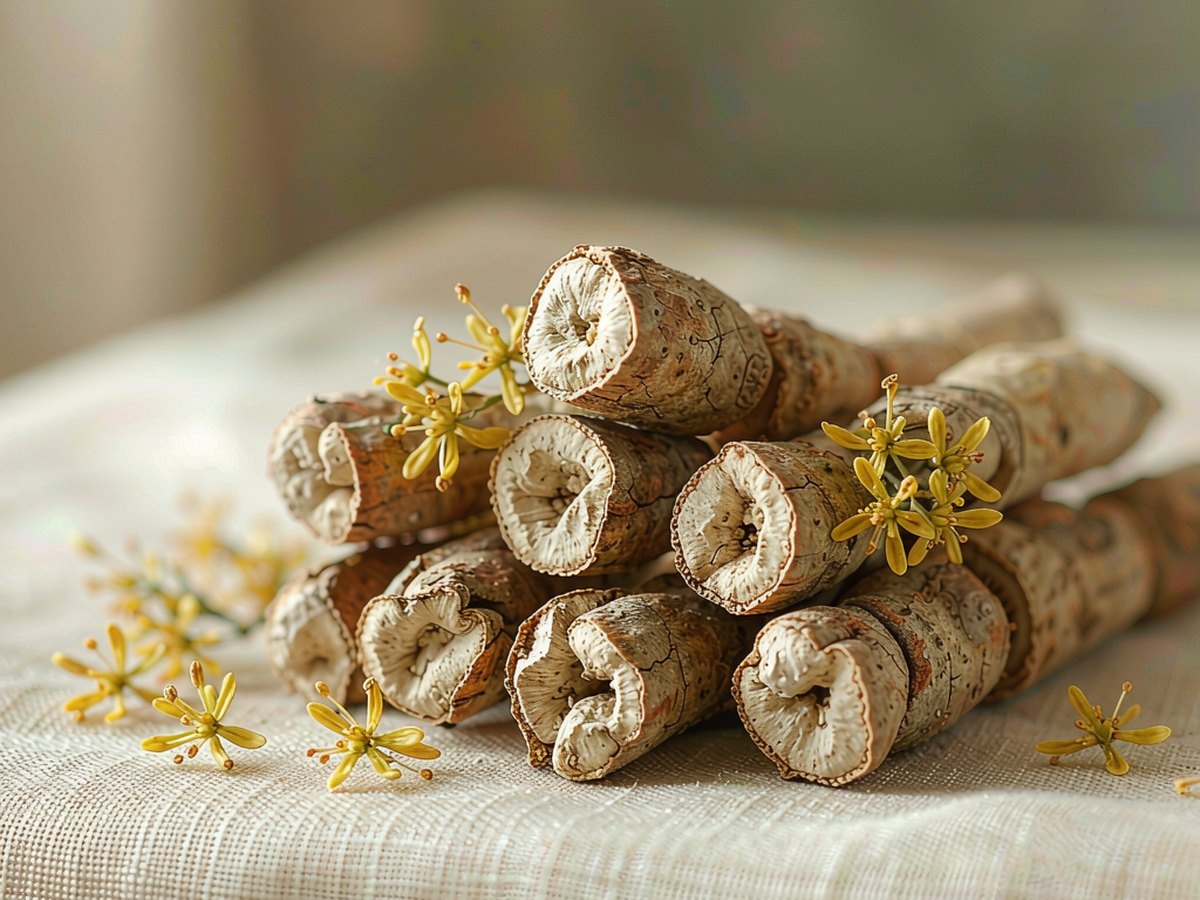
Yuan zhi is on nearly every Chinese pharmacy counter and almost none in the west, and the reason is a name. It is not milkwort — the plant that gave the word its English name is a completely different species from a completely different family. The Chinese name is the one that matters, and the herb behind it has a surprisingly clear job.
- Botanical
- Polygala tenuifolia — the Chinese milkwort, of the family Polygalaceae. The name “milkwort” comes from Polygala vulgaris, a European plant of the same genus but a different species, and the resemblance is misleading in every way that matters.
- Part used
- The dried root, sliced. Sometimes the whole root is used; sometimes it is prepared, by stir-frying or by processing with licorice juice.
- Origin
- Hebei, Shanxi, Shaanxi, Liaoning, Jilin and Inner Mongolia. Also Korea and Japan, where it appears in the classical formulae of all three traditions.
- Flavour
- Bitter and slightly sweet, with a faint, pleasant aromatic that is unusual for a root and comes from the volatile oil.
- Use
- 3–9 g per 200 ml, simmered 20–30 minutes. Usually blended, and the aromatic quality means it stands up better than most roots.
- Keeps
- 18–24 months sealed and dry.
The name, and why it misleads
The English name is a genuine trap. Milkwort in European herbalism is Polygala vulgaris, a small plant of chalk grassland whose root was used as an expectorant and which was believed to increase breast milk — hence the name, and hence the belief that it would dry up a wet cough. That belief has been largely abandoned, because the plant barely contains anything of the sort.
Polygala tenuifolia is a different species, from a different habitat — dry sandy slopes and open scrubland — and it is used in Chinese medicine for a different and much more specific purpose. It is a root with a long, slightly twisted, cylindrical taproot, and it is dug in spring or autumn.
So if you are reading a western herbal text about milkwort, none of it applies to this herb. The Chinese pharmacopoeia entry is the one that governs, and it is a different plant entirely.
Opening what is closed
Yuan zhi’s classical action is described in the standard Chinese phrase for transforming phlegm and opening the orifices, and it is used for two specific complaints: a cough with copious, sticky phlegm that is difficult to bring up, and a blocked sensation in the throat — the kind where something seems stuck and will not go down.
There is a second classical use that surprises people, and it is the one the herb is named for in a sense: it is used to calm the spirit and to open the heart, in the classical sense of a mind that is unsettled and closed off. It appears in formulas with jujube and licorice for insomnia and restlessness, and with the calming herbs.
That combination of throat and spirit is what makes it unusual. It is one of the few herbs in the phlegm group that is simultaneously used for a chest and a heart, and the traditional reasoning is that the two are connected — a chest full of thick phlegm and a mind full of stuck thoughts are treated with the same opening herb.
The prepared versions, and why they exist
Chinese pharmacy sells yuan zhi in several preparations, and the differences are worth knowing because they change the effect quite a lot.
Raw yuan zhi is the standard material. There is also zhi gan cao yuan zhi, yuan zhi stir-fried with licorice juice, and yuan zhi processed with wine. The licorice-processed version is milder and is used where the drying effect of the raw herb is too strong. The wine-processed version is used in the calming formulas, where the warming and the blood-moving are wanted.
In practice, for a kitchen, raw yuan zhi is what you want, and the point of buying it from a supplier that states the preparation is to avoid ending up with a processed root and no idea what it does.
What it is used for
- Transforming phlegm The principal classical use: for a cough with thick, sticky phlegm that is difficult to bring up, and for a blocked throat.
- Opening the orifices Used for the sensation of something lodged in the throat, and classically for a blocked nose.
- Calming the spirit A genuinely unusual use for a phlegm herb: it appears in calming formulas for restlessness and insomnia, with jujube and licorice.
- Aromatic quality The volatile oil gives it a real aroma, which is why it can carry a formula better than most roots.
- Antitussive and expectorant activity Studied in animal models for effects on mucus and cough, consistent with its classical use.
- Mental-emotional use Classically used for a closed, unhappy, unsettled mind — one of the rare herbs where the emotional picture is explicit in the classical text.
In the kitchen
- The classical phlegm formula Yuan zhi with platycodon and fritillaria, simmered — the standard combination for a chest full of phlegm.
- With licorice and jujube The calming version — yuan zhi with licorice and jujube, for a restless night.
- With ginger and a citrus peel A kitchen blend that makes the root drinkable and warms the chest picture.
- As a throat gargle A stronger decoction, cooled and used as a gargle rather than drunk.
- With platycodon The other half of the classic phlegm pair, and a good blend for a wet, rattling cough.
Yuan zhi is drying, and drying herbs can aggravate dryness, heat and a dry cough. It is traditionally avoided in pregnancy and in people with a dry, hot picture or an ulcer.
I
t
i
s
a
l
s
o
t
r
a
d
i
t
i
o
n
a
l
l
y
a
v
o
i
d
e
d
i
n
p
e
o
p
l
e
w
i
t
h
u
l
c
e
r
s
o
r
g
a
s
t
r
i
t
i
s
,
b
e
c
a
u
s
e
o
f
i
t
s
d
r
y
i
n
g
a
n
d
i
r
r
i
t
a
t
i
n
g
q
u
a
l
i
t
y
.
A
n
y
o
n
e
w
i
t
h
a
p
e
r
s
i
s
t
e
n
t
c
o
u
g
h
n
e
e
d
s
a
d
i
a
g
n
o
s
i
s
r
a
t
h
e
r
t
h
a
n
a
d
r
y
i
n
g
h
e
r
b
,
a
n
d
a
n
y
o
n
e
o
n
m
e
d
i
c
a
t
i
o
n
s
h
o
u
l
d
a
s
k
a
p
h
a
r
m
a
c
i
s
t
b
e
f
o
r
e
u
s
i
n
g
i
t
r
e
g
u
l
a
r
l
y
.
Disclaimer
The phlegm and orifice-opening indications are traditional and pattern-based, and the calming use is one of the more distinctive examples of the classical system being explicit about an emotional picture. Do not use yuan zhi to treat a cough or any other condition in place of medical assessment, and do not use it in pregnancy.