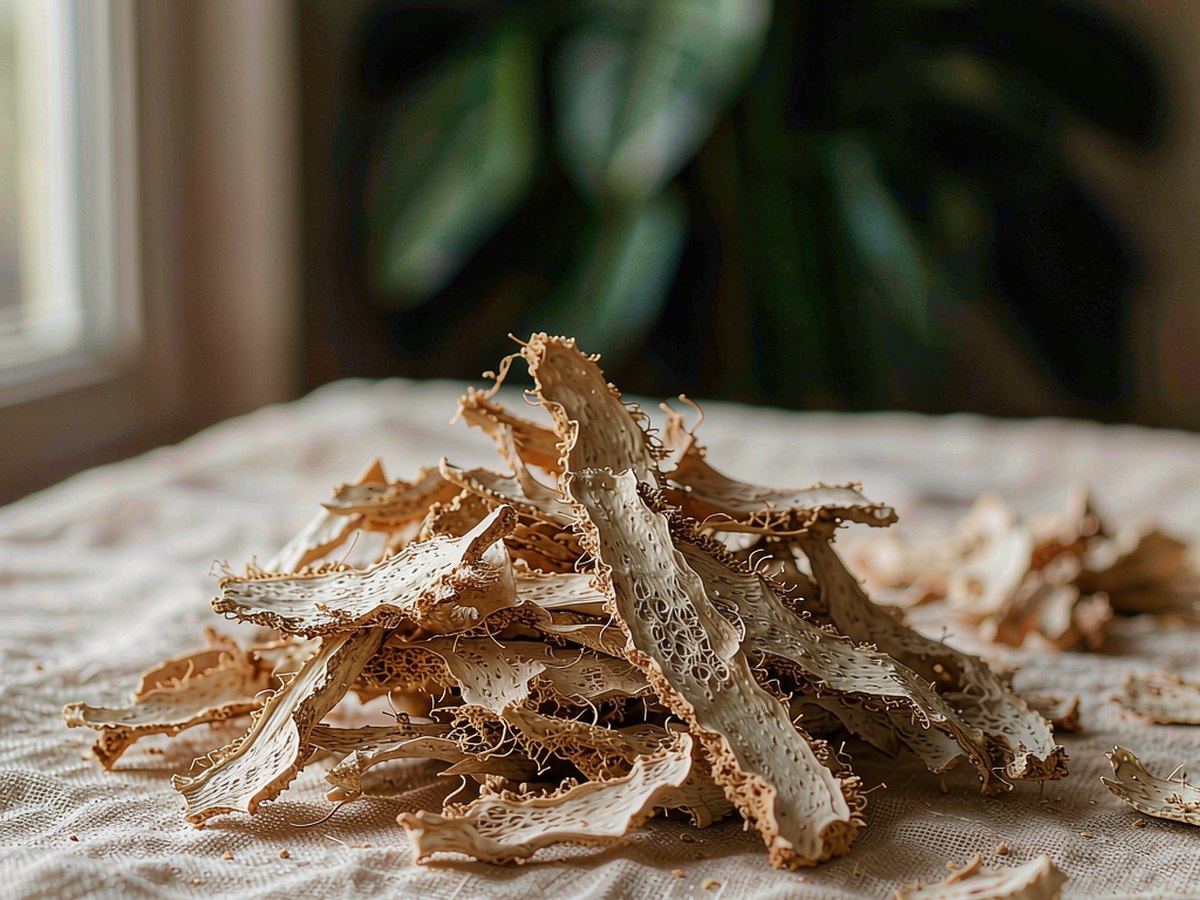
Cotton root bark is one of the few materials in this collection that you should approach with real caution. It is a genuine Chinese medicine with a documented history, it is still used by qualified practitioners, and it also carries a compound that is genuinely toxic in the wrong dose. Banned as a food additive in the United States, it belongs on this shelf only in the sense that a pharmacy shelf is different from a kitchen shelf.
- Botanical
- Gossypium hirsutum and G. herbaceum — the cotton plant. The root bark is the medicinal part. The root itself is the toxic part in the fresh plant.
- Part used
- The dried root bark, stripped from the root. It is a pale, woody, fibrous material.
- Origin
- Historically from China, where cotton was cultivated for millennia; later from the American cotton belt and from Central Asia.
- Flavour
- Bland and slightly bitter, with a faint musty, earthy smell and no aroma.
- Use
- In classical practice, 1.5–3 g, decocted, in a formula. This is a physician-level herb and not a kitchen one.
- Keeps
- 24 months sealed and dry.
The compound that matters
Cotton root bark contains gossypol, a yellow polyphenolic compound that occurs in the root, the stem and the seed of the cotton plant. Gossypol is genuinely toxic above a threshold, and it is also, at low doses, a genuinely interesting pharmacological agent — it has been studied as a male contraceptive, and it appears in the Chinese medicine literature as a treatment for a specific kind of fibrotic condition.
The history is instructive. Gossypol was used in the United States in the 1950s as a contraceptive, and the trials were stopped when the safety problems became clear. It was banned as a food additive by the Food and Drug Administration, and the raw root is not safe to eat.
The dried root bark contains far less gossypol than the fresh root, and the classical doses are small and the herb is used in formulas where it is one ingredient among many. That is the entire basis on which it remains a legitimate professional herb, and it is also why it has no business being brewed at home.
What it is classically used for
In Chinese medicine, cotton root bark is used for a specific and rather narrow picture: what is called a fibrotic or contracted tissue condition, classically in the lung. The classical sources describe it as being used where there is a scarred, contracted or obstructed lung, and it appears in formulas for a cough with a chronic, fixed character.
It is also used in the treatment of what traditional medicine calls amenorrhea — the absence of menstruation — and this is the use for which it has been most studied and most heavily restricted.
All of these are supervised indications. There is no home version of this herb. The classical dose of 1.5 to 3 g is a physician’s dose, and it is used inside formulas that also contain herbs chosen to buffer it.
Why it is still on the shelf
Three reasons, none of them a recommendation. First, the Chinese pharmacopoeia still lists it, and it remains in genuine professional use in China, so a comprehensive herb supplier is expected to carry it. Second, it is historically important in the development of Chinese medicine, and it appears in classical texts that a student needs to be able to read. Third, the adulteration problem runs the other way — because it is restricted and because it is powerful, it is used as a contaminant in other products, and knowing what it looks like is useful.
If you are not practising or studying Chinese medicine, the correct answer is to leave this one alone. It sits on the shelf as a reference item and a safety reference, and it is worth knowing that the fresh cotton root is toxic and that cottonseed oil is also gossypol-containing.
What it is used for
- Gossypol content The root bark contains gossypol, a compound with real toxicity at higher doses and real pharmacological activity at lower ones. This is the reason for the caution, and it is not a theoretical one.
- Contracted or fibrotic tissue A narrow classical use for what traditional medicine describes as scarred, contracted lung tissue. A physician-level indication.
- Amenorrhea The most studied and most restricted classical use, and the one with the most documentation of gossypol’s effects.
- Historical contraceptive research Gossypol was trialled as a male contraceptive in the 1950s and abandoned for safety reasons. The research continues in other directions.
- Food additive ban Gossypol is banned as a food additive in the United States, and the raw cotton root is not edible.
- Adulteration reference Useful as a reference: knowing what it looks like is how you recognise it when it turns up inside something else.
In the kitchen
- Not for the kitchen There is no culinary use for this herb, and the honest answer to how to use it is: only within a supervised classical prescription, at a physician’s dose, in a formula.
- Identifying it If you want to know what it looks like: pale woody bark strips, fibrous, faintly musty, quite bland. Knowing this is how you spot contamination in other products.
- The food-safety point The reason this matters beyond tea is that gossypol is also in cottonseed, and it is a compound people can encounter without realising it.
- What to do instead For anything in this category — a chronic cough, a fibrotic picture, an amenorrhea — a qualified practitioner is the route, not a teapot.
- Professional supply This is a herb for a clinic shelf, not a kitchen shelf, and it should be bought from a supplier who supply clinics.
This herb carries genuine toxicity. Gossypol is the compound responsible, and the fresh cotton root is unsafe. Do not brew it, do not use it in pregnancy, and do not use it alongside any medication without advice from a qualified practitioner.
G
o
s
s
y
p
o
l
h
a
s
e
f
f
e
c
t
s
o
n
b
l
o
o
d
c
l
o
t
t
i
n
g
a
n
d
o
n
t
h
e
r
e
p
r
o
d
u
c
t
i
v
e
s
y
s
t
e
m
,
a
n
d
i
t
i
n
t
e
r
a
c
t
s
w
i
t
h
a
r
a
n
g
e
o
f
m
e
d
i
c
a
t
i
o
n
s
.
I
t
i
s
b
a
n
n
e
d
a
s
a
f
o
o
d
a
d
d
i
t
i
v
e
i
n
t
h
e
U
n
i
t
e
d
S
t
a
t
e
s
a
n
d
r
e
s
t
r
i
c
t
e
d
i
n
s
e
v
e
r
a
l
o
t
h
e
r
c
o
u
n
t
r
i
e
s
.
A
n
y
o
n
e
w
i
t
h
a
h
i
s
t
o
r
y
o
f
l
i
v
e
r
o
r
k
i
d
n
e
y
d
i
s
e
a
s
e
s
h
o
u
l
d
n
o
t
u
s
e
i
t
.
Disclaimer
This article exists to explain what cotton root bark is, why it carries real risks, and why it appears on a professional herbal shelf. It is not an invitation to use it. Its classical indications are supervised, narrow and formula-based, and its safety profile requires the judgement of a qualified practitioner. Do not use it to treat any condition.