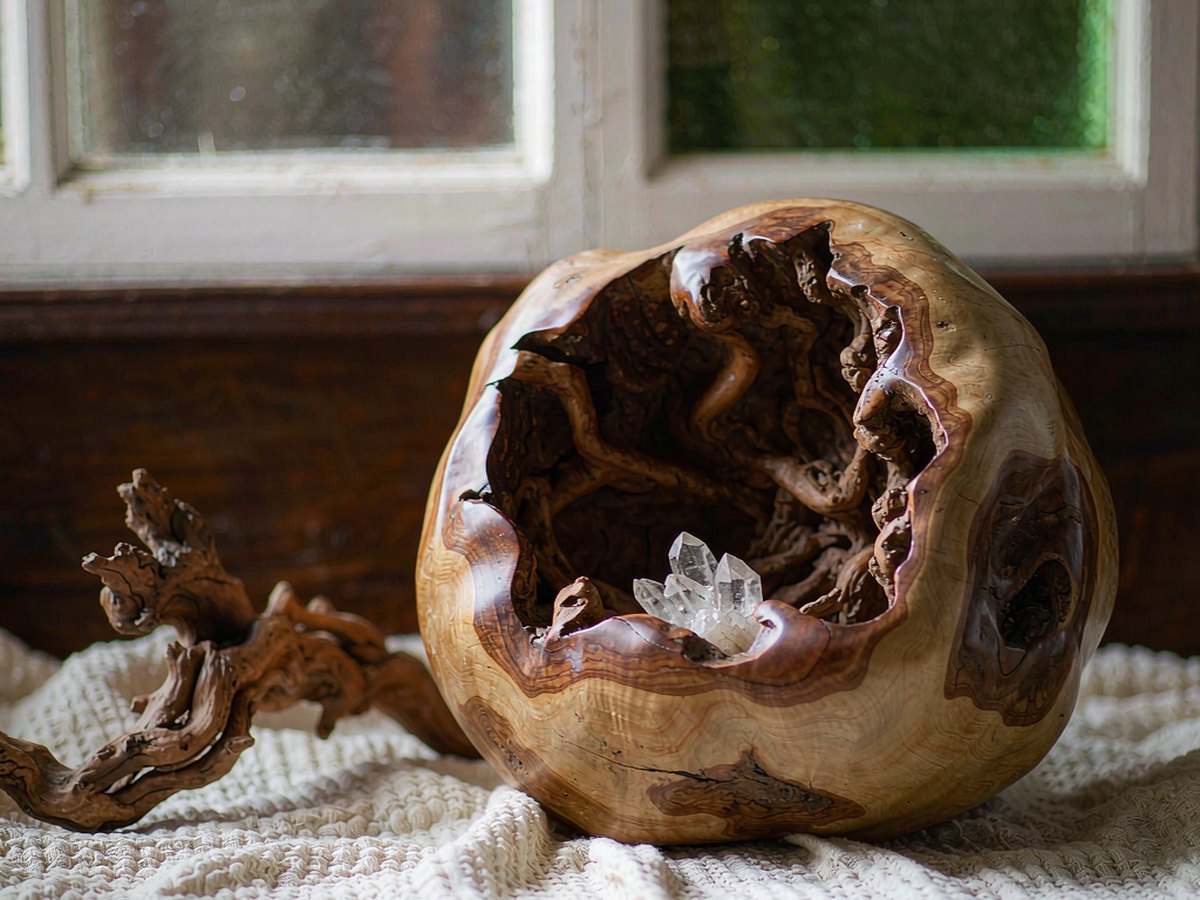
Not everything in a tea shop should go in a teapot. The celastrus root sphere is one of those things: a dried root, shaped and polished into an object, sold as a botanical specimen for a shelf, a desk, or a collection. It looks like a piece of art and it is genuinely beautiful. It is also a plant material with a real toxicology, and that distinction is the whole point of this article.
- Botanical
- Celastrus — the staff vine family, Celastraceae. Several species produce a woody, twisting root that is worked into craft objects; it is not a tea ingredient.
- Part used
- The dried root, shaped and polished. No part of this object is intended for consumption.
- Origin
- Yunnan, Sichuan, Guangxi and Guizhou. The tradition of shaping dried roots into spheres comes from the Chinese craft and curio trade.
- Form
- A hollow or solid sphere, usually 5–8 cm across, polished to show the grain of the wood, sometimes mounted with a small mineral or crystal cluster.
- Use
- A display object — on a shelf, a desk, a display case, or as a gift. It is not used in a decoction and should not be.
- Handling
- Keep it dry and out of direct sun. Handle with clean dry hands, and keep it away from damp, which will dull the polish and encourage mould in the grain.
What the material is
Celastrus is a genus of woody climbing vines in the staff vine family, and several Chinese species produce a distinctive woody root that twists and knurls as it grows around other plants and stones. That tortured, sculptural shape is exactly why the root has been worked into objects for centuries.
The craft is traditional and it is a real craft, not a novelty. The root is dug, allowed to dry slowly so that it hardens and stops shrinking, then shaped — traditionally by abrasion and lathe work, more recently with finer tools — into a sphere, a bead, or a small carved form. The polishing stage brings out the grain, which in a well-chosen piece can be extraordinary: tight, swirling, almost marbled.
The best examples come from roots that grew around an obstacle, because the plant’s response to being obstructed is what creates the dense, interesting figure. A straight root makes a dull sphere; a root that spent years negotiating a rock makes a remarkable one.
Why it is in a tea shop at all
It is a fair question, and the honest answer is that the celastrus sphere straddles two categories that the shop has chosen to keep in the same place: the botanical and the decorative.
It belongs to a family of objects in Chinese craft culture that includes carved rosewood, root carvings, natural stone and the small mineral specimens that collectors arrange on a desk — objects whose interest is in the material itself and the hands that worked it, rather than in any function. It is the same instinct as a person who buys a piece of carved boxwood or a palm-sized piece of raw agate.
It is also worth noting what it is not. It is not a tea, it is not a decoction, and it is not in any way interchangeable with the dried roots sold elsewhere in this shop. It is a botanical specimen and a decorative object, and we would rather sell it honestly as that than dress it up.
The toxicology, and why it should stay out of the cup
This is the part that is genuinely important, and it is not a formality. Celastrus species are not harmless plants. The genus contains alkaloids — celastrine among them — and other bioactive compounds, and parts of the plant, particularly the seeds and the bark, have well-documented toxicity. Traditional Chinese pharmacology has used certain Celastrus materials medicinally in precisely controlled circumstances, under supervision, and those uses are a long way from a kitchen infusion.
The sphere in this shop is the root, shaped and polished, and it is sold for display. It is not prepared for consumption, it has not been assessed for anything, and the polishing process is a craft treatment rather than any kind of processing that would make it safe to drink.
So: it belongs on a shelf. It does not belong in a teapot, it does not belong in a soup, and it should not be cut, boiled or grated. If you want a Celastrus material for traditional use, that is a conversation to have with a qualified practitioner and with a reputable pharmacy, not with an ornament. It also means it should be kept away from children and pets, both because it is an attractive object and because of the plant material.
How to keep it looking good
The polish is the fragile part. Dust is the enemy — it works into the grain and dulls the surface — so a soft brush or a dry cloth, used occasionally, is much better than a damp one. A damp cloth will lift the oils that give the wood its depth and can leave water marks.
Keep it away from direct sunlight, which fades both the colour and the grain, and away from heat sources and radiators, which dry the wood and cause it to crack. This matters more for a worked sphere than it would for a plank, because the shaping removes material unevenly and the thin sections dry out first.
Keep it out of damp spaces — a bathroom shelf is the worst place for it — because moisture trapped in the grain encourages mould, and mould in a worked root is not something you can clean off without taking the polish with it. If you live somewhere with genuinely humid air, a small silica gel pack near where you store it will do more than anything else.
Finally, handle it with clean, dry hands. The oils in skin will darken the surface over time, which some collectors consider a patina and others consider damage. Whichever view you hold, a soft cloth in between is the safer habit.
What it is used for
- A display object The intended use: a shelf, a desk, a display case, a tea tray side table. Its value is in the material, the grain and the hand-work, not in any function.
- A botanical specimen It is a genuine piece of plant material showing the growth habit of a woody vine root, which makes it a teaching object as well as a decorative one.
- A craft object Root carving is a recognised Chinese craft tradition, and a sphere is among the simplest and most achievable forms of it.
- A collector’s item Pieces with strong figure, from a known root, well finished, are collected in their own right, alongside natural stones and mineral specimens.
- A gift It is a good object to give to somebody who does not drink tea, and it is not consumed, so it carries none of the cautions that come with an ingredient.
- Not an ingredient It is not a tea, not a decoction material, and not a food. No part of this object should be prepared for consumption.
In the kitchen
- On a shelf with light A single object with good directional light reads far better than a group. The grain only shows if there is something for it to catch.
- On a tea tray side table Beside a pot rather than in it — it makes a good conversation piece and pairs naturally with the tea.
- As a paperweight It is heavy enough to hold a stack of papers, and the rounded form means it will not mark the page.
- Grouping three small pieces Three spheres of different sizes look deliberate. One large and one small looks like an oversight.
- Dust with a soft brush A clean dry brush along the grain every few months keeps the polish alive without touching the surface.
- Pairing with a stand A simple wooden or brass stand lifts it slightly and shows the underside of the base, which is often where the best carving is.
This is a display object and not an edible or medicinal material. Celastrus species contain alkaloids and other compounds with real toxicity, and parts of the plant have caused poisoning. The root in this product has been shaped and polished for decoration, not processed for use, and no part of it should be brewed, grated, boiled or added to food.
K
e
e
p
i
t
o
u
t
o
f
r
e
a
c
h
o
f
c
h
i
l
d
r
e
n
a
n
d
p
e
t
s
,
b
o
t
h
b
e
c
a
u
s
e
o
f
t
h
e
p
l
a
n
t
m
a
t
e
r
i
a
l
a
n
d
b
e
c
a
u
s
e
a
p
o
l
i
s
h
e
d
w
o
o
d
e
n
s
p
h
e
r
e
i
s
e
x
a
c
t
l
y
t
h
e
s
o
r
t
o
f
t
h
i
n
g
a
c
h
i
l
d
w
i
l
l
w
a
n
t
t
o
p
i
c
k
u
p
a
n
d
p
u
t
i
n
t
h
e
i
r
m
o
u
t
h
.
H
a
n
d
l
e
i
t
w
i
t
h
c
l
e
a
n
d
r
y
h
a
n
d
s
t
o
a
v
o
i
d
s
t
a
i
n
i
n
g
t
h
e
g
r
a
i
n
,
a
n
d
i
f
y
o
u
e
v
e
r
h
a
v
e
a
p
i
e
c
e
o
f
C
e
l
a
s
t
r
u
s
r
o
o
t
a
n
d
a
r
e
c
o
n
s
i
d
e
r
i
n
g
a
t
r
a
d
i
t
i
o
n
a
l
u
s
e
o
f
t
h
e
p
l
a
n
t
,
t
a
k
e
t
h
a
t
q
u
e
s
t
i
o
n
t
o
a
q
u
a
l
i
f
i
e
d
p
r
a
c
t
i
t
i
o
n
e
r
a
n
d
a
r
e
p
u
t
a
b
l
e
s
o
u
r
c
e
r
a
t
h
e
r
t
h
a
n
w
o
r
k
i
n
g
i
t
o
u
t
f
r
o
m
a
d
e
c
o
r
a
t
i
v
e
o
b
j
e
c
t
.
Disclaimer
This article describes a decorative botanical object and a craft tradition. Nothing in it is medical advice, and nothing in it should be taken to suggest that any part of this plant is safe or suitable for consumption or for the treatment of any condition. If you have any interest in the traditional medicinal use of Celastrus, speak to a qualified practitioner, and if you are pregnant or nursing, take medication, manage a chronic condition, or are giving herbs to a child, talk to your doctor or pharmacist.