Lavender is the one herb almost every household already owns, and it is the one most often used without reading anything about it. It is genuinely useful, genuinely fragrant, and — as the research on it has grown more thoughtful in the last fifteen years — considerably more complicated than a cup of soothing purple water.
- Botanical
- Lavandula angustifolia, the true or English lavender, is the culinary and tea species. Lavandula latifolia, the French lavender, is a different plant and behaves differently. The distinction matters more than most packaging suggests.
- Part used
- The dried flower bud, or the leaf in culinary use. The oil is a separate and much more concentrated product.
- Origin
- The Mediterranean — Spain, France, Italy, Greece — plus England, Australia and the United States. The best tea is usually from a named cultivar.
- Flavour
- Floral, slightly camphorous, faintly sweet and a little bitter. The English species is markedly sweeter and less medicinal than the French.
- Use
- 1–2 tsp of buds per 200 ml, 3–5 minutes, not boiling. Steeped too hot or too long, it turns soapy.
- Keeps
- 18–24 months sealed and dark. The buds hold their scent well; the powder does not.
Two lavenders, and the one that matters
Lavandula angustifolia and Lavandula latifolia are often both sold as lavender, and they are not interchangeable. The angustifolia — true lavender, English lavender — is low in camphor and high in linalool and linalyl acetate. It is the plant whose buds are culinary, whose aroma is sweet and floral, and whose traditional use as a mild nervine and carminative is the long-established one.
Lavandula latifolia carries a high camphor content. Its aroma is sharper, more medicinal and more penetrating, and the camphor component is what gives lavender oil its reputation for usefulness and its reputation for caution at the same time.
This is why the label matters more than it looks. Many tea-bag lavenders are a blend, or are the higher-camphor species, or are cut with cheaper filler material. A buds-only product from a named cultivar of L. angustifolia will taste noticeably sweeter and drink noticeably more easily than anything else.
A second category to be aware of is lavender oil and lavender absolute in capsules, which are far more concentrated than the tea and carry entirely different safety questions. The dried flower is a much gentler thing than the oil, and the two should not be treated as versions of each other.
What it has traditionally been used for
Lavender has a genuinely long and consistent record of use in European herbalism, and the traditional indications are coherent: it is a mild nervine, a carminative, and a gentle sleep aid. It was used for restlessness and mild anxiety, for digestive wind and cramping, for headache and tension, and simply as a fragrance that calms a room.
The mechanism people usually point to is the volatile oil — linalool and linalyl acetate are the main constituents — which has a measurable effect on the nervous system in laboratory conditions. That is a plausible basis for a mild relaxing effect, and it is also why lavender aromatherapy has become so widely used.
It is worth being clear, though, about how much this justifies. Most of the celebrated research on lavender and anxiety has been conducted with lavender oil, either inhaled or taken in capsules, and a good deal of it has small samples and short follow-up. The tea is a much smaller dose than the oil, and the honest description of a cup of lavender is that it is a pleasant, mildly calming aromatic drink with a long history behind it, not a pharmacological treatment for an anxiety disorder.
The specific cautions, and why they are specific
Lavender oil has been associated with a small number of cases of gynaecomastia in men, apparently through effects on pituitary hormones, and there is a well-documented caution in pregnancy for the same reason. The doses involved are far higher than a cup of tea, but the direction of the caution is worth knowing.
Coumarin is another compound of interest: it is present in lavender at low levels and is associated with hepatotoxicity at high intake in sensitive individuals. Lavender tea is not a coumarin risk at normal servings, but concentrated products deserve attention.
There is also the practical one: lavender on an empty stomach commonly causes nausea in sensitive people, and taken in quantity it can cause headache and agitation rather than calm — a paradoxical effect that is reported often enough to be worth naming. And because it is sedating in character, anyone taking sedatives, sleeping medication, or anti-anxiety medication should speak to a pharmacist before drinking it regularly.
Finally, the everyday one: lavender is extremely allergenic for some people, and the people most likely to react are those already reactive to other members of the mint and lavender family. If you have ever had a reaction to a scented product, start with a very small amount.
Choosing, storing and brewing it well
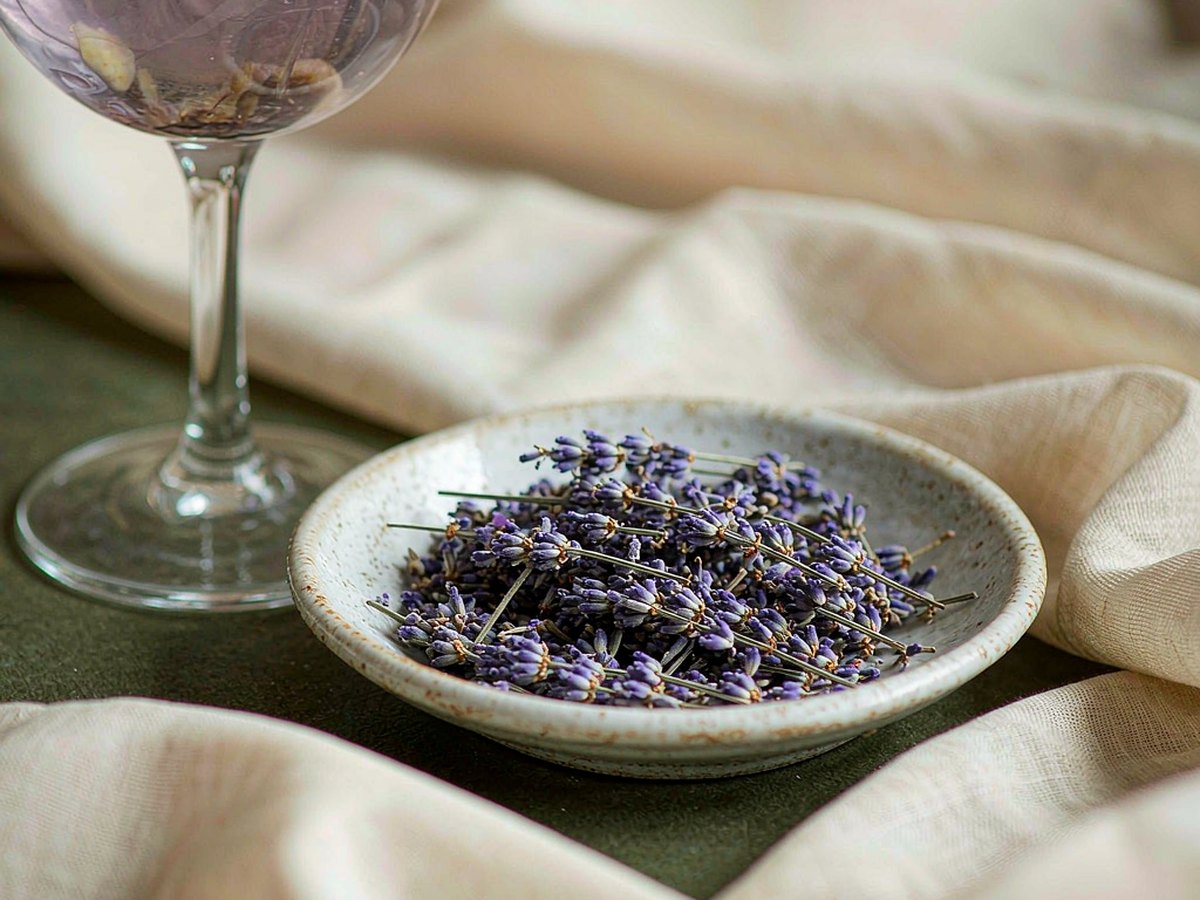
Look for buds over a cut-leaf blend. Whole buds are more fragrant, and a blend that is largely leaf and stem will taste like a grass rather than a flower. Deep violet-blue buds with a little green stem is the classic appearance; grey-brown dusty material has been badly stored or is old.
For storage, the rule is the same as for all aromatic material: airtight, dark, cool. A jar kept properly will still be fragrant after a year; a bag left open on a counter will be flat in a few months.
For brewing, use water just off the boil, and do not over-steep. Three to five minutes is the window. Boiling water scorches the flower and drives the sharper camphorous notes forward, and a long steep turns the cup bitter and soapy — which is exactly the taste that puts people off lavender entirely, and is usually a technique problem rather than a problem with the herb.
What it is used for
- A mild calming drink The classical and most widespread use: a fragrant, mildly relaxing infusion, traditionally taken in the evening. The effect is gentle, and it is not a treatment for anxiety or insomnia.
- Digestive comfort Carminative use: classically taken for wind, cramping and a settled stomach, often combined with peppermint or fennel.
- Headache and tension Traditionally used for mild headache and a feeling of tension, usually as a warm compress alongside the drink.
- Sleep support, mild Long traditional use as an evening drink before bed. Evidence is limited; it is a warm aromatic ritual more than a pharmacological effect.
- Aromatherapy, separately Lavender oil inhaled or applied is a different product with a different evidence base and a different set of cautions from the dried flower.
- Culinary use The buds and leaves are used in baking, with honey, in shortbread and in drinks, where the sweetness of L. angustifolia is an advantage.
In the kitchen
- A simple cup One to two teaspoons of buds per 200 ml of water just off the boil, steeped three to five minutes. Sweet, floral, faintly bitter.
- Cold brew overnight A generous teaspoon in cold water, left in the fridge overnight. Very smooth, no bitterness, and the colour is lovely.
- With chamomile One part lavender to two parts chamomile. A calm, mild evening cup that is genuinely pleasant.
- With lemon peel Fresh lemon zest and a few lavender buds. The citrus sharpness keeps the cup from being too sweet.
- With honey and lemon The familiar combination — but add the honey once the tea has cooled a little below scalding, so you keep the volatile aroma.
- In baking Dried buds chopped into a shortbread or tea biscuit, where they stay visible and the flavour holds through the oven.
Lavender is gentle but not inert. It is classically avoided in pregnancy, and it should not be used regularly by anyone taking sedatives, sleeping medication, or anti-anxiety medication without asking a pharmacist first. Concentrated lavender oil and lavender capsules are a different category from the dried flower and carry stronger cautions.
T
w
o
m
o
r
e
p
r
a
c
t
i
c
a
l
p
o
i
n
t
s
.
I
f
y
o
u
a
r
e
s
e
n
s
i
t
i
v
e
t
o
f
r
a
g
r
a
n
c
e
i
n
g
e
n
e
r
a
l
,
s
t
a
r
t
w
i
t
h
a
v
e
r
y
s
m
a
l
l
c
u
p
r
a
t
h
e
r
t
h
a
n
a
f
u
l
l
p
o
t
,
b
e
c
a
u
s
e
l
a
v
e
n
d
e
r
i
s
o
n
e
o
f
t
h
e
m
o
s
t
p
o
t
e
n
t
a
r
o
m
a
i
n
t
h
e
h
e
r
b
a
l
w
o
r
l
d
.
A
n
d
i
f
y
o
u
f
i
n
d
l
a
v
e
n
d
e
r
t
e
a
m
a
k
e
s
y
o
u
j
i
t
t
e
r
y
r
a
t
h
e
r
t
h
a
n
c
a
l
m
,
t
h
a
t
i
s
a
r
e
c
o
g
n
i
s
e
d
e
f
f
e
c
t
i
n
s
o
m
e
p
e
o
p
l
e
a
n
d
t
h
e
a
n
s
w
e
r
i
s
s
i
m
p
l
y
l
e
s
s
,
o
r
n
o
n
e
.
Disclaimer
Lavender tea is a pleasant aromatic drink with a long history of traditional use. It is not a treatment for anxiety, insomnia, depression, headaches or digestive complaints, and nothing here should be read as a claim that it will treat any of them. Please talk to your doctor or pharmacist before making it a daily habit, particularly if you are pregnant or nursing, take prescription medication, manage a chronic condition, or are giving it to a child.