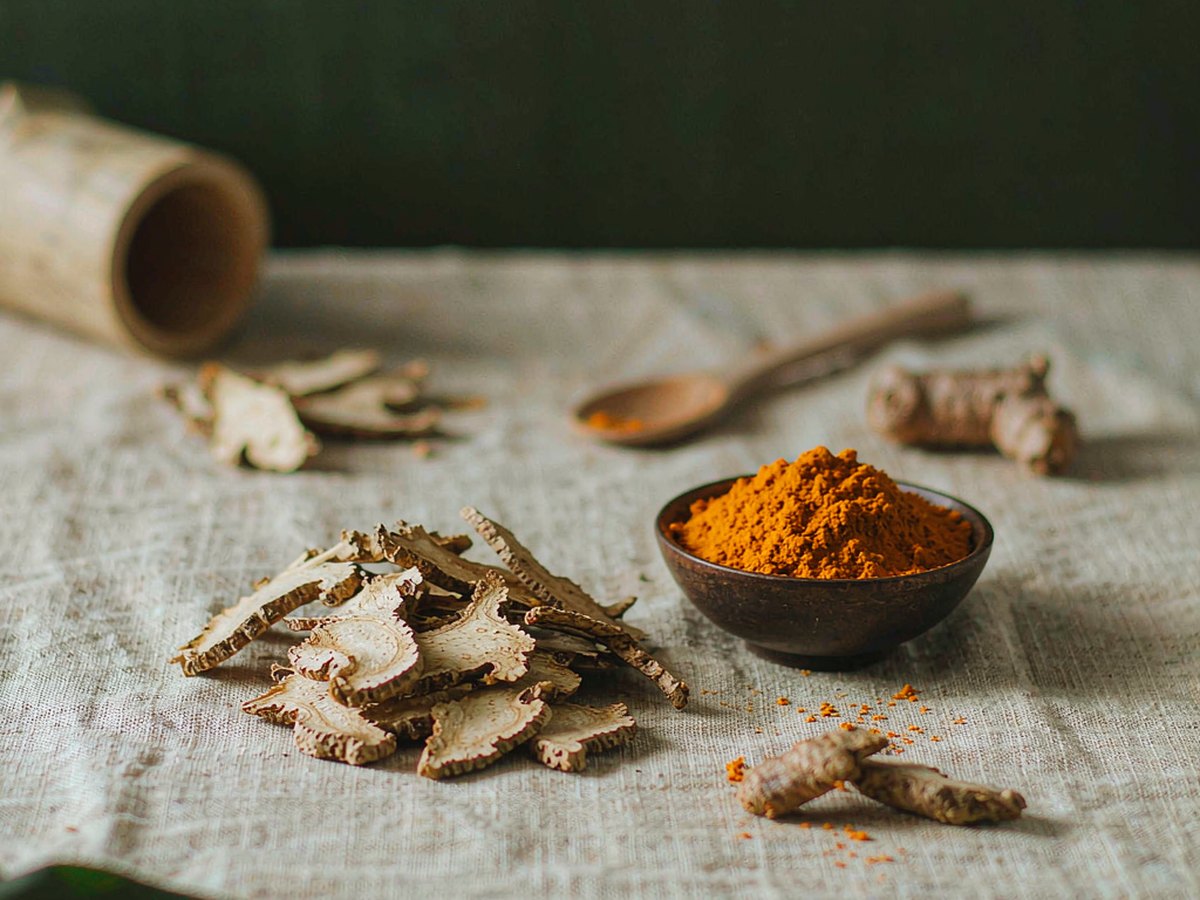
Turmeric is a rhizome that has been traded, dyed, ground and swallowed for three thousand years, and it has been the subject of more scientific papers than almost any other spice. Most of that research is real. Most of it is also about a compound that barely survives the trip from the root to the bloodstream. That is the interesting part.
- Botanical
- Curcuma aromatica is the Chinese pharmacy species, Yu Jin. The culinary turmeric of Indian cooking is usually Curcuma longa, and the dye turmeric is C. longa as well. Three related plants, three jobs.
- Part used
- The dried rhizome, sliced. Whole rhizomes are the export crop and are sliced for the retail trade.
- Origin
- Yunnan, Guangxi, Fujian, Sichuan and Zhejiang in China for Yu Jin; India for the culinary and dye crops, where it has been grown for millennia.
- Flavour
- Warm, slightly bitter and aromatic, with a distinct earthy note. Less perfumed than fresh turmeric and less hot.
- Use
- 3–6 g per 200 ml, simmered 15 minutes. In cooking, a small amount goes a long way — the colour and the bitterness are both strong.
- Keeps
- 24 months whole or sliced, sealed and dark. The colour fades in light and the aroma goes with it.
Curcumin and the absorption problem
Curcumin is the headline compound, and it has genuine anti-inflammatory activity in laboratory models. It is also, in its natural form, very poorly absorbed — estimates of oral bioavailability in humans run well under one per cent. Most of what you swallow goes straight past.
There are two well-known workarounds. The first is fat: curcumin is fat-soluble, and a turmeric dish with oil in it delivers measurably more than the same turmeric boiled in water. This is the reason the golden milk tradition is not arbitrary.
The second is piperine, the compound in black pepper, which inhibits the enzymes that break curcumin down and can raise its bioavailability substantially in a single study. This is the logic behind the turmeric-and-black-pepper pairing that appears in so many recipes. It is also a reason to be careful if you are on medication, because piperine changes how the liver handles other drugs.
The honest summary is that turmeric is a genuinely useful culinary ingredient, that the curcumin literature is real, and that the gap between a teaspoon of turmeric in a meal and a curcumin supplement is very large.
Three turmerics, three uses
Curcuma longa is the culinary and dye species, with the highest curcumin content, and it is the one the enormous research literature is mostly about. It is also the source of the dye that has coloured textiles, bride’s clothes and temple robes across Asia for millennia.
Curcuma aromatica, Yu Jin, is the Chinese pharmacy species. It is used as a qi-moving aromatic that relieves pain and moves blood, and it appears in the classic formula for what traditional medicine calls damp-heat in the lower body.
There is also Curcuma kwangsiensis, the Guangxi species, and a long list of regional varieties. The differences are real but they are subtle in a teacup — what changes most between lots is freshness and how the rhizome was dried and sliced.
Drying, and what it does to the colour
Fresh turmeric is bright orange, dense and moist. Dried turmeric is a duller, more mustard yellow, harder, and much more aromatic because the water has gone and the oils have concentrated.
The colour difference has a practical consequence. The pigment curcumin is unstable in light, heat and alkaline conditions, which is why fresh turmeric bleeds so violently when you grate it and why dried turmeric holds its colour better in a stew. It also fades in a jar on a sunny shelf, which is the reason for storing it dark.
A good dried lot should be a deep, even yellow-orange inside with a slightly darker, wrinkled skin, and it should smell strongly of turmeric when you break a piece. A lot that is pale, dull and smells of dust has been around.
What it is used for
- Anti-inflammatory activity Curcumin has well-documented anti-inflammatory effects in laboratory and animal models. Human trial results are mixed and the doses used are far higher than a serving of food provides.
- Arthritis and joint pain Frequently taken for joint pain, and there is some clinical evidence for symptom relief at high doses of a bioavailable formulation. This is not a treatment for inflammatory arthritis and should not replace one.
- Digestion Classed as aromatic and as moving qi, and used classically for distension and for pain in the lower abdomen.
- Blood stasis Yu Jin is used in Chinese medicine to move blood and relieve pain, and it appears in formulas for what traditional medicine calls blood stasis, including menstrual patterns.
- Culinary colour and flavour Its real, reliable and completely safe role: colour, warmth and a savoury note in curries, rice, pickles and sauces.
- Absorption Fat and black pepper both measurably increase how much curcumin reaches the bloodstream.
In the kitchen
- Golden milk Turmeric, black pepper, ginger, a little fat and honey in warm milk. The pairing exists because fat and piperine both help.
- Curries and rice The core culinary use. Bloom the powder in oil before adding liquid — that is where the flavour and the absorption come from.
- Pickled turmeric Fresh turmeric pickled in vinegar or brine for the sharp, cold, deeply coloured side dish served in Chinese households.
- Turmeric rice Rice coloured with turmeric and a stock cube, a staple in South Asian households.
- Safflower-substitute dye Turmeric gives a yellow-gold; safflower gives a red. In a rice or a dough, they make a good pair.
Turmeric in food quantities is safe and there is no need for caution. The cautions apply to concentrates: curcumin supplements and turmeric extracts in high dose can cause gallbladder problems, and turmeric interferes with blood-thinning medication and with some chemotherapy agents.
B
e
c
a
u
s
e
p
i
p
e
r
i
n
e
c
h
a
n
g
e
s
h
o
w
t
h
e
l
i
v
e
r
m
e
t
a
b
o
l
i
s
e
s
o
t
h
e
r
d
r
u
g
s
,
t
h
e
t
u
r
m
e
r
i
c
–
a
n
d
–
b
l
a
c
k
–
p
e
p
p
e
r
c
o
m
b
i
n
a
t
i
o
n
i
s
w
o
r
t
h
d
i
s
c
u
s
s
i
n
g
w
i
t
h
a
p
h
a
r
m
a
c
i
s
t
i
f
y
o
u
a
r
e
o
n
a
n
y
r
e
g
u
l
a
r
m
e
d
i
c
a
t
i
o
n
.
P
e
o
p
l
e
w
i
t
h
g
a
l
l
s
t
o
n
e
s
o
r
a
h
i
s
t
o
r
y
o
f
g
a
l
l
b
l
a
d
d
e
r
i
n
f
l
a
m
m
a
t
i
o
n
s
h
o
u
l
d
a
v
o
i
d
c
o
n
c
e
n
t
r
a
t
e
d
t
u
r
m
e
r
i
c
.
Disclaimer
The curcumin research is real and worth reading, but none of it makes turmeric a treatment for arthritis, cancer or any other condition. It remains one of the best-valued spices in the world, and the most useful thing to know about it is that it works far better with fat and pepper than without them.