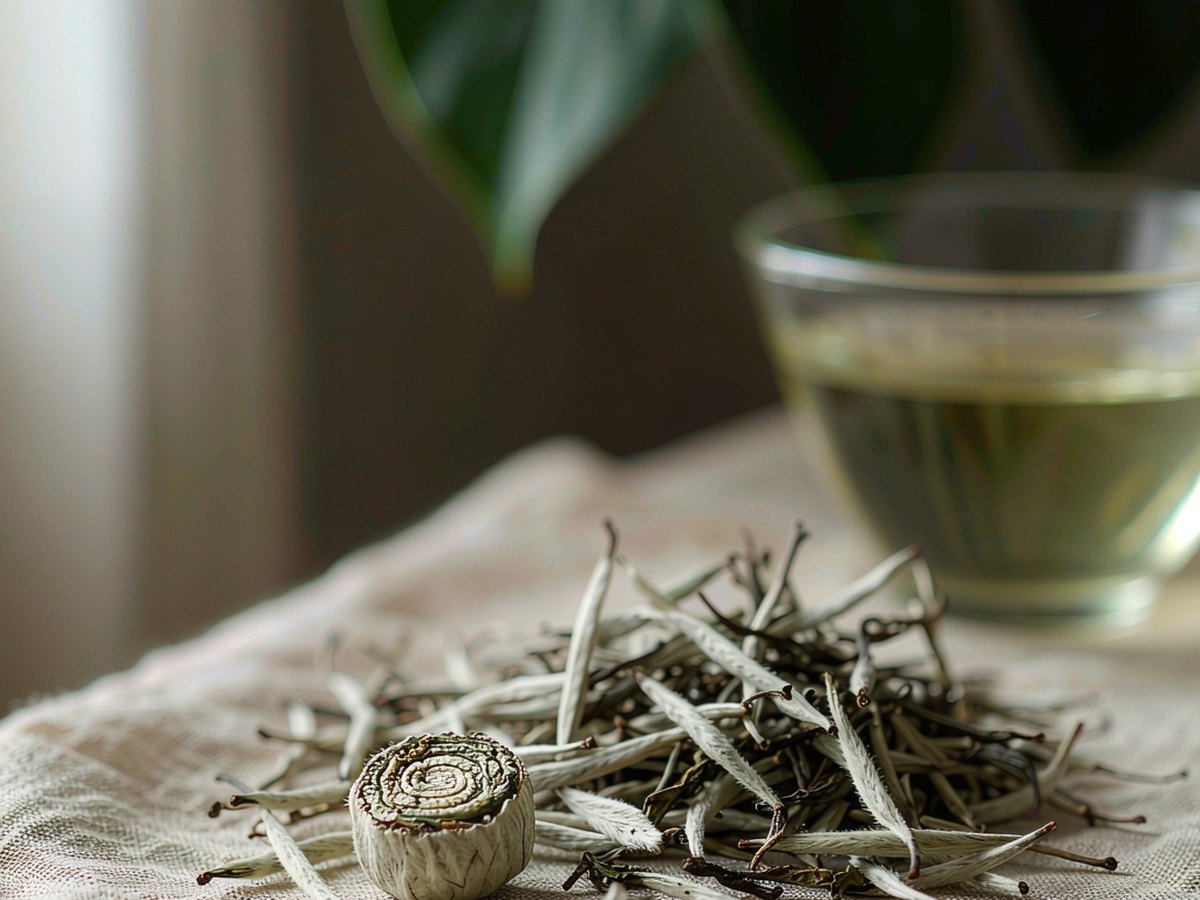
White tea is not a tea that has been bleached white, and it is not a delicate imitation of green tea. It is the same plant, the same Camellia sinensis, picked at the same moment as green tea — and then left alone for as long as the weather allows. Almost everything that distinguishes it from its cousins comes from what was not done to it.
- Botanical
- Camellia sinensis var. sinensis — the same species as green, black, oolong and pu-erh. White tea is a processing method, not a different plant.
- Part used
- The bud and the first leaf, in some styles only the bud. Buds carry the dense silver-white down.
- Origin
- Fuding and Zhenghe in Fujian, and the Jianyang mountains of Sichuan. Fuding is the source of the best-known styles.
- Flavour
- Light, sweet, hay-like and faintly floral, with a soft body and no astringency if brewed correctly.
- Use
- 4–6 g per 200 ml at 80–85 °C, steeped 30–45 seconds, with a second and third short steep. Boiling water is the usual mistake.
- Keeps
- 18–24 months sealed and dry. White tea ages very slowly, and older cakes are a separate category with a separate market.
What makes it white
The name comes from the appearance of the finished leaf, which is covered in fine silver-white hairs — trichomes, in botanical language — that catch the light and give the bud its pale, downy look. It is a property of the plant and the bud, not of anything done during processing.
The processing is what makes the story interesting. Traditionally, the leaves are withered in the sun and then allowed to dry slowly, often over several days, in a process called bai qian. That extended, uncontrolled drying is the key difference. The enzymes in the leaf stay active for longer, and a little more oxidation happens as the leaf dries — not the deliberate, full oxidation of black tea, but a slow, gentle drift that produces the honeyed, slightly dried-fruit notes white tea is known for.
Modern commercial white tea is made with controlled withering and drying, sometimes with a short oxidation step, and it can be more consistent than the old village method. It can also be more ordinary. The best white tea still comes from small batches picked and withered by people who can read the weather.
Shou mei, silver needle, and the difference between them
There are two families of white tea and the distinction is worth knowing. The first is bai hao yin zhen, silver needle, made from single unopened buds only. It is the most precious, the most delicate and the least forgiving of bad brewing. A good silver needle is almost entirely down, with no leaf at all, and steers toward honey, hay and white flowers.
The second is shou mei, which translates roughly as longevity plum and is the workhorse of the white tea world. Shou mei is made from buds and leaves — traditionally one bud with one or two leaves — and it is pressed into cakes after drying. It is darker, more robust and considerably more forgiving than silver needle, and it is the style most of the shop’s white tea is.
There are also the mid-range varieties: white peony, which is bud-and-leaf but not pressed, and plum blossom, which is a whole-bud style with more leaf and more body. If you are new to white tea, shou mei or white peony are the sensible places to start, because silver needle demands attention that most people are not yet paying.
Brewing it properly
The single most common mistake with white tea is boiling water. The tender leaf does not need it, and the heat draws out the astringency that white tea is supposed to be free of. Ninety degrees is the traditional figure for Fuding white tea; eighty-five is safer if you are unsure, and a bowl of hot water left to sit for a minute will get you most of the way there.
The second mistake is over-steeping. Because the leaf is tender and the compounds extract quickly, a five-minute steep will be harsh. The gongfu method suits white tea particularly well: short steeps of thirty to forty-five seconds, poured off completely, then repeated four or five times, building strength gradually rather than extracting everything at once.
The third is too much leaf. White tea expands more than it looks like it should, and it is easy to overfill a pot or a cup. Five grams per pot is plenty for a gongfu session, and in a large Western cup, three grams for 250 ml is a generous serving.
Stored properly, white tea does not spoil in any dangerous sense — it simply becomes less interesting. But unlike green tea, which fades within a year, properly stored shou mei can improve, and cakes aged for several years are a genuine and collecting market of their own.
A note on what the research does and does not say
White tea is unusually heavily promoted in the supplement and wellness world, and it is worth sorting out what is established from what is not. What is established: white tea is a source of catechins, including EGCG, and it is a source of caffeine, theobromine and theanine. It contains more total polyphenols than black tea, because black tea converts its polyphenols into theaflavins and thearubigins during oxidation, and white tea does not.
What is not established: that drinking white tea causes weight loss, that it prevents cancer, that it reverses heart disease, or that a specific antioxidant effect in a cell culture means anything at all in a person. A great deal of the impressive-sounding literature on white tea and chronic disease is in animals or in test tubes, at doses no one drinks, and the human trials that do exist are mostly small and short.
The honest summary is that white tea is a pleasant, hydrating, lightly caffeinated drink with a favourable nutrient profile, and that its reputation runs well ahead of the evidence. It is a good tea. It is not a medicine.
What it is used for
- A gentle daily drink The main use: a light, sweet, low-caffeine-tasting tea for everyday drinking. It is hydrating and pleasant enough to drink without sugar, which is the practical reason many people choose it.
- Caffeine in a milder form White tea contains caffeine, often comparable to green tea, but its taste is gentler and the caffeine is often perceived differently. It is not caffeine-free, whatever the marketing.
- Polyphenol and catechin content Well established as a source of catechins including EGCG. Effects in cell and animal studies do not translate directly into clinical outcomes in people.
- Aging and value Properly stored shou mei improves with age, and aged white tea cakes have become a serious collecting category with their own pricing, auctions and authentication problems.
- Low-caffeine alternative, in practice Caffeine content varies a lot by leaf and brew, so white tea is not a reliable way to reduce caffeine — but many people find it gentler in the stomach and more drinkable in the evening than black tea.
- Culinary use White tea leaves and powder are used in flavoured teas, in cooking, and increasingly in food pairings where a clean, grassy note is wanted.
In the kitchen
- Gongfu, short steeps Five grams in a small pot, 80 °C water, thirty-second steeps poured off completely, repeated four or five times. This is the method white tea was made for.
- In a large cup Three grams per 250 ml, water at 80–85 °C, four minutes. Remove the leaf before it goes bitter — a small infuser basket makes this easy.
- Cold brew Six grams in a litre of cold water, six hours in the fridge. Sweet, clean, no astringency, and the most foolproof method for white tea.
- A second-flush of a cake A pressed shou mei cake broken off, warmed briefly in a dry pot before the first pour, which helps the leaves open.
- With a touch of rock sugar The traditional way to drink a good shou mei in China is with a small lump of rock sugar, which softens the hay note without hiding the tea.
- Toasted, for a different cup A few grams of shou mei toasted briefly in a dry pan before brewing gives a deeper, warmer, more autumnal cup.
The main caution with white tea is not about the herb but about the caffeine. White tea typically contains a moderate amount of caffeine, and higher amounts at higher leaf grades, so anyone sensitive to caffeine, pregnant, or managing a heart-rhythm or anxiety condition should account for it. Children should not drink it routinely.
A
p
r
a
c
t
i
c
a
l
p
o
i
n
t
a
b
o
u
t
s
o
u
r
c
i
n
g
:
p
r
e
m
i
u
m
a
g
e
d
w
h
i
t
e
t
e
a
i
s
h
e
a
v
i
l
y
c
o
u
n
t
e
r
f
e
i
t
e
d
,
a
n
d
t
h
e
m
a
r
k
e
t
c
o
n
t
a
i
n
s
a
g
r
e
a
t
d
e
a
l
o
f
a
r
t
i
f
i
c
i
a
l
l
y
a
g
e
d
o
r
b
l
e
n
d
e
d
m
a
t
e
r
i
a
l
s
o
l
d
a
t
a
g
e
d
–
c
a
k
e
p
r
i
c
e
s
.
I
f
a
c
a
k
e
i
s
b
e
i
n
g
s
o
l
d
a
t
a
h
i
g
h
m
u
l
t
i
p
l
e
o
f
w
h
a
t
a
g
o
o
d
n
e
w
o
n
e
c
o
s
t
s
,
t
h
e
p
r
o
v
e
n
a
n
c
e
i
s
w
o
r
t
h
a
s
k
i
n
g
a
b
o
u
t
.
A
n
d
o
n
s
t
o
r
a
g
e
:
k
e
e
p
t
h
e
c
a
k
e
i
n
a
b
r
e
a
t
h
a
b
l
e
c
o
n
t
a
i
n
e
r
a
w
a
y
f
r
o
m
l
i
g
h
t
a
n
d
s
t
r
o
n
g
o
d
o
u
r
s
,
a
n
d
d
o
n
o
t
r
e
f
r
i
g
e
r
a
t
e
i
t
,
b
e
c
a
u
s
e
t
e
a
a
b
s
o
r
b
s
o
d
o
u
r
s
a
n
d
t
h
e
c
o
n
d
e
n
s
a
t
i
o
n
c
y
c
l
e
r
u
i
n
s
i
t
.
Disclaimer
White tea is a beverage with a long history and a favourable nutritional profile, and nothing in this article is a claim that it will treat, prevent or cure any condition. The research on white tea and chronic disease is largely preclinical, and claims about weight loss, cancer prevention or heart disease go well beyond what has been shown in people. If you are pregnant or nursing, take medication, manage a chronic condition, or are giving tea to a child, talk to your doctor or pharmacist.