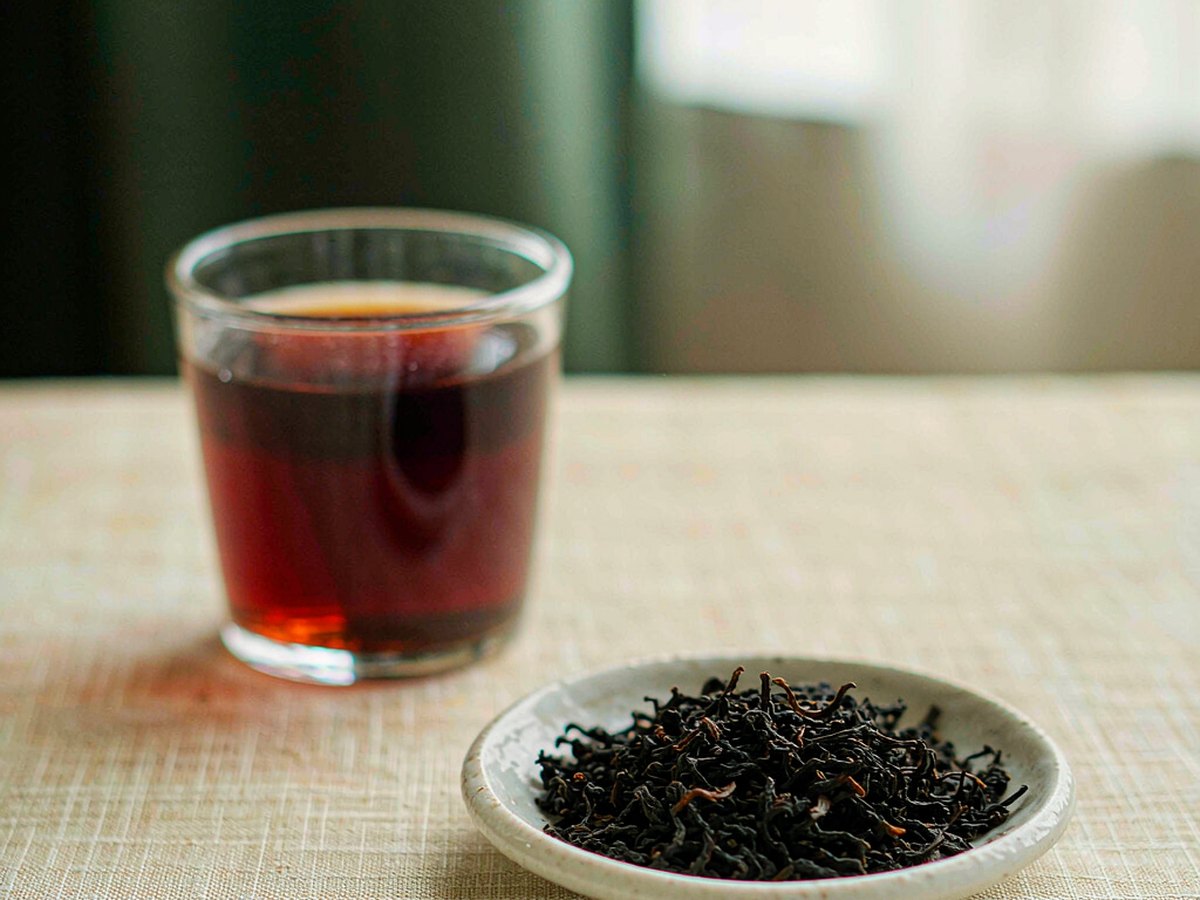
Black tea is the most processed of the six major tea types, and it is the one most often reduced to a single claim it cannot support. It is a warm, strong, predictable drink that behaves completely differently from green tea in the pot and in the body. Understanding why is mostly about understanding what oxidation actually does to a leaf.
- Botanical
- Camellia sinensis var. sinensis. Black tea is the same plant as green, white, oolong and pu-erh — the difference is entirely in what happens after picking.
- Part used
- The whole leaf, rolled into small, dark, wiry twists, or cut into grades.
- Origin
- Yunnan, Zhejiang, Fujian, Anhui, Hunan, Guangdong and Sichuan in China, plus Assam, Kenya and Sri Lanka worldwide.
- Flavour
- Malt, cocoa, honey, dried fruit, sometimes smoke or leather. Wide-ranging, and the biggest gap in quality of any tea type.
- Use
- 3–5 g per 200 ml at 90–95 °C, steeped 2–4 minutes. Black tea tolerates boiling water and hard steeping far better than any other type.
- Keeps
- 18–24 months sealed and dry. It is the most forgiving of the six in storage, and it improves for a year or so after picking.
What oxidation actually is
The word causes confusion because it sounds like something going bad. Nothing is burning. When a leaf is picked and its cells are broken, the enzymes inside — the polyphenol oxidase most importantly — meet oxygen, and they convert the leaf’s polyphenols, which are mostly colourless and tasteless in that state, into compounds that are coloured and strongly flavoured.
In green tea the leaf is heated quickly after picking, which kills those enzymes, so the polyphenols stay as they are and the tea remains green, vegetal and light. In black tea the leaf is allowed to react with air fully, so the polyphenols convert almost completely into theaflavins, which are bright orange-red and brisk, and thearubigins, which are darker brown and fuller-bodied. Those two groups of compounds are what black tea is, chemically.
This is why the colour of the brewed liquor is such a good indicator of a well-made black tea. A cup that has gone dull brown rather than glowing amber-red is a cup that has been over-brewed or over-stored, because theaflavins degrade faster than thearubigins and the cup loses its bright edge first.
A terminological note: in Chinese, black tea is hong cha, and the character for red, hong, is used, because the brewed liquor is red. Western tea-drinking countries call it black because the dry leaf is black. Same tea, two names, and Chinese shops will generally understand both.
The grades, and what the names mean
Chinese black tea has a grading vocabulary that looks impenetrable and is actually fairly logical once you know the two axes it works on: the size of the leaf and the style of processing.
On size, the main categories are ye hong, the finest broken leaf, which gives a fast, strong, bright cup; and the whole-leaf grades like jin gan, with the whole buds and leaves rolled tight. On style, the major divisions are the fermented varieties, the semi-fermented varieties, and the smoked varieties — and this is where the most interesting black teas live.
The three worth knowing by name: di hong, the Guangdong style, which is heavily fermented and sweet, with a dark, malty liquor; qimen, the Anhui style, which is the great smoke tea, with a distinct pine-smoke character; and menghai, the Yunnan style, which is the most famous for its malty, almost chocolatey, deep-gold cups from large-leaf tea grown at altitude.
The premium tier, tihong, is the young buds and first leaves of the finest spring picking, made in small quantities, and it can genuinely be worth the price in a way that inexpensive tihong is not.
Brewing black tea well
Black tea is the most forgiving tea in the shop and also the one most often ruined by habit. The traditional Chinese method is a gongfu-style short steep, and it is worth learning because it changes what the tea tastes like: five grams of menghai in a small pot, ninety-five degree water, twenty to thirty seconds per steep, poured off fully, repeated six or eight times. The result is a bright, layered, changing cup. The same tea brewed in a large Western mug for five minutes will be a flat, harsh brown drink.
The reason is the same chemistry. Theaflavins extract quickly and completely in the first minutes and then simply keep going into something harsh and flat, while thearubigins come out more slowly. A long steep gets you everything at once and drowns the brightness. A short steep gets the brightness and leaves the body behind for the next round.
The practical rule in a big pot: 4 g per 500 ml, 95 °C, four minutes, and then take the leaves out. And use a proper strainer — black tea leaves are small and wiry and they will find every gap.
If your water is very hard, black tea will taste metallic and flat no matter what you do. Soft, low-mineral water is worth more to a black tea than a better teapot.
On the claims, and what to make of them
Black tea has been the subject of an unusually large and unusually confident body of health claims, and the biggest single study in the field — the CPS-II observational study in the1990s — found no association at all between black tea consumption and heart disease or mortality. It is worth holding that in mind when reading the enthusiastic summaries.
What is reasonably established: black tea is a significant source of theaflavins and thearubigins, which are polyphenols; it contains theanine, which is associated with a more alert but not more jittery state; and it contains caffeine. A cup of black tea typically has more caffeine than a cup of coffee on a milligram-for-milligram basis in most estimates, which surprises people who assume tea is the mild option.
What is not established: that black tea prevents cancer, that it lowers cholesterol enough to matter clinically, that it burns fat, or that it protects against heart attacks. The trials that do exist are heterogeneous, often short, and rarely support the confidence of the claims made about them. Black tea is a genuinely good drink, and it is better to drink it because you like it than because a website told you it would save your life.
What it is used for
- A warm, everyday drink The primary use: a strong, predictable, warming drink that holds up to milk, sugar and repeated reheating better than any other tea type.
- Caffeine with theanine A combination that is often described as alert rather than jittery, and that is a reasonable summary of the research on the two compounds together.
- Polyphenol source A well-established source of theaflavins and thearubigins, the characteristic oxidation products of the tea leaf.
- Traditional Chinese use for cold and stagnation In Chinese practice, hong cha is classically regarded as warm, and is used for the picture of cold and sluggish digestion. This is a traditional understanding, not a clinical claim.
- Digestive use with a meal Taken with fatty or rich food, tea has a long tradition in China as a digestive accompaniment, and black tea is the type most often drunk in Chinese restaurants for exactly that reason.
- Culinary and blending use Black tea is the base of countless blends, of the classic English and Chinese masala blends, and it is used in cooking for sauces, gravies and braised dishes.
In the kitchen
- Gongfu, short steeps Five grams in a small pot, 95 °C water, twenty to thirty seconds per steep, poured off completely, repeated six to eight times.
- A large pot 4 g per 500 ml, 95 °C, four minutes, then remove the leaves. Adding a splash of milk and a little sugar is entirely legitimate.
- Gongfu black, the traditional Chinese way The same leaf in a gaiwan with a fair amount of leaf, and a cup that is nearly full each time — the style used for the old-school gongfu shops.
- With osmanthus A little osmanthus in a black tea softens the tannin and adds an apricot note. This is a classic pairing in Chinese tea.
- Iced Brewed strong, cooled quickly, and served with a lot of ice and a slice of lemon. Black tea is the only tea that survives being iced without becoming thin.
- In a braise or a rub A spoonful of black tea in a braising liquid or a dry rub for beef, where it adds tannin and depth.
Black tea is high in caffeine, and that is the caution that matters. A strong Western-style brew can contain as much caffeine as a small coffee, and tea leaves are often re-steeped, which compounds it. Anyone sensitive to caffeine, pregnant, nursing, with a heart-rhythm condition, or with anxiety should account for it. Tannins also interfere with iron absorption, which matters for anyone treating iron deficiency.
A
p
r
a
c
t
i
c
a
l
n
o
t
e
o
n
t
a
n
n
i
n
s
a
n
d
i
r
o
n
:
t
e
a
p
o
l
y
p
h
e
n
o
l
s
b
i
n
d
n
o
n
–
h
a
e
m
i
r
o
n
,
s
o
d
r
i
n
k
i
n
g
a
s
t
r
o
n
g
c
u
p
w
i
t
h
a
m
e
a
l
,
p
a
r
t
i
c
u
l
a
r
l
y
f
o
r
a
n
y
o
n
e
w
i
t
h
l
o
w
i
r
o
n
o
r
h
e
a
v
y
p
e
r
i
o
d
s
,
r
e
d
u
c
e
s
h
o
w
m
u
c
h
o
f
t
h
a
t
i
r
o
n
y
o
u
a
b
s
o
r
b
.
M
o
v
i
n
g
t
h
e
t
e
a
t
o
b
e
t
w
e
e
n
m
e
a
l
s
s
o
l
v
e
s
i
t
i
n
a
w
a
y
t
h
a
t
a
b
a
n
d
o
n
i
n
g
i
t
i
s
n
o
t
n
e
c
e
s
s
a
r
y
.
A
n
d
i
f
y
o
u
a
r
e
n
e
w
t
o
b
l
a
c
k
t
e
a
,
s
t
a
r
t
w
i
t
h
a
l
i
g
h
t
e
r
b
r
o
k
e
n
–
l
e
a
f
g
r
a
d
e
r
a
t
h
e
r
t
h
a
n
a
d
e
n
s
e
w
h
o
l
e
–
l
e
a
f
o
n
e
—
t
h
e
t
a
n
n
i
n
w
i
l
l
b
e
m
u
c
h
m
o
r
e
f
o
r
g
i
v
i
n
g
.
Disclaimer
Black tea is a common, pleasant and well-studied beverage, and nothing in this article is a claim that it will prevent, treat or cure any condition. The widely repeated health claims about black tea and cardiovascular disease or cancer are not supported by the strongest evidence available, and the well-known large study found no such association. If you are pregnant or nursing, have a heart condition, are sensitive to caffeine, or are giving tea to a child, talk to your doctor.