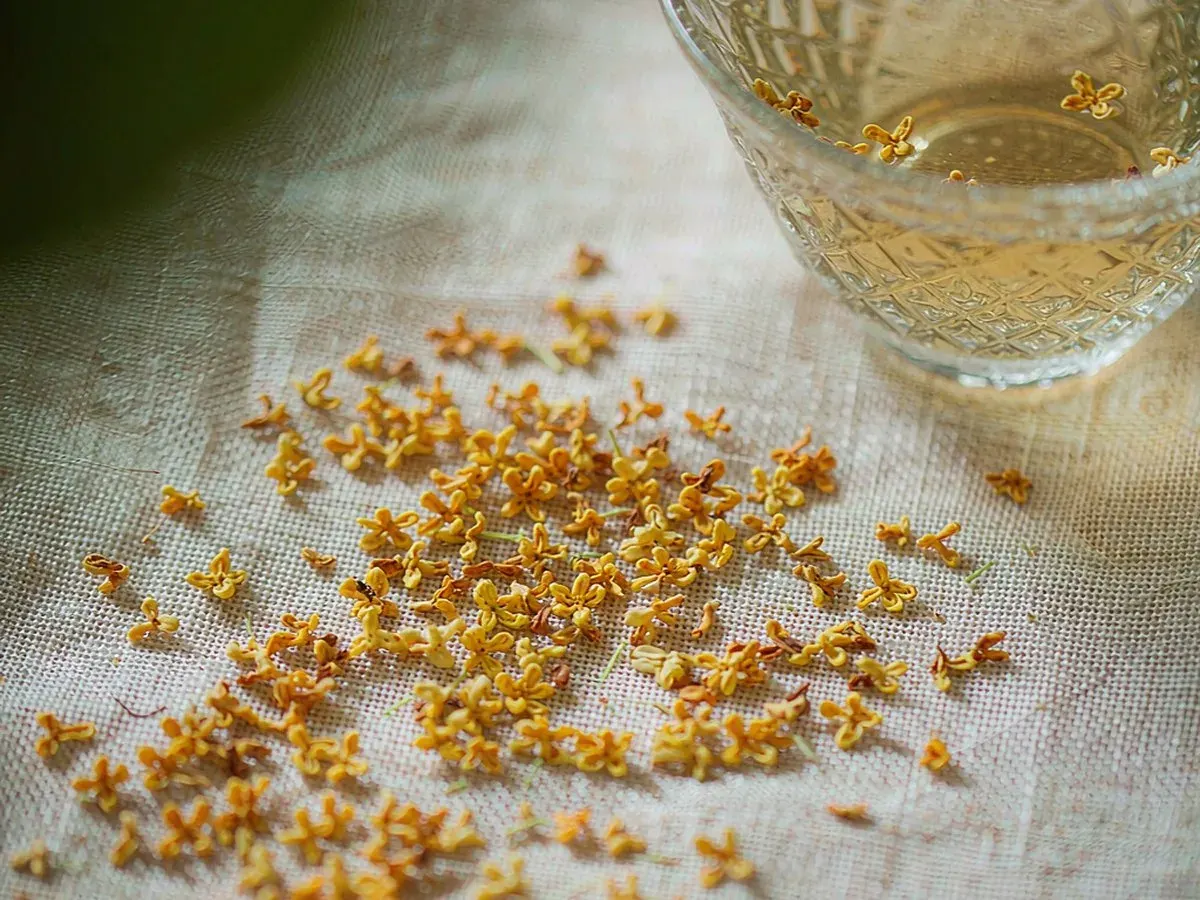
Osmanthus blooms for about two weeks a year, usually in the ninth lunar month, and for those two weeks the whole of southern China smells of apricot. The flowers are tiny — a few millimetres across — and the scent is strong enough that a hundred of them will perfume a pot of tea and then some.
- Botanical
- Osmanthus fragrans, an evergreen tree of the olive family. Four garden forms: Jin Gui (金桂, golden), Yin Gui (银桂, silver), Dan Gui (丹桂, red) and Sui Gui (四季桂, four-seasons, which flowers almost year round).
- Part used
- The dried flower, picked in the morning at full bloom and dried quickly so the fragrance holds.
- Origin
- Zhejiang — Hangzhou, Lin’an and Yiwu — Guangxi, Sichuan, Hubei and Hunan. Zhejiang is the reference origin for tea-grade flowers.
- Flavour
- Apricot and honey with a warm, almost almond note and a clean sweet finish.
- Use
- 3–5 g per 200 ml, 90 °C, 3 minutes. Less is more: osmanthus concentrates in the second infusion and dominates a third.
- Keeps
- 12 months sealed, dark and cool. The colour fades to pale yellow over that year; the scent does not fade nearly as fast.
The four kinds, and why it matters
Jin Gui, the golden osmanthus, has deep yellow-orange flowers and the strongest, sweetest aroma. It is the one most commonly sold for tea and the one most people picture.
Yin Gui, the silver osmanthus, has pale creamy-white flowers with a lighter, cooler, more delicate scent — closer to fresh apricot and less syrupy. For scenting a white tea, this is the one you want, because it does not fight the tea.
Dan Gui, the red osmanthus, has flowers in warm orange-red and a deeper, slightly more resinous aroma. It is the traditional choice for sweetening osmanthus wine and for osmanthus cake.
Sui Gui flowers in several flushes through the year rather than one, which makes it the most practical for a year-round supply and the least interesting for a single-origin tea.
Reading the harvest
Good osmanthus is picked at full bloom in the morning, when the flower is open but the sun has not yet burned the fragrance off it, and dried the same day. It should be a uniform golden yellow with almost no green, no brown, and no bits of leaf or stem.
Dried osmanthus is fragile and it travels badly. By the time a retail bag reaches a western shelf it has usually lost a good part of its scent, which is why an old bag smells like faint hay rather than apricot. A tin that smells strongly when opened is a tin that was packed well; a bag that smells of nothing is often not old but simply badly stored, and the fix is to add a fresh spoonful of good flowers to the jar and shake it closed for a week.
Colour is the other quick check. Naturally dried osmanthus fades from deep gold to a pale butter yellow over a year. A bag of brilliant orange-yellow with a chemical edge has been dyed or sulphured.
In the kitchen, and on the table
Osmanthus is unusual among Chinese herbs in that it is a genuine culinary ingredient and not just a tea. In Suzhou and Hangzhou it goes into sweet cakes, into osmanthus wine, into duck braised with lotus leaf, and into a sweet soup with dried longan and red dates.
The most famous use is osmanthus wine, where a small quantity of the flowers steeped in rice wine gives a drink that is somewhere between a liqueur and a scented dessert wine, and that has been made in the region for centuries.
The flowers also hold their scent astonishingly well in syrup and in sugar. A jar of osmanthus honey keeps for a year and turns a plain yoghurt into something worth eating.
What it is used for
- Digestion A gentle warming aromatic traditionally taken after a heavy or greasy meal, and one of the ingredients in the classic osmanthus digestive blends sold in Chinese tea houses.
- Cough and throat A warm infusion of osmanthus with rock sugar is a traditional comfort for a scratchy throat and for a cough with phlegm.
- Mood and fragrance The aroma is the point in many uses — it appears in temple incense, in sachets, and in the steam of a bath.
- Warming in autumn Classed as warm in traditional practice and associated with the damp, cool early autumn when Chinese households start drinking osmanthus tea.
- Astringency A mild astringent quality that gives the infusion its clean, drying finish.
- Cooking fragrance The classic Chinese flavour of autumn sweets, savoury duck and sweet soup.
In the kitchen
- Osmanthus wine 40 g of flowers per litre of rice wine, steeped two weeks, strained. The single most traditional use.
- Sweet soup A pinch with dried longan, red date and rock sugar in a thirty-minute simmer.
- Osmanthus cake and pudding Folded into a steamed rice-flour batter for the layered sweet cakes of Suzhou.
- Duck with lotus leaf A few flowers in the braising liquid for the Hangzhou and Guangzhou version.
- Osmanthus honey Flowers steeped in warm honey for a week, strained. Keeps a year.
- Tea scenting Layered with a delicate white tea for a scented tea in the jasmine manner.
Osmanthus is mild and generally well tolerated, but it is a warm aromatic and it is traditionally avoided in heat-type conditions. A small number of people react to it, and people with tree-nut allergies should note the almond-like note is a similarity of aroma rather than an actual nut content.
I
f
y
o
u
a
r
e
p
r
e
g
n
a
n
t
,
n
u
r
s
i
n
g
,
o
r
t
a
k
i
n
g
m
e
d
i
c
a
t
i
o
n
,
a
s
k
a
c
l
i
n
i
c
i
a
n
b
e
f
o
r
e
d
r
i
n
k
i
n
g
i
t
d
a
i
l
y
,
a
n
d
k
e
e
p
i
n
m
i
n
d
t
h
a
t
c
o
n
c
e
n
t
r
a
t
e
d
o
s
m
a
n
t
h
u
s
e
x
t
r
a
c
t
s
a
n
d
o
s
m
a
n
t
h
u
s
e
s
s
e
n
t
i
a
l
o
i
l
a
r
e
s
e
p
a
r
a
t
e
p
r
o
d
u
c
t
s
w
i
t
h
t
h
e
i
r
o
w
n
s
a
f
e
t
y
p
r
o
f
i
l
e
s
.
Disclaimer
This article describes an edible flower and its long culinary and traditional history. Nothing here is a claim that osmanthus treats a cough, a digestive complaint or any other condition. If you have a persistent cough or digestive symptom, see a clinician rather than a teapot.