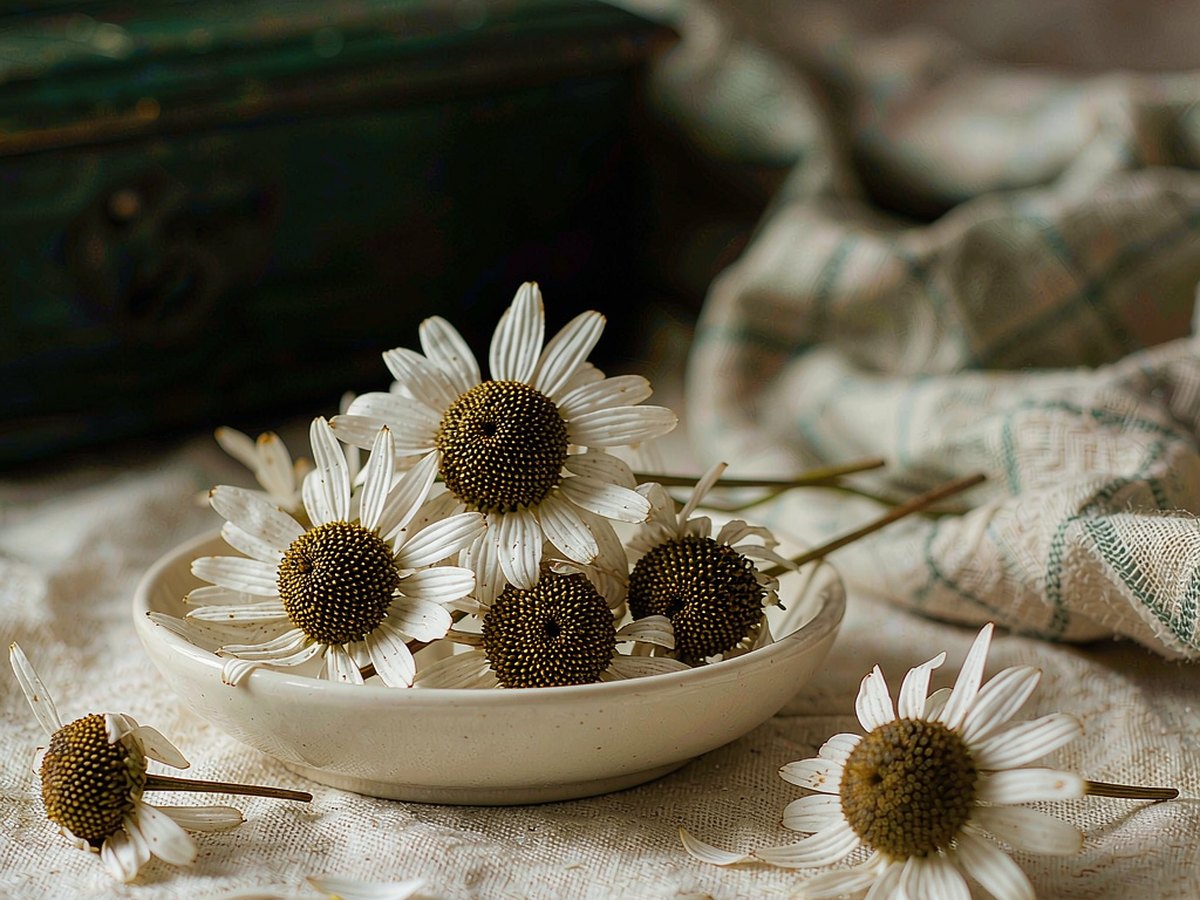
Chamomile is the rare herb where the folk reputation, the clinical research and the taste all agree. It is the best-selling herbal tea in the world, there is genuine trial evidence for mild anxiety and sleep, and it tastes like a meadow in a cup. The interesting parts are the differences between the two chamomiles and the difference between a good bag and a bad one.
- Botanical
- Two species, and they are not interchangeable. Matricaria chamomilla (German chamomile) and Chamaemelum nobile (Roman chamomile) — the German is annual and hollow-stemmed, the Roman perennial and solid-stemmed.
- Part used
- The dried flower head, with the yellow disc florets and the white ray petals. A well-made bag is mostly whole heads.
- Origin
- Egypt, Hungary, Germany, Croatia and Chile. Egyptian chamomile is the largest producer and the bulk of the world’s supply.
- Flavour
- Sweet and apple-like, with a soft hay note underneath and a gentle bitterness at the back. The Roman variety is a little less sweet and more bitter.
- Use
- 2–3 g per 200 ml, 95 °C, covered for 5 minutes. Covering matters — it traps the volatile oils.
- Keeps
- 12 months sealed and dark. The colour fades from a bright yellow-white to a dull tan.
German and Roman
The German chamomile, Matricaria chamomilla, is the annual with a hollow stem and a conical flower head with a hollow receptacle — that hollow centre is how you tell it. The Roman chamomile, Chamaemelum nobile, is a perennial with a solid stem and a flatter head with more ray petals.
In European herbalism they are used somewhat differently. Roman chamomile, with its higher proportion of bitter constituents and its more robust woody base, is the classic digestive herb — it is the one in the classic digestive bitters and in the chamomile tea drunk after a heavy meal. German chamomile, which is sweeter and softer, is the one drunk at night for sleep.
In German tradition the distinction is made the other way about which is medicinal and which is for the bath, and the chamomile bath — a weak infusion of the flowers added to a warm bath — is one of the great traditional uses of the German species. Both are safe and both are good; the practical difference is that German is sweeter and better as an evening drink, and Roman is more bitter and better as a digestive.
Buying a bag worth drinking
Good chamomile is whole flower heads, not dust and not just the yellow centres. A bag where you can see recognisable little daisy heads is a better bag, and the colour should be a clear yellow-white with green showing in the stems.
The single most common problem is that a lot of commercial chamomile is cut over-mature, harvested after the flowers have gone to seed, and it has almost no fragrance and a flat, dusty taste. The smell test is decisive: a good bag smells like a hay meadow the moment you open it, and a bad one smells like nothing at all.
Another common adulteration is the stem and the chaff. Stems are cheap filler and they dilute the cup. Look for a bag where the pieces are recognisably flowers, and where the stem content is low.
And buy smaller. Chamomile fades fast — the volatile oils are the whole point — and a large bag opened in a humid kitchen will be a disappointment within a few months.
How to brew it, and why the lid matters
The single biggest factor in a good cup of chamomile is that it is covered while it steeps. The plant’s active volatile oils are volatile, and an uncovered cup loses most of them to the air while you are waiting. Put a lid on the pot or the cup, steep for five minutes, and strain.
The temperature should be just off the boil. Chamomile is a flower and it does not need boiling water, and boiling water scorches the petals into a flat, bitter liquor rather than drawing out the sweet apple note.
Two other refinements worth making. Steeping the bag a second time is worthwhile, because chamomile gives a second cup that is milder and still fragrant. And adding a small amount of honey at the end rather than dissolving it in boiling water keeps more of the floral character in the cup.
What it is used for
- Sleep and mild anxiety This is the best-supported use of chamomile in the whole herbal world. Extracts of both species have been shown in clinical trials to modestly improve sleep quality and reduce anxiety scores, and chamomile is included in some national guidelines for mild insomnia.
- Digestion A carminative and antispasmodic, used for gas and intestinal cramping. The Roman chamomile is the classical digestive species in European practice.
- Topical inflammation Chamomile is one of the very few herbs with genuine clinical evidence for topical use, in creams for eczema and in mouth rinses for mouth ulcers.
- Antioxidant activity Apigenin and the other flavonoids are well documented in laboratory work, and chamomile has a substantial antioxidant literature.
- Colour and flavour Its real and reliable role in a kitchen: a sweet, apple-like floral note and a natural golden colour.
- Digestive bitters Classically used in the European bitter blends, where the bitterness is what stimulates digestion.
In the kitchen
- The evening cup Three grams per cup of water just off the boil, covered, five minutes. The classic.
- German chamomile bath A strong infusion of the flowers poured into a warm bath. The great traditional use of the German species.
- Chamomile and apple Two dried apple slices in the pot with the flowers — the apple note doubles the sweetness.
- With lemon and honey Honey stirred in after it cools a little, and a thin slice of lemon.
- Cold brew Five grams in cold water overnight for a mild, sweet, caffeine-free drink.
Chamomile is one of the most allergenic herbs, because it is in the daisy family. Anyone with a ragweed, chrysanthemum, marigold or daisy allergy can react, sometimes seriously. If you have never taken it before and you have a known daisy-family allergy, think twice.
I
t
i
n
t
e
r
a
c
t
s
w
i
t
h
b
l
o
o
d
–
t
h
i
n
n
i
n
g
m
e
d
i
c
a
t
i
o
n
a
n
d
w
i
t
h
s
e
d
a
t
i
v
e
s
,
a
n
d
i
t
i
s
t
r
a
d
i
t
i
o
n
a
l
l
y
a
v
o
i
d
e
d
d
u
r
i
n
g
p
r
e
g
n
a
n
c
y
.
I
f
y
o
u
t
a
k
e
w
a
r
f
a
r
i
n
o
r
a
n
y
s
e
d
a
t
i
v
e
,
a
s
k
a
p
h
a
r
m
a
c
i
s
t
b
e
f
o
r
e
d
r
i
n
k
i
n
g
i
t
d
a
i
l
y
.
Disclaimer
Chamomile genuinely does have trial evidence behind it for mild anxiety and sleep, and it is one of the few herbs where that claim is properly supported. It is still not a treatment for anxiety disorders or chronic insomnia, and it should not replace prescribed care. Check with a doctor before using it regularly if you take medication.