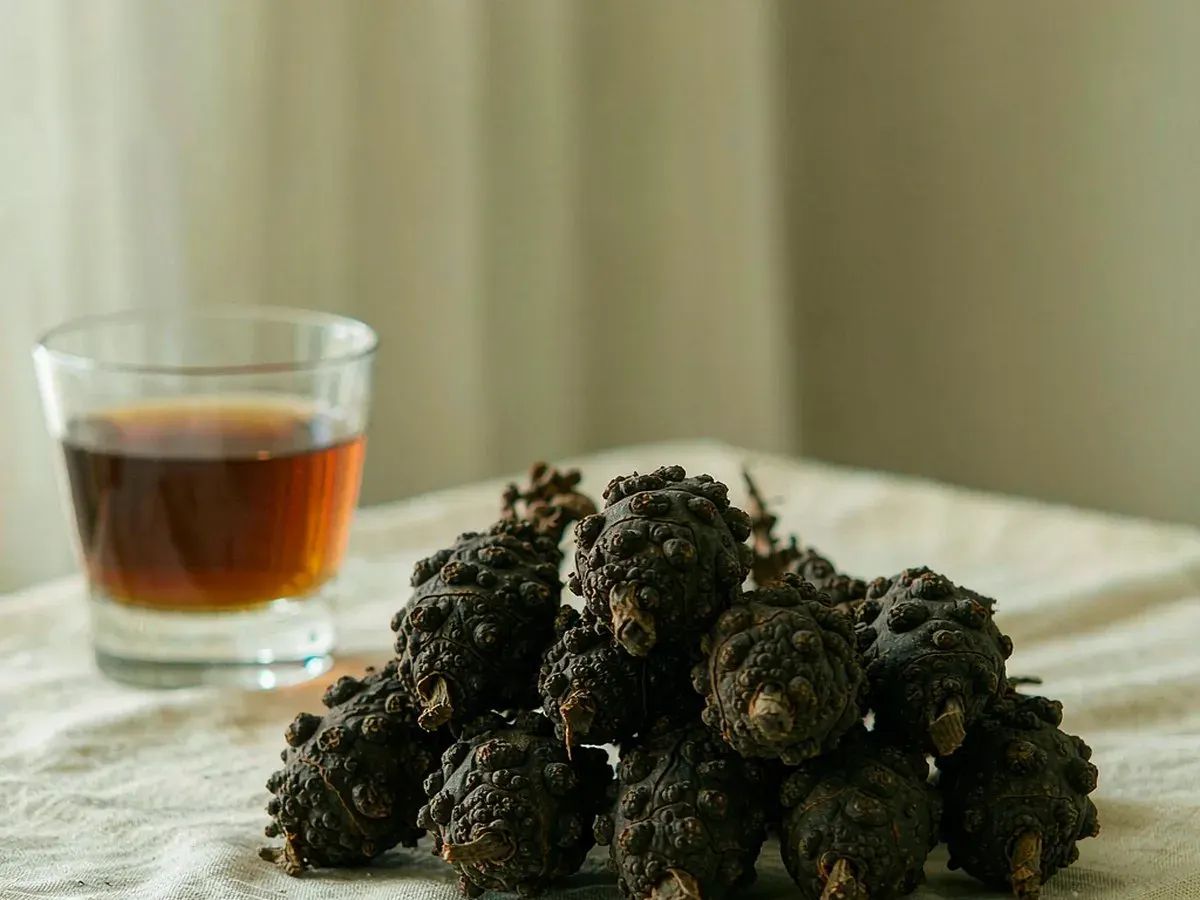
San leng is a strange-looking tuber — hard, dark, knobbly, and shaped like a deformed water chestnut — and it is one of the most powerful herbs in the Chinese pharmacy for clearing obstruction. It is also one of the least used outside classical practice, because it is genuinely strong, and that combination makes it worth understanding properly.
- Botanical
- Sparganium stoloniferum — a water-plantain relative of the family Sparganiaceae, growing in marshes, ponds and slow water across China and much of the northern hemisphere.
- Part used
- The dried tuber, sliced. It is dug from the mud in winter, and the slices are hard, woody and slightly translucent.
- Origin
- Anhui, Jiangsu, Hubei, Henan, Jiangxi and Shandong. Wild-gathered from ponds and marshes; also cultivated in the Yangtze delta.
- Flavour
- Bland, slightly bitter, with a faint earthy smell and a hard, fibrous bite.
- Use
- 3–9 g per 200 ml, simmered 20–30 minutes. Always blended with an aromatic, and never used alone.
- Keeps
- 24 months sealed and dry. The tuber is dense and stores very well.
One of the strongest movers
San leng belongs to a small and formidable group in the Chinese pharmacopoeia — the blood-breaking herbs, of which the other members are the safflower, the dragon bone, the myrrh and the frankincense. These are the strongest movers of blood and the strongest clearers of obstruction in the entire system, and they are used for exactly one broad category of problem: something that has become stuck.
In classical terms, they are indicated for masses and lumps, for a hard and fixed pain, for a constricted abdomen, and for the picture of blood that has stopped moving. In a modern frame, they are the herbs a practitioner reaches for when there is a discrete, palpable, stubborn problem rather than a vague functional one.
The strength is exactly why they need supervision. These are not casual teas. They are used in formulas, in a defined dose, for a defined time, and generally with the explicit instruction that they should not be used in pregnancy — which is not a token caution, because blood-moving herbs are the classical contraindication in pregnancy.
The plant, and the awkward harvest
Sparganium grows in the mud at the bottom of ponds and slow rivers, and harvesting it is genuinely unpleasant work: it means wading into cold water in winter and cutting the tubers out of the mud by hand.
The tuber is remarkable for its durability. It is nearly impossible to cut, resistant to rot, and it has been found in archaeological contexts in ancient China, which suggests it was gathered and eaten long before it was medicinally used. The Chinese name, san leng, literally means three ridges, which refers to the ridges on the tuber.
The dried slices are greyish-brown to dark brown, hard, with a visible fibrous grain and a slightly translucent edge. They should smell of earth and nothing else. A lot with a sweet or musty note was stored badly.
Why it is always in a formula
San leng has no aroma and only a faint taste, so it is never drunk on its own. In classical formulas it appears with the other blood movers — with safflower, with myrrh and frankincense, with the dragon bone — and with aromatic herbs that make the decoction drinkable.
The famous classical combination to know is with the citrus peels and with the aromatic digestives, where san leng’s clearing action is balanced by something gentler. Another well-known pairing is with the prickly ash or with the turmeric, both of which move blood as well.
A practical note on preparation: the slices are hard and take time. Thirty minutes of simmering extracts far more than ten minutes, and a decoction in a pressure cooker or a covered pot left to stand overnight is the traditional way to get the full value out of the material.
What it is used for
- Clearing obstruction The principal classical use: for the picture of something that has become stuck or fixed — a mass, a lump, a hard and localised pain.
- Moving blood One of the strongest blood-moving herbs in the Chinese pharmacopoeia, and a member of the classical blood-breaking group.
- Hard and fixed pain Used for pain that is severe, fixed and localised, rather than for a vague or shifting discomfort.
- Abdominal masses A classical indication that requires a diagnosis, and it belongs in a supervised practice rather than in a teapot.
- Trauma and bruising Used in formulas for the after-effects of injury, and in the external application of the powder to bruises.
- Historical food use The tubers were eaten as a famine vegetable and are archaeologically documented as a food long before they were a medicine.
In the kitchen
- The classical blood-moving formula San leng with safflower and myrrh, simmered and taken warm.
- With citrus peel and ginger A gentler kitchen blend — the aromatic makes the flat root drinkable.
- Long overnight decoction The slices left to stand in cold water overnight and simmered in the morning, which is the traditional extraction.
- With turmeric A modern, warming pairing for a circulation-focused cup.
- Powdered, for external use The root powdered and mixed into a paste for bruises, which is the classical external application.
San leng is one of the strongest herbs in this collection and it is not a casual drink. It should never be used in pregnancy, and it should not be used by anyone with a bleeding disorder or on blood-thinning medication without medical advice.
B
e
c
a
u
s
e
i
t
m
o
v
e
s
b
l
o
o
d
,
i
t
i
n
t
e
r
a
c
t
s
w
i
t
h
a
n
t
i
c
o
a
g
u
l
a
n
t
s
a
n
d
a
n
t
i
p
l
a
t
e
l
e
t
d
r
u
g
s
,
a
n
d
w
i
t
h
a
n
y
p
r
e
p
a
r
a
t
i
o
n
b
e
f
o
r
e
s
u
r
g
e
r
y
.
A
n
y
o
n
e
w
h
o
i
s
p
r
e
g
n
a
n
t
,
o
n
m
e
d
i
c
a
t
i
o
n
,
o
r
b
e
i
n
g
t
r
e
a
t
e
d
f
o
r
a
m
a
s
s
o
r
a
b
l
o
o
d
c
o
n
d
i
t
i
o
n
s
h
o
u
l
d
s
p
e
a
k
t
o
a
q
u
a
l
i
f
i
e
d
p
r
a
c
t
i
t
i
o
n
e
r
r
a
t
h
e
r
t
h
a
n
a
s
h
o
p
k
e
e
p
e
r
.
Disclaimer
San leng’s classical indications involve discrete masses, obstruction and blood stasis — all of which need a diagnosis rather than a guess. Do not use it to treat any condition, do not use it during pregnancy, and do not use it in place of medical assessment for a lump, a mass or persistent pain.